FMCG distribution
FMCG distributors: beats, scheme claims and kirana credit
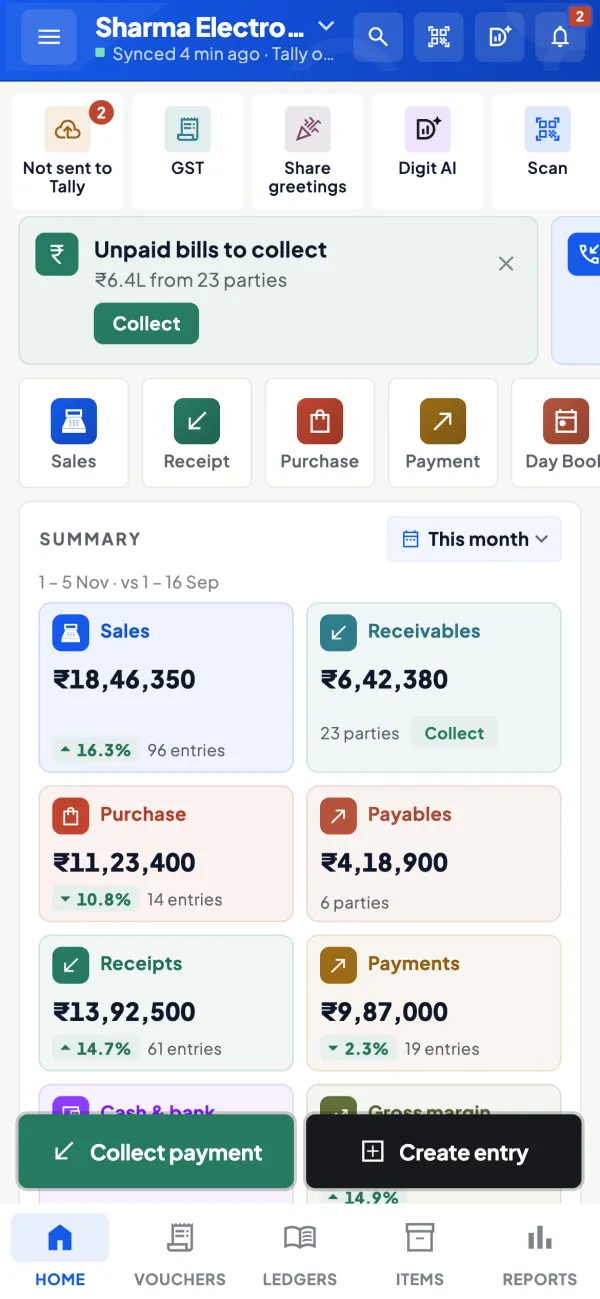
An FMCG distributor serves hundreds of retailers on fixed beats, with tight company terms on one side and kirana credit on the other. Margins are small, so claims, collections and expiry decide whether the agency makes money.
- Beat orders straight to Tally
- Collections seen the same day
- Bill-wise dues for every outlet
- Hindi or English
Start free trialBook a free demo
Works with your TallyPrime14-day free trialJaipur team, call +91 70738 53555
Built for FMCG distributors
Who it’s for
- FMCG distributorsOne company's range across a town's beats
- Super stockistsSupplying sub-distributors and wholesalers in a region
- Multi-company agenciesTwo or more principals from one godown
- Rural sub-distributorsVillage wholesalers and haat-day selling on credit
- Van-sales distributorsOrder, bill and collect on the same visit
- Snacks and confectionery distributorsShort shelf life, many SKUs, frequent schemes
- Home and personal care distributorsKirana, chemists and general stores on fixed beats
Pain → fix
The problems we fix
The everyday headaches of FMCG distributors, and what changes when the books are on every phone.
- The problemSalesman's paper orders misread at night
Wrong pack sizes go on the van and the retailer refuses half the delivery.
With Cashflow OSOrders booked at the outlet, posted to TallyThe salesman enters the order in the staff app; it posts to Tally as a sales order, with approval first if you want it.
See how it works - The problemWrong rate on the bill for the outlet type
Wholesale rates go to kirana shops and retail rates to wholesalers, and nobody notices until the claim.
With Cashflow OSOutlet types with discount rules fill the ratePrice lists by dealer type with layered discount rules fill rates on orders automatically.
See how it works - The problemBeats skipped and nobody finds out
A beat missed for two weeks and a competitor's stock is on the shelf.
With Cashflow OSRoute plans, recommended visits and GPS check-inAreas and route plans for each salesman, with visit check-in by location and geofence.
See how it works - The problemCash collected on the van, reported days later
The retailer says he paid; the ledger says he did not.
With Cashflow OSCollections recorded against the outlet on the spotThe salesman or delivery person records what was collected, and the owner sees it the same day.
See how it works - The problemRetailer pays the new bill, the old one keeps ageing
Hundreds of small overdue bills add up to lakhs that nobody is chasing.
With Cashflow OSBill-wise dues with ageing for every outletOutstanding comes from Tally's bill-wise details, so you can hand each beat a list of specific bills to collect.
See how it works - The problemCompany claims and credit notes hard to trace
Scheme, damage and rate-difference claims sit pending and nobody knows the balance.
With Cashflow OSThe company's ledger and credit notes on the phoneSettlement credit notes recorded in Tally show in the company's ledger, so pending balances are easy to check.
See how it works
Features
How Cashflow OS works for FMCG distributors
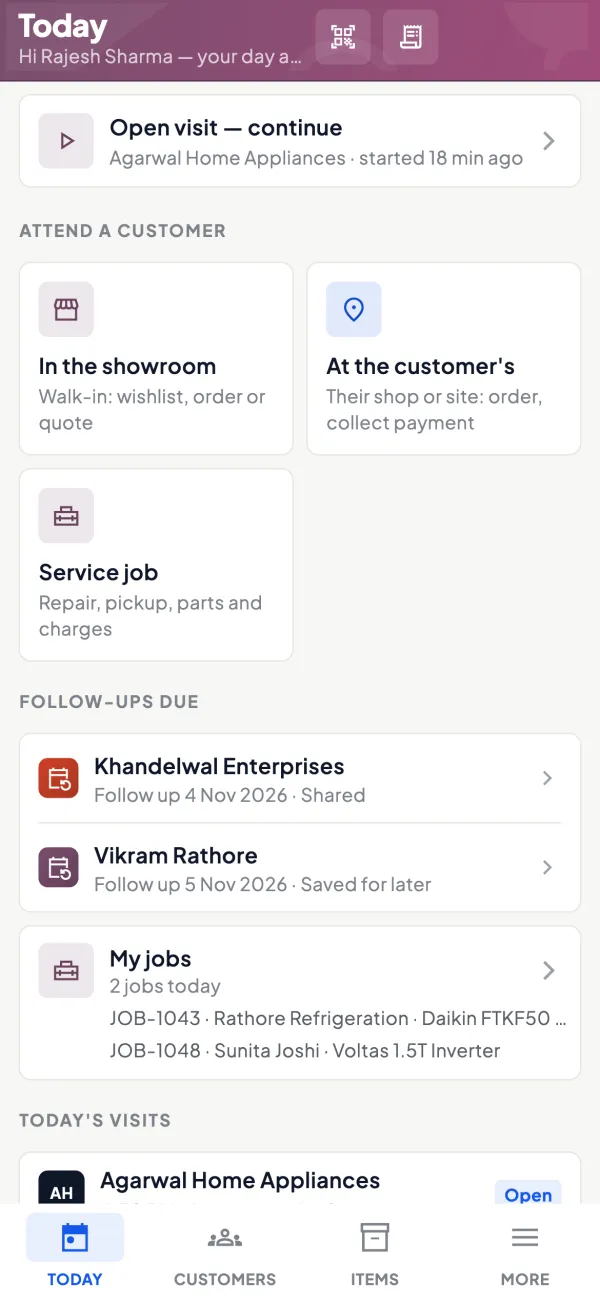
A Today screen for each salesman
How it works. The staff app opens to the day's customers, visits, orders and collections. Salesmen see items and their own outlets, not the company's accounts.
- The beat's outlets listed for the day
- Orders and collections from the same screen
- No access to your margins or ledgers
In practiceMohan's Wednesday beat in Gomti Nagar lists the outlets to attend; he books orders at each and records ₹9,400 collected before lunch.
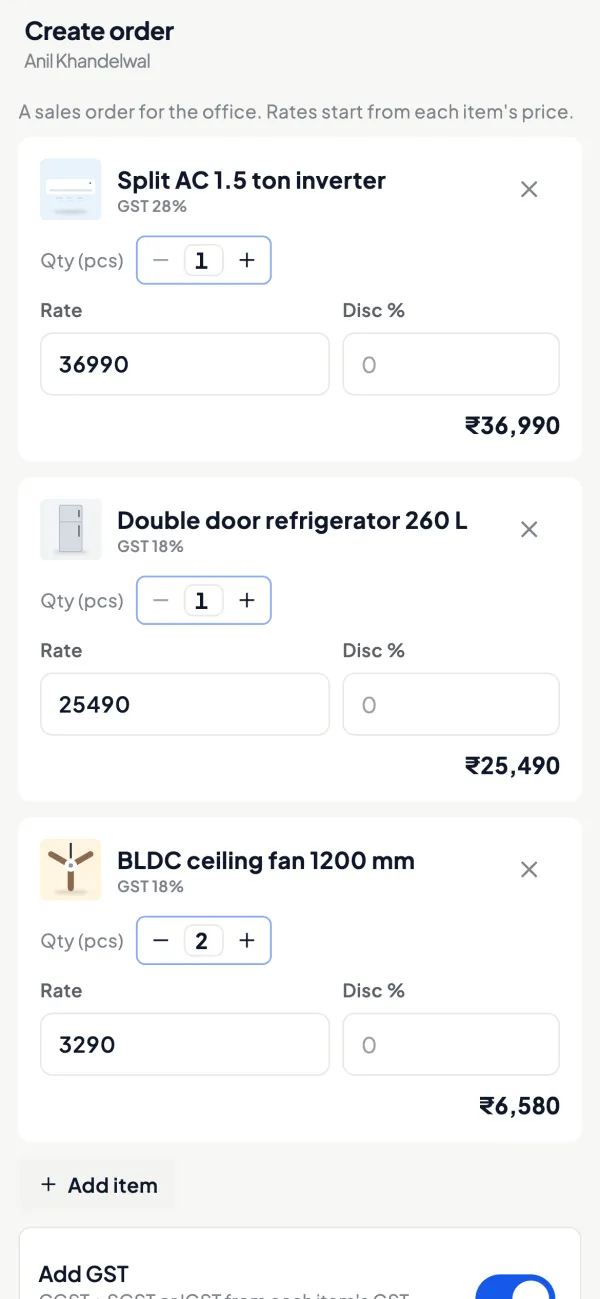
Orders that reach Tally before the van is loaded
How it works. Orders carry lines, rates from the price list and GST, and post to Tally as sales orders through the connector. Frontline orders can need approval first.
- No overnight retyping from order books
- Right rate for each outlet type
- Approval step before anything reaches Tally
In practiceBy 6 pm the office sees the day's orders from four salesmen as sales orders in Tally and bills them for next-morning dispatch.
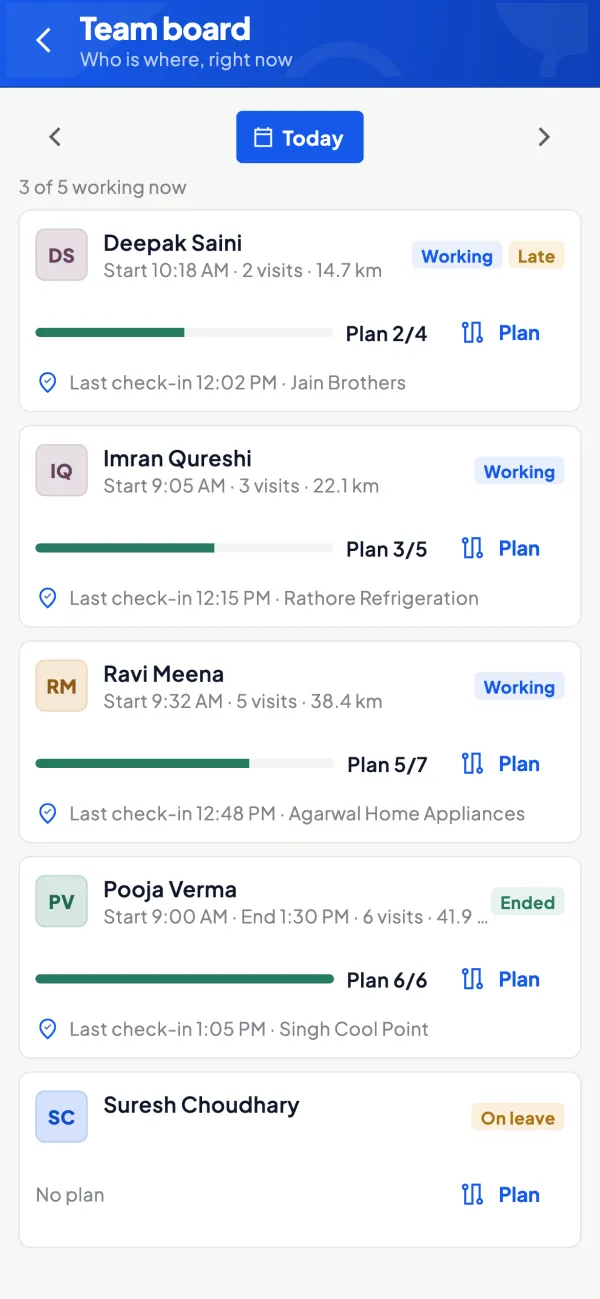
Beats planned and visits checked
How it works. Outlet locations on a map, areas and route plans per salesman, recommended visits, and check-in with GPS and geofence, with notes and photos.
- Each outlet on its fixed day
- Shelf photos and notes from the visit
- Performance view and attendance for the owner
In practiceThe owner sees that Rajesh checked in at 18 outlets on Monday's beat but skipped the three furthest ones, and moves them to Thursday.
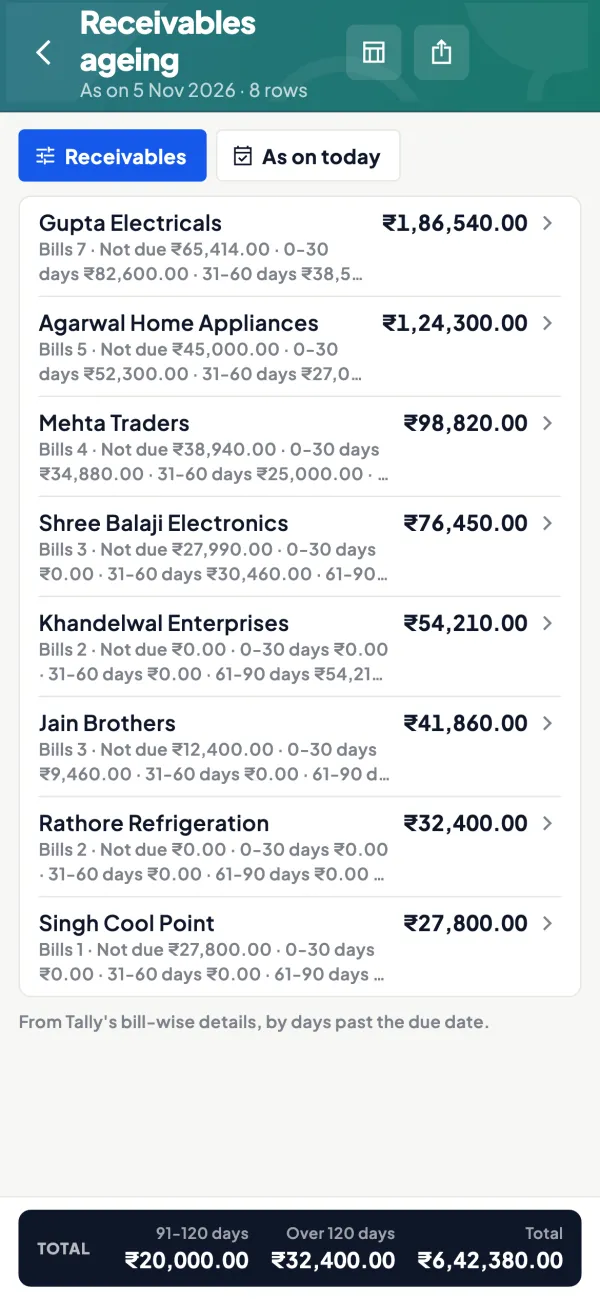
Outstanding across hundreds of outlets
How it works. Bill-wise receivables with ageing for every retailer, synced from Tally. Share a statement on WhatsApp when a shopkeeper questions the balance.
- Spot old bills hiding behind recent payments
- Ageing to decide who gets goods on credit
- Statements in Tally's format or simple Hindi
In practiceLaxmi General Store pays every week, yet two bills of ₹3,200 and ₹2,850 from last month are still open, so the salesman collects those first.
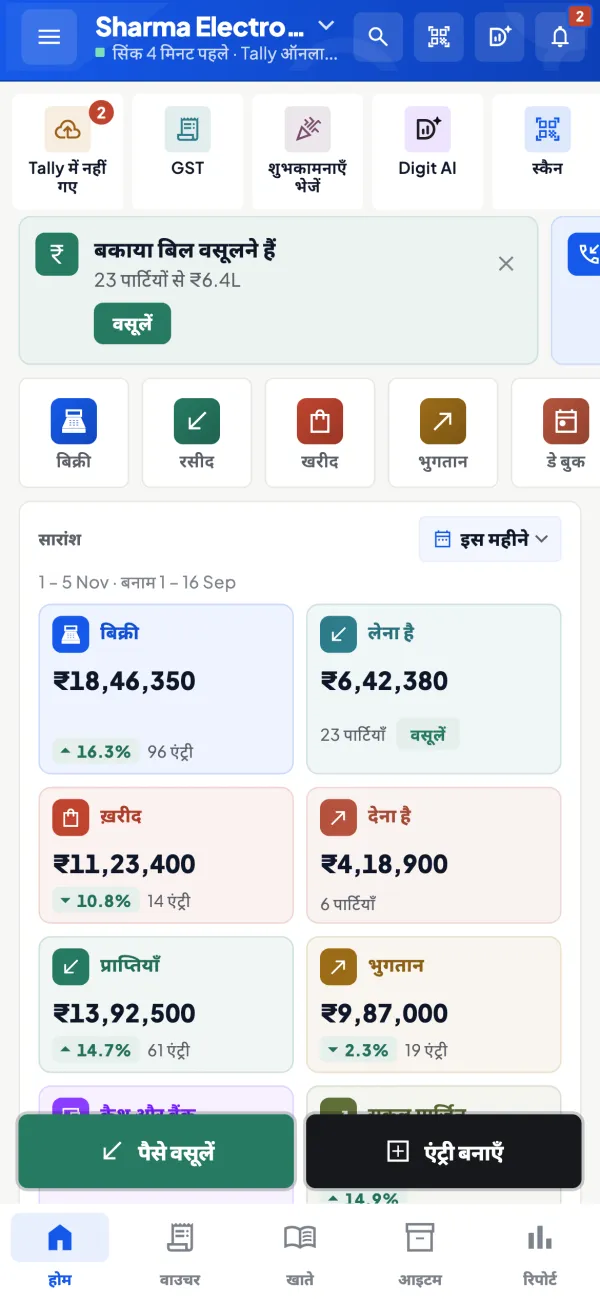
Hindi for the team, English for the accountant
How it works. Each person picks English or Hindi for the app and reports, so salesmen and the accountant read the same data in their own language.
- Salesmen work in the language they read best
- Reports in Hindi or English, per person
- Same numbers whatever the language
In practiceThe salesmen use the app in Hindi while the accountant keeps English; the outstanding list is the same for both.
Know your trade
A guide for FMCG distributors
How the business works, where money gets stuck, and the GST points to watch.
How FMCG distribution is organised
Consumer goods companies appoint distributors (often called stockists or super stockists in larger setups) for a territory. The distributor buys from the company's depot or C&F; agent, frequently on advance payment or very short credit, and resells to kirana stores, general stores, chemists, paan shops and small supermarkets. Some distributors also service wholesalers who in turn supply smaller villages.
The distributor's earnings come from a fixed margin on the company's price, plus incentives for achieving targets, and reimbursement of schemes it passes to retailers. Many companies require the distributor to use their own ordering or reporting system, but the distributor's accounts, credit and collections still live in its own books, usually TallyPrime.
Beats, salesmen and delivery
Retailers are grouped into beats, and each beat is visited on a fixed day of the week. The salesman takes orders, checks shelf stock, puts up promotional material and collects payment for earlier bills. Orders are billed in the office overnight, loaded on vans and delivered the next day, often with the delivery person collecting cash.
The weak points are well known: orders written on paper and misread, schemes applied wrongly, collections reported a day late or not at all, and returns not entered. A beat plan combined with orders entered at the outlet removes most of them.
Schemes and claims
FMCG runs on schemes: buy-ten-get-one, slab discounts, display incentives, launch offers. The distributor gives these to retailers on the bill and then claims reimbursement from the company with supporting data. Claims also cover damaged and expired goods, rate differences when prices change, and transport.
A distributor with several companies can easily have lakhs of rupees in pending claims. Keep a claims register: claim type, period, amount, date submitted, amount settled, and the balance. Match each settlement credit note against the claim. Our guide on managing schemes and discounts explains how to keep scheme discounts visible in the books.
| Claim type | Submitted | Settled | Pending |
|---|---|---|---|
| Scheme reimbursement, quarter | ₹1,85,000 | ₹1,40,000 | ₹45,000 |
| Damage and expiry | ₹32,000 | ₹0 | ₹32,000 |
| Price-drop on stock | ₹18,500 | ₹18,500 | ₹0 |
The amounts are illustrative; what matters is knowing the pending column at any time.
Expiry, damages and returns
Food, personal care and household products carry manufacturing and expiry dates. Retailers return near-expiry and damaged packs to the salesman, and the distributor must either claim them from the company under its policy or write them off. Tally can keep batch and expiry details where you enable them, which helps you sell older stock first. Record returns as credit notes on the day they come back, not in a heap at month end.
Retailer credit and collections
Kirana credit is usually short, a week or two, but spread across hundreds of outlets. The danger is not one large default but many small overdue bills that nobody chases. Each salesman should carry the list of pending bills for that day's beat and collect against specific bills. Bill-wise outstanding matters more than the total balance, because retailers will happily pay the newest bill and leave the oldest one. See reducing outstanding receivables.
GST points for FMCG distributors
A single FMCG invoice can carry several GST rates, because food, personal care and household items fall under different HSN codes, and many rates were revised in recent years. Keep item masters updated with the current rates from the GST portal. Free goods under schemes and post-sale discounts have specific GST treatment; settle the method with your accountant and apply it the same way every time. This is general information, not tax advice.
Cashflow OS for FMCG distributors
Cashflow OS works on your TallyPrime data. Salesmen get a Today screen with the beat's customers, visits, orders and collections; they check in with location, take orders with the right price list, and record what they collected. Orders post to Tally as sales orders, with approval if you want it. Route plans and recommended visits organise beats, and the owner sees performance and team activity. Bill-wise outstanding for every retailer is on the phone. See field force tracking.
This page is general information for Indian businesses, not tax, legal or financial advice. Rules and rates change — check the official portals or your CA before acting.
Set-up
Up and running in 4 steps
No new software to learn for your accountant — Tally stays as it is.
- 1
Install the Tally Connector on the PC where TallyPrime runs
- 2
Sign in with your mobile number and scan the connector's QR
- 3
Set outlet types and draw areas and route plans for each beat
- 4
Invite salesmen with a link and switch on order approval if you need it
Buyer’s checklist
What to look for in software for FMCG distributors
Whatever you choose, check these before you commit.
- Orders taken at the outlet reach billing without being typed again
- Beat plans with a fixed day per outlet, and a record of actual visits
- Correct rate for each outlet type without the salesman typing it
- Collections recorded against specific bills and visible the same day
- Bill-wise outstanding and ageing across hundreds of small accounts
- Separate Tally companies, if you keep one per principal, in one login
- Works in the language your salesmen read, Hindi or English
- Salesmen cannot see your margins or the company's accounts
Plans
Simple yearly plans
- 14-day free trial on your own books
- 3-year term saves up to 25%
- Premium modules (catalogue, field force, price lists, store…) priced extra
Start free trialGet the price for your business
Compare all plans- Growth₹3,000/year + GSTBooks, reports, outstanding and sharing
- Pro₹5,000/year + GSTEverything in Growth, plus entries into Tally
- Pro+₹7,000/year + GSTEverything in Pro, plus e-invoice and e-way bill
Why Cashflow OS
Why FMCG distributors choose Cashflow OS
- Made for beatsRoute plans, check-ins, orders and collections in one staff app.
- Orders into TallySales orders post through the connector, with approval if you want it.
- Every outlet's duesBill-wise outstanding and ageing for hundreds of retailers.
- Several principalsSwitch between Tally companies in one account.
- HindiEach salesman reads the app in his own language.
- 14-day free trialTry it on a few beats with your own Tally data first.