
Running the business Collections
How to reduce outstanding receivables
Outstanding receivables fall when you make terms clear before the sale, follow up on a fixed rhythm after it, and stop new credit to parties who are already overdue. None of this needs harsh words, only consistency.
- Distributors and wholesalers
- Manufacturers selling on credit
- Owners and accounts teams
- Sales managers
- Traders with dealer credit

On this page 10
First, measure where you stand
Before changing anything, take two numbers from your books.
- DSO (days sales outstanding) = closing debtors ÷ credit sales for the period × days in the period. If debtors are ₹36,00,000 and last quarter's credit sales were ₹90,00,000, DSO = 36 ÷ 90 × 90 = 36 days.
- Overdue share = bills past their due date ÷ total outstanding. If ₹14,40,000 of the ₹36,00,000 is past due, 40% of your receivables are overdue.
Track both every month. An ageing analysis shows exactly which parties and which bills make up the overdue amount.
Ten steps that work
- Agree terms before the first sale. Credit days, credit limit and what happens if payment is late, in writing on the quotation or order.
- Print the due date on every invoice. "Due on 15-12-2026" is clearer than "30 days".
- Keep bill-wise records. Adjust each receipt against specific bills, not "on account". Otherwise you cannot tell which bills are old.
- Review ageing every Monday. Sort by oldest first and pick the ten parties to call this week.
- Send a courtesy reminder before the due date. Most late payments are forgetfulness, not refusal.
- Send a monthly statement to every party. Disputed bills, missing credit notes and wrong rates come out early.
- Call on the due date, then at 7 and 15 days past due. Use the same polite sequence every time; see our payment reminder templates.
- Stop supply at a fixed point. For example, no new orders if any bill is more than 30 days overdue or the limit is crossed.
- Give salespeople a collection target alongside the sales target. A sale is complete when it is paid.
- Escalate the oldest cases. Owner-to-owner call, then a formal letter, then your CA or lawyer for very old dues.
Fix the reasons bills get stuck
Many bills are unpaid because of a problem on your side. Before pushing, check:
- Was the rate or scheme discount on the bill what the dealer expected?
- Has a credit note for a return or shortage been issued?
- Does the party have the invoice and the delivery proof?
- Was there a quality complaint nobody followed up?
Resolve these quickly. See handling disputed bills for a process.
Cash discount for early payment: do the maths
A 2% discount for payment in 10 days instead of 45 is expensive. You give up 2% to get money 35 days earlier, which works out to about 21% a year (2 ÷ 98 × 365 ÷ 35). It makes sense only if your borrowing costs more than that or you are badly short of cash. A smaller discount, such as 1% for payment within 7 days, costs less and still nudges good payers.
A weekly 30-minute collection routine
- Monday, 10 minutes: open the ageing report. List every party with a bill more than 7 days overdue, biggest amount first.
- Monday, 10 minutes: send statements to everyone on the list, with a short reminder.
- Through the week: salespeople call or visit the top ten; each call ends with an amount and a date.
- Friday, 10 minutes: check which promises were kept. Move missed promises to the owner's call list for Monday.
Keep a simple log of promises: party, amount, promised date, result. After a few months it shows clearly which customers keep their word, which is useful when you review credit limits.
Many businesses find that this routine alone, done every week without fail, brings down overdue amounts more than any discount or penalty, because customers learn that bills will be followed up.
Tracking receivables with Tally and Cashflow OS
Cashflow OS reads bill-wise outstanding from TallyPrime and shows it with ageing on your phone and the web, so the Monday review takes minutes. From any party you can send a statement on WhatsApp, as a PDF in Tally's format or a simple Hindi हिसाब page. Salespeople can see their own customers' dues on the staff app's Today screen and record what they collect. Read more on outstanding receivables and collections.
Avoid these
Common mistakes
- MistakeKeeping receipts on account instead of against billsDo this instead
Adjust each receipt to specific bills so ageing shows exactly which bills are old.
- MistakeChasing payment only when cash is shortDo this instead
Review ageing every Monday and follow the same reminder sequence for every party, every week.
- MistakeSupplying more to parties already overdueDo this instead
Set a fixed stop-supply rule, such as no new orders when any bill is more than 30 days overdue, and apply it to all.
- MistakeOffering big early-payment discounts without the mathsDo this instead
Work out the yearly cost of the discount; 2% for paying 35 days earlier costs about 21% a year.
Keep handy
Checklist
How to reduce outstanding receivables — 8 checks. Tick them as you go.
In Cashflow OS
How Cashflow OS helps
Cashflow OS puts your TallyPrime books on every phone in the team. Where it fits this topic:
Ageing on your phone for the Monday review
Bill-wise outstanding from TallyPrime shows with ageing on phone and web, and from any party you can send a statement on WhatsApp as a Tally-format PDF or a Hindi हिसाब page.
See Outstanding receivables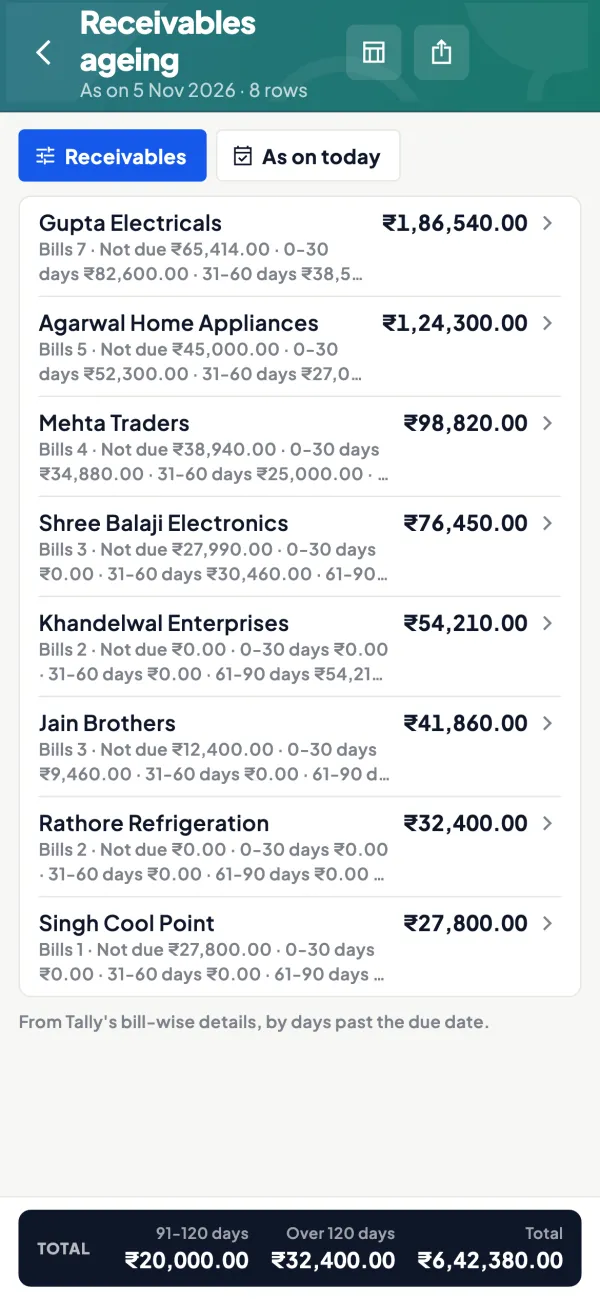
Salespeople see and record collections
On the staff app's Today screen, salespeople see their own customers' dues and record what they collect.
See Collections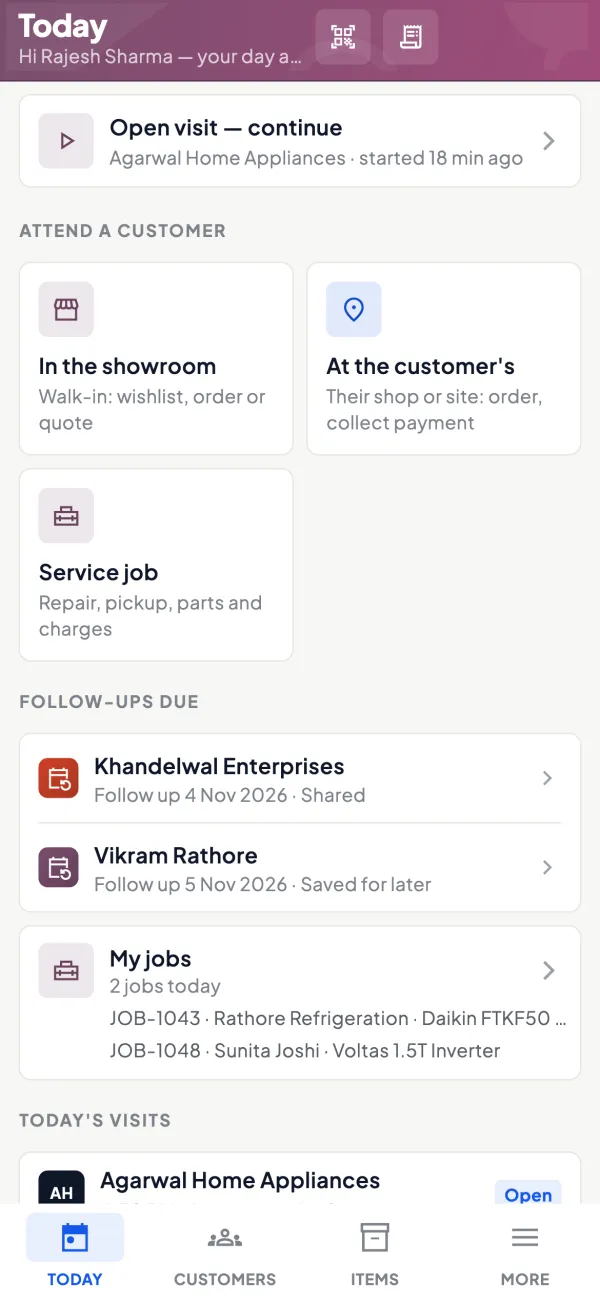
Questions people ask
How much outstanding is too much?
Should I charge interest on late payments?
Who should follow up for payment, the salesperson or the accounts team?
Do I need special software to reduce outstanding?
How do I calculate DSO?
Is a cash discount for early payment worth it?
What should I do with very old dues?
Should I check my own bills before chasing?
This page is general information for Indian businesses, not tax, legal or financial advice. Rules and rates change — check the official portals or your CA before acting.