
Running the business Receivables
Ageing analysis explained
An ageing analysis groups unpaid bills by how old they are, usually in 30-day buckets. It tells you not just how much customers owe, but how stale that money is, which is what decides how likely you are to collect it.
- Distributors and wholesalers
- Owners giving credit to dealers
- Accounts and collection staff
- Salespeople who collect
- Businesses with supplier credit

On this page 11
What the report looks like
Each row is a party; each column is an age bucket. The age is counted either from the bill date or from the due date. Counting from the due date is more useful for collection, because a 45-day-old bill on 60-day terms is not yet late.
| Party | Not due | 1–30 days | 31–60 | 61–90 | 90+ | Total |
|---|---|---|---|---|---|---|
| Jain Traders | ₹1,20,000 | ₹40,000 | – | – | – | ₹1,60,000 |
| Shree Hardware | ₹35,000 | ₹60,000 | ₹55,000 | – | – | ₹1,50,000 |
| Rao & Sons | – | – | ₹30,000 | ₹45,000 | ₹82,000 | ₹1,57,000 |
| Total | ₹1,55,000 | ₹1,00,000 | ₹85,000 | ₹45,000 | ₹82,000 | ₹4,67,000 |
How to read it
- Totals look similar, risk does not. All three parties owe about ₹1,50,000. Jain Traders is healthy, Shree Hardware needs a call, and Rao & Sons has ₹82,000 over 90 days past due, which needs the owner's attention now.
- Watch the share, not just the amount. Here ₹2,12,000 of ₹4,67,000, about 45%, is more than 30 days overdue. If that share grows month after month, your collection process is slipping even if sales are rising.
- Look for "on account" receipts. If receipts are not adjusted against bills, the report shows old bills as unpaid when the party has actually paid. Clean these up before chasing anyone.
What to do with each bucket
| Bucket | Action |
|---|---|
| Not due | Courtesy reminder a few days before the due date. |
| 1–30 days overdue | Statement and reminder; phone call at about 7 days. |
| 31–60 days | Visit by salesperson; new orders need approval. |
| 61–90 days | Supply on hold; owner-to-owner call; agree a written payment plan. |
| 90+ days | Formal notice; discuss with your CA whether to provide for or write off the debt; legal options for large amounts. |
For the full sequence of messages, see our payment reminder templates.
Payables ageing: the other side
The same report for suppliers shows what you owe and how late you are. It helps you plan payments and protect your standing with key suppliers. It is also how you check purchases from micro and small enterprises, which have a legal payment time limit; see the MSME 45-day payment rule.
Getting a reliable ageing report
- Maintain bill-wise details for all customer and supplier ledgers in your accounting software. In TallyPrime this is the bill-wise option on the ledger; see Tally bill-wise details explained.
- Enter the credit period on each sales bill so the due date is correct.
- Adjust every receipt against specific bills ("Agst Ref"), not "On Account".
- Post credit notes for returns and scheme discounts promptly, against the right bill.
- Run the report weekly on the same day.
Turning the report into a weekly list
The report is only useful if it produces actions. A practical way:
- Filter parties with anything in the 31-day-plus buckets.
- Sort by the amount in the oldest bucket, not the total.
- Assign each party to a person: salesperson, accounts or owner, depending on the bucket.
- Note the next action and date next to each name.
- Next week, start by checking last week's list before running the new one.
Over a few months, compare the bucket totals at each month end. A healthy business sees money flow out of the older buckets, not pile up in them. If the 90+ column grows every month, the issue is not individual customers but your credit process; see credit control policy for distributors.
It also helps to look at ageing by salesperson or area. One territory with an unusually heavy 61–90 bucket usually points to a specific problem: a lenient salesperson, a struggling market or a big dealer in trouble.
Ageing on your phone with Cashflow OS
Cashflow OS syncs bill-wise outstanding from TallyPrime and shows receivables and payables with ageing on your phone and the web. You can open a party from the list, see which bills are in which bucket, and send the statement on WhatsApp. Reports export to Excel or PDF for your weekly review. Details are on the outstanding receivables page.
Avoid these
Common mistakes
- MistakePosting receipts 'On Account' instead of against billsDo this instead
Adjust every receipt against specific bills, or old bills show as unpaid and you chase customers who have already paid.
- MistakeLooking only at total outstanding per partyDo this instead
Sort by the amount in the oldest bucket; two parties with equal totals can carry very different risk.
- MistakeLeaving the credit period blank on sales billsDo this instead
Enter the credit days on each bill so the due date, and the overdue bucket, is correct.
- MistakeRunning the report but not assigning any actionDo this instead
Turn it into a weekly list: each overdue party gets a person, a next step and a date, and check last week's list first.
Keep handy
Checklist
Ageing analysis explained — 8 checks. Tick them as you go.
In Cashflow OS
How Cashflow OS helps
Cashflow OS puts your TallyPrime books on every phone in the team. Where it fits this topic:
Receivables and payables ageing on your phone
Bill-wise outstanding is synced from Tally and shown with ageing on phone and web, so you can see which bills sit in which bucket.
See Outstanding receivables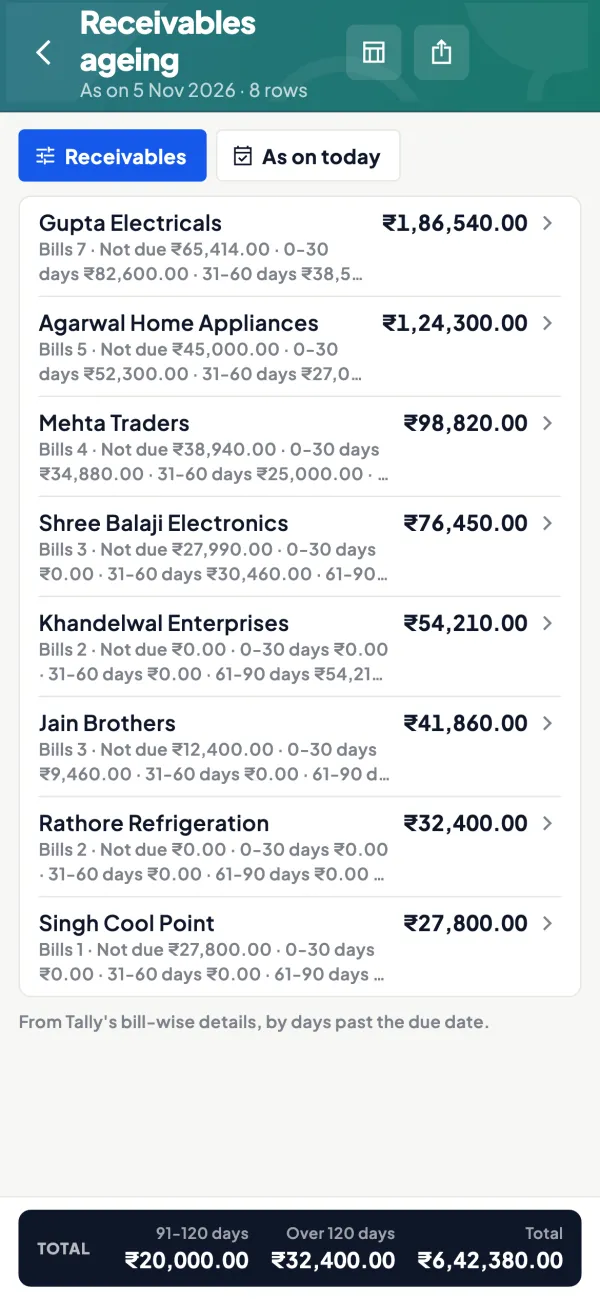
Statements to the party on WhatsApp
Open a party from the list and share their statement as a PDF in Tally's format, or a simple Hindi page, with a payment reminder.
See Party ledger statements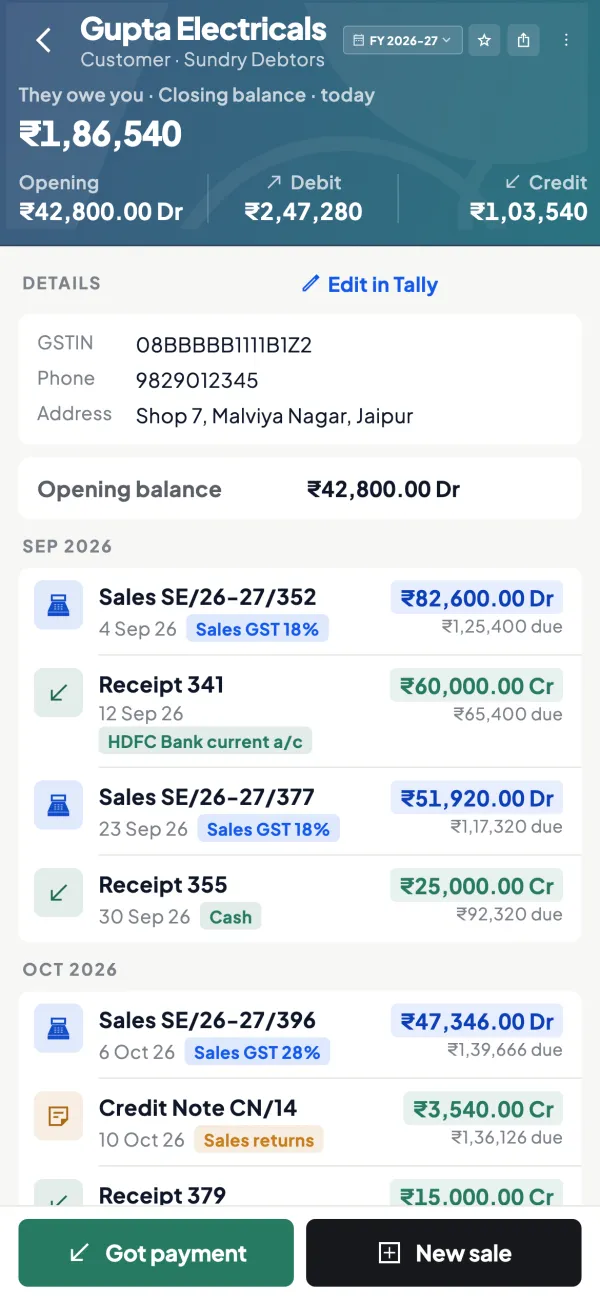
Questions people ask
Should ageing be calculated from bill date or due date?
How often should I run an ageing analysis?
When should an old debt be written off?
What buckets should I use?
What is payables ageing?
Why does a customer who has paid still show old bills?
Can I see ageing by salesperson or area?
Does ageing show in Tally?
This page is general information for Indian businesses, not tax, legal or financial advice. Rules and rates change — check the official portals or your CA before acting.