Tally how-tos TallyPrime
Bill-wise details in Tally, explained
Bill-wise details let Tally track each invoice separately inside a party's ledger. Every bill gets a reference, and every payment or credit note is matched to the bills it settles, so Tally can show exactly which bills are still pending and how old they are.
- Businesses selling on credit
- Accountants and data-entry staff
- Distributors and wholesalers
- Owners chasing collections
- Businesses buying on credit
On this page 12
Why bill-wise matters
Without bill-wise details, a customer's ledger shows only a running balance, say ₹1,20,000 debit. You cannot tell whether that is one recent bill or ten bills, some of them six months old. With bill-wise details, the same ₹1,20,000 is broken into bills with dates, and Tally can produce outstanding and ageing reports. For any business that sells on credit, this is the foundation of collections. See bill-wise details in the glossary for a short definition.
Switching it on
Bill-wise tracking is set at two levels in TallyPrime. At the company level, the feature to maintain bill-wise details is enabled in the company's accounting features. At the ledger level, each party ledger under Sundry Debtors or Sundry Creditors has an option to maintain balances bill by bill, along with a default credit period. New party ledgers usually pick this up automatically once the company feature is on, but check existing ledgers, especially ones created long ago.
The four reference types
| Type | Use it when | Example |
|---|---|---|
| New Ref | A new bill is created | Sales invoice 1182 for ₹47,200 |
| Agst Ref | Settling an existing bill, fully or partly | Receipt of ₹30,000 against bill 1182 |
| Advance | Money received or paid before the bill exists | ₹25,000 advance before an order is delivered |
| On Account | Amount not linked to any bill | A lump payment the customer has not explained |
On Account should be the exception. Every On Account amount sits in the ledger reducing the balance, while the bills it should settle still look unpaid.
Worked example: part payment across bills
Mehta Hardware owes three bills: 1145 for ₹18,000 (60 days old), 1182 for ₹47,200 (35 days) and 1207 for ₹22,500 (10 days). Total ₹87,700. They pay ₹50,000.
- In the receipt, allocate ₹18,000 Agst Ref 1145 (now cleared).
- Allocate ₹32,000 Agst Ref 1182 (₹15,200 still pending).
- Bill 1207 is untouched.
Outstanding now shows ₹15,200 on bill 1182 (35 days) and ₹22,500 on bill 1207 (10 days). If the same ₹50,000 had been entered On Account, the party total would be correct but all three bills would still appear outstanding, and the 60-day bill would keep showing in your ageing.
Credit notes, discounts and TDS
- Sales return or rate difference: pass a credit note and adjust it Agst Ref the original bill.
- Cash discount for early payment: record the discount and adjust it against the same bill as the receipt, so the bill closes fully.
- TDS deducted by the customer: the customer pays less than the bill; record the TDS receivable and adjust it against the bill too, so the bill does not stay open for the TDS amount.
Small leftover amounts, such as ₹3 or ₹10 differences from rounding, should be written off against the bill, not left hanging for years.
Advances, done properly
When a customer pays ₹25,000 before delivery, record the receipt with reference type Advance and a reference name, such as the order number. When the invoice is made, adjust the advance against the new bill in the next receipt or journal. If the advance is left as an advance after billing, both the advance and the bill show separately, and outstanding looks higher than it is. GST on advances has its own rules; see GST on advances received.
Cleaning up messy outstanding
- List parties with On Account amounts.
- For each, ask the accountant to match On Account amounts to specific bills, using the customer's own payment details if needed.
- Close tiny leftover balances with a write-off entry, with the owner's approval.
- Check opening bills carried from earlier years; if they were brought in as one lump, re-enter them as individual bills where you still need to collect them.
- Send statements to the cleaned-up parties and confirm balances.
Bill-wise data on the phone
Because Cashflow OS reads Tally's bill-wise data through the connector, the outstanding and ageing screens on the phone show the same bills Tally does. If receipts are entered On Account in Tally, the app will show those bills as pending too, so cleaning up bill-wise entries improves both. Owners and salespeople can open a party, see pending bills with days overdue, and share the statement on WhatsApp. See outstanding receivables.
Avoid these
Common mistakes
- MistakeEntering receipts On AccountDo this instead
Allocate each receipt Agst Ref the bills it pays, using the customer's payment details if needed.
- MistakeLeaving TDS short-payments open on billsDo this instead
Record the TDS receivable and adjust it against the same bill, so the bill closes.
- MistakeAdvances left unadjusted after billingDo this instead
Adjust the advance against the new bill once it is raised, so outstanding is not overstated.
- MistakeOpening balances brought in as one lumpDo this instead
Enter opening bills one by one for parties you still need to collect from.
Keep handy
Checklist
Bill-wise details in Tally, explained — 8 checks. Tick them as you go.
In Cashflow OS
How Cashflow OS helps
Cashflow OS puts your TallyPrime books on every phone in the team. Where it fits this topic:
The same bills on the phone
Bill-wise data is read from Tally, so the outstanding and ageing screens show the same pending bills Tally does.
See Outstanding receivables
Pending bills into a WhatsApp statement
Open a party, see pending bills with days overdue, and share the statement on WhatsApp.
See Party ledger statements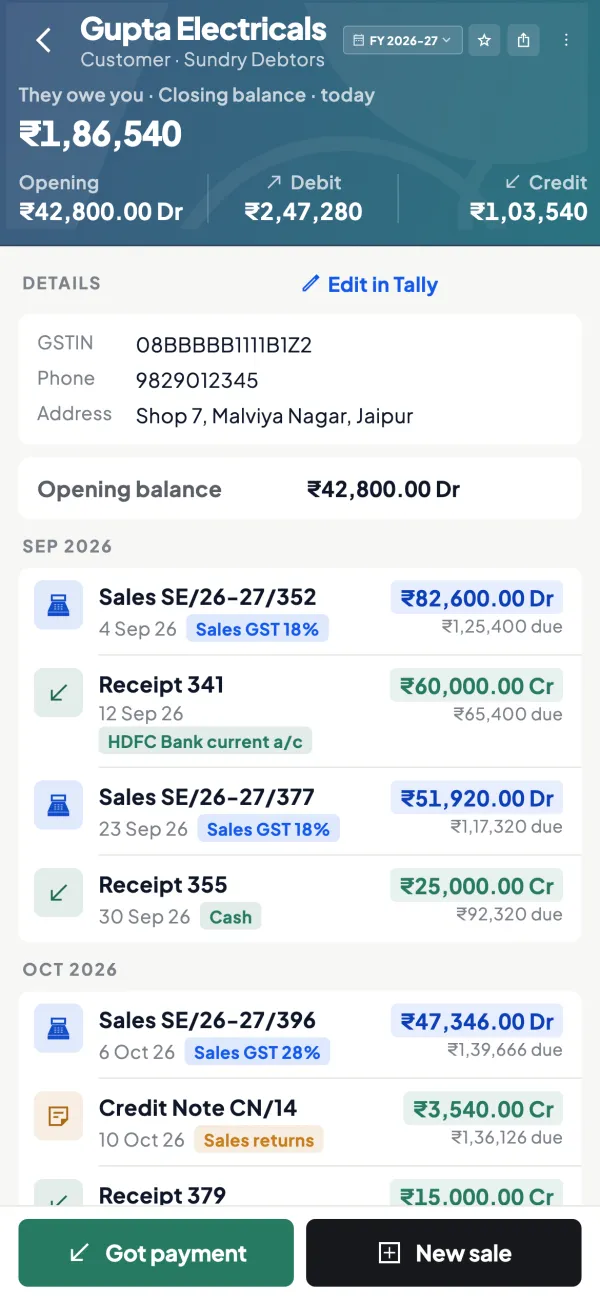
Questions people ask
Can I switch on bill-wise details for an existing company?
What is the difference between Advance and On Account?
Should suppliers also be bill-wise?
Why does ageing show old bills that were paid?
What does the credit period on a party ledger do?
Can I fix a wrong bill allocation later?
Does bill-wise matter for cash customers?
How should I allocate a round-figure payment?
This page is general information for Indian businesses, not tax, legal or financial advice. Rules and rates change — check the official portals or your CA before acting.