Glossary Tally
Bill-wise details
Definition
Bill-wise details track each invoice separately in a party's ledger, so every receipt, payment or note is matched to the exact bills it settles.

Example
Sharma Traders owes ₹70,000 on bill 210 and ₹40,000 on bill 233. It pays ₹70,000, and you enter the receipt against bill 210. The outstanding now shows only bill 233 pending, instead of a ₹40,000 balance nobody can trace to a bill.
Bill-wise details in TallyPrime and in Cashflow OS
Where to find itIn TallyPrime
In TallyPrime you switch on bill-wise details for the company and set party ledgers to maintain balances bill-by-bill. Each voucher for that party then asks for a reference such as New Ref, Agst Ref, Advance or On Account.
 On your phoneIn Cashflow OS
Cashflow OS reads the bill references from Tally, so bill-wise outstanding and ageing on the phone match what Tally shows.
See Outstanding receivables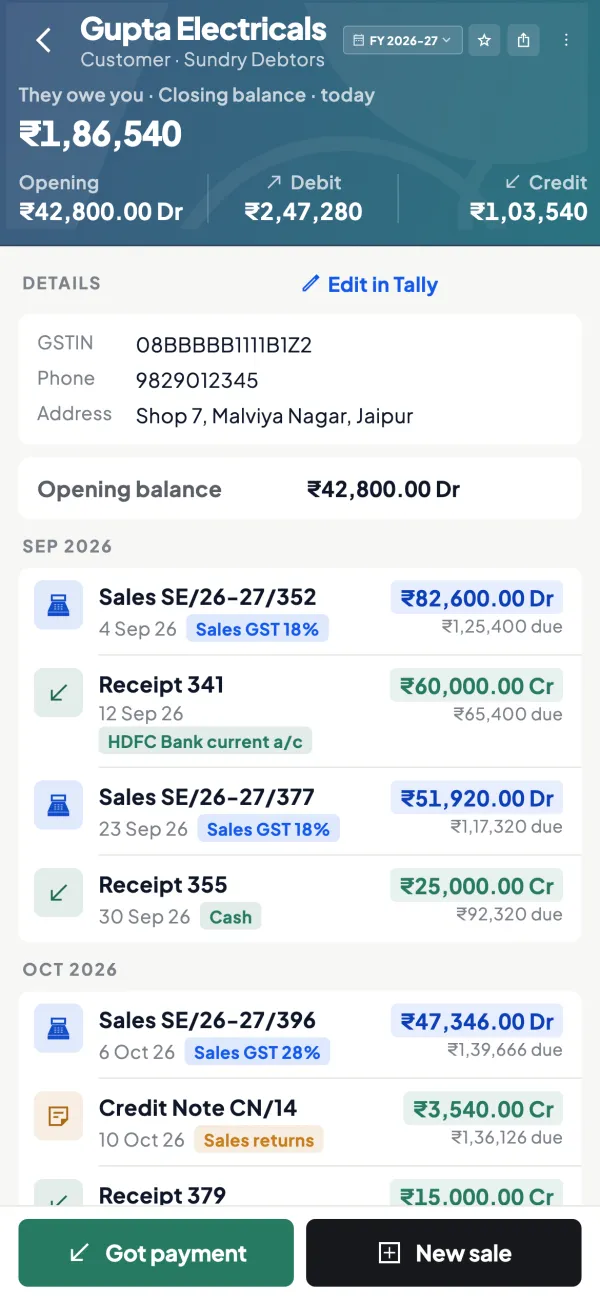
Common misunderstandings
- Watch outEntering receipts as On Account and never adjusting them against bills later.
- Watch outTurning bill-wise on for an old ledger without entering its opening bills, so the totals do not match.
Why bill-wise matters
Without bill-wise details, a party ledger shows only a running balance. You know a customer owes ₹1,20,000, but not which bills are pending or how old they are. With bill-wise details, each receipt is set against named bills, and the outstanding and ageing reports can show exactly which bills are unpaid and since when. It also makes statements easier for customers to check against their own books.
Reference types
| Type | Use |
|---|---|
| New Ref | A new bill, usually on a sales or purchase voucher |
| Agst Ref | A payment, receipt or note against an existing bill |
| Advance | Money received or paid before the bill |
| On Account | An amount not linked to any bill, to be adjusted later |
Example
Mehta Paints has three unpaid bills: 501 for ₹30,000, 518 for ₹45,000 and 533 for ₹25,000, total ₹1,00,000. It pays ₹50,000. If the receipt is entered on account, all three bills still look pending. If it is entered against reference 501 (₹30,000) and 518 (₹20,000), the report shows 501 cleared, ₹25,000 left on 518, and 533 untouched. The ledger balance is ₹50,000 either way, but only the second tells you what is overdue.
Where it shows up in TallyPrime
In TallyPrime, bill-wise details are switched on in the company features and then per ledger through the option to maintain balances bill-by-bill, with a default credit period if you want one. When you enter a voucher for that party, TallyPrime asks for the reference type and bill. Our guide to Tally bill-wise details covers cleaning up on-account entries. Cashflow OS reads these bill references, so the bill-wise outstanding on the phone matches Tally.
Related terms
Questions about Bill-wise details
Should every party ledger use bill-wise details?
Can I switch on bill-wise details for an existing ledger?
What if a customer pays a round amount covering several bills?
What is the difference between New Ref and Agst Ref?
Do expense ledgers need bill-wise details?
This page is general information for Indian businesses, not tax, legal or financial advice. Rules and rates change — check the official portals or your CA before acting.