Running the business Collections
Customer ledger statement best practices
A customer ledger statement shows every bill, payment, credit note and the closing balance for one customer over a period. Sent regularly and in a clear format, it speeds up payment and catches disagreements before they become disputes.
- Distributors and wholesalers
- Businesses selling on credit
- Accountants
- Collections executives
- Salespeople visiting dealers
On this page 12
Why statements matter more than reminders
A reminder says you owe us money. A statement shows exactly how that amount is made up. Retailers and dealers often pay several suppliers and lose track; when their own records differ from yours, they wait. A clear statement lets the customer's accountant tick off each line, raise any difference, and release payment for the rest.
Regular statements are also one of the simplest internal controls: a customer who receives a statement will notice a receipt that was never credited or a credit note they never asked for.
What a good statement includes
| Date | Particulars | Debit (₹) | Credit (₹) | Balance (₹) |
|---|---|---|---|---|
| 01-Sep | Opening balance | 84,500 Dr | ||
| 04-Sep | Sales bill 1182 | 36,200 | 1,20,700 Dr | |
| 10-Sep | Receipt – UPI, against bills 1104, 1121 | 54,500 | 66,200 Dr | |
| 18-Sep | Credit note 41 – rate difference bill 1182 | 1,800 | 64,400 Dr | |
| 26-Sep | Sales bill 1240 | 28,900 | 93,300 Dr | |
| 30-Sep | Closing balance | 93,300 Dr |
Add underneath: a bill-wise list of pending bills with due dates and days overdue, your bank and UPI details, and a contact for queries.
Ledger view vs bill-wise view
Send both if you can. The running ledger shows the history; the bill-wise list shows exactly which bills are open. In the example, the closing ₹93,300 is made up of the ₹30,000 still pending from August, bill 1182 (₹34,400 after the credit note) and bill 1240 (₹28,900). If the August bill is overdue, the customer can see it immediately.
Bill-wise statements only work if receipts are booked against specific bills. Receipts left on account make every statement confusing; see Tally bill-wise details explained.
How often to send
- Monthly to every credit customer, in the first week of the month.
- Before a big festive order or a credit limit increase, so both sides agree on the starting balance.
- Quarterly or yearly confirmation with major customers, asking them to confirm the balance in writing — useful at year-end.
- On request, the same day.
Sending on WhatsApp: etiquette that works
- Send a PDF, not a photo of a screen. It looks professional and can be forwarded to their accountant.
- Add a short polite message with the total due and the oldest overdue bill. Example: Namaste, please find your statement for September. Balance ₹93,300, of which ₹30,000 from August is now due. Kindly let us know if anything does not match.
- Use Hindi or the customer's language where that is what they prefer.
- Send at a reasonable hour on a working day.
- Keep the same day each month so customers expect it.
For follow-up wording, see payment reminder message templates.
Who should send statements, and how to track them
Make statements one person's job, usually the accountant or a collections executive, with a fixed day each month. Keep a simple tracker: customer, date sent, balance shown, customer's reply, and any difference raised. Customers who never reply are worth a phone call — silence sometimes means the statement went to the wrong number or the customer disagrees but has not said so.
Salespeople should carry the latest statement when they visit. A conversation that starts with the exact pending bills is more productive than a general request for payment, and the salesperson can collect a cheque or UPI payment against specific bills on the spot.
Before sending, check three things: all receipts up to the statement date are entered, credit notes promised during the month are issued, and the opening balance matches last month's closing balance. A statement with a known error damages trust more than a late statement.
When the customer's balance differs from yours
Common reasons: a payment received but not booked, a payment booked to the wrong party, a credit note promised but not issued, goods returned but not recorded, or a bill the customer never received. Ask for their ledger, compare line by line, and correct whichever side is wrong — quickly. Unresolved differences turn into disputed bills; see handling disputed bills.
Statements with Tally and Cashflow OS
Cashflow OS creates party statements from your Tally data as a PDF in Tally's format or as a simple Hindi हिसाब page, and shares them on WhatsApp from the phone. Bill-wise outstanding with ageing shows which bills are due. Statements cover any date range, including ranges across financial years. See party ledger statements.
Avoid these
Common mistakes
- MistakeSending a photo of the screen instead of a PDFDo this instead
Send a PDF the customer can forward to their accountant; it looks professional and is easy to check.
- MistakeLeaving receipts On AccountDo this instead
Book receipts against specific bills, so the bill-wise list shows exactly which bills are open.
- MistakeSending a statement before entries are completeDo this instead
Enter all receipts and promised credit notes, and match the opening balance to last month's closing, before sending.
- MistakeIgnoring customers who never replyDo this instead
Call them. Silence can mean a wrong number or a disagreement they have not raised.
Keep handy
Checklist
Customer ledger statement best practices — 8 checks. Tick them as you go.
In Cashflow OS
How Cashflow OS helps
Cashflow OS puts your TallyPrime books on every phone in the team. Where it fits this topic:
Statements in Tally's format or Hindi
Create a party statement from Tally data as a PDF in Tally's format or a simple Hindi हिसाब page, for any date range, and share it on WhatsApp.
See Party ledger statements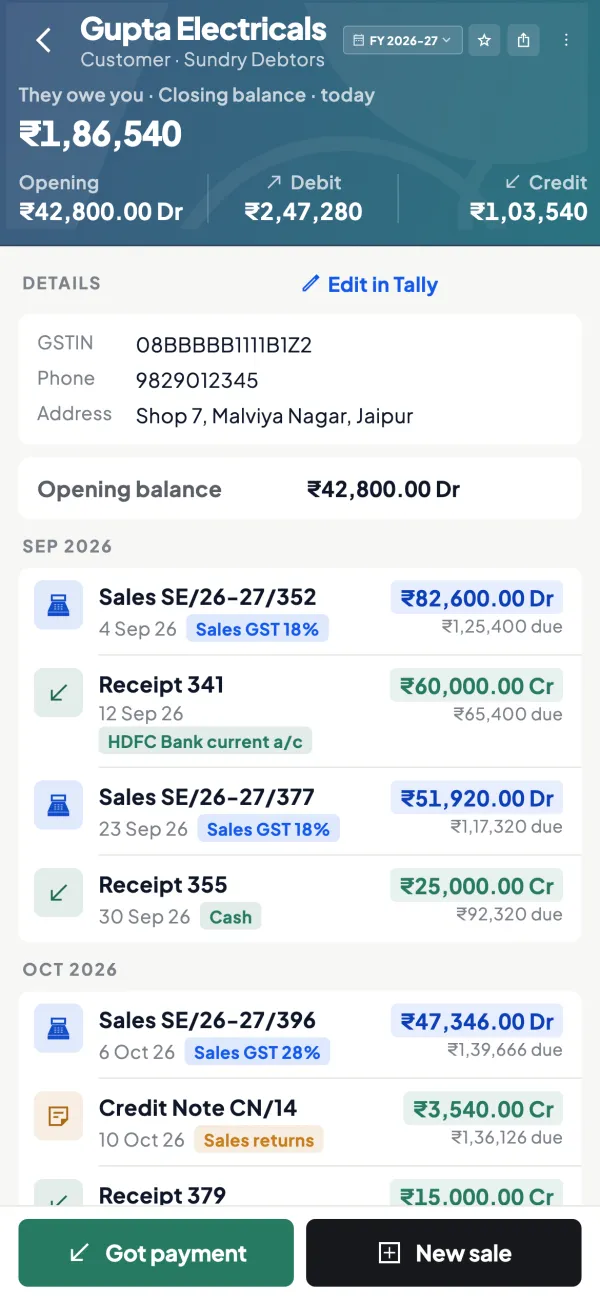
Pending bills with ageing
Bill-wise outstanding with ageing shows which bills are due before you send or call.
See Outstanding receivables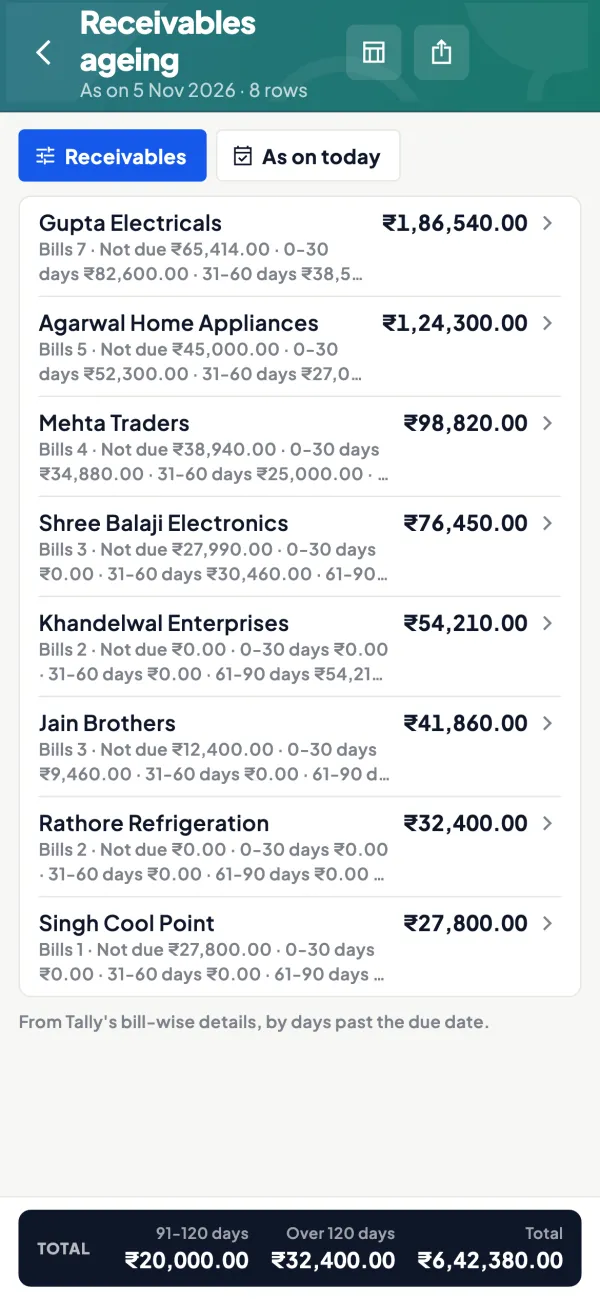
Questions people ask
What is a customer ledger statement?
How often should I send statements to customers?
Should I send a ledger or a bill-wise statement?
What if a customer disputes the balance?
What is a balance confirmation?
Should statements show credit notes?
Can a statement cover more than one financial year?
Who should send statements?
This page is general information for Indian businesses, not tax, legal or financial advice. Rules and rates change — check the official portals or your CA before acting.