Running the business Collections
Handling disputed bills
A disputed bill is one the customer will not pay because they disagree with something on it — quantity, rate, quality, or whether it is owed at all. The faster you identify the exact point of disagreement and settle it, the faster the rest of the money comes in.
- Distributors and wholesalers
- Manufacturers selling on credit
- Owners chasing payments
- Salespeople and collection staff
- Accountants
On this page 12
Why disputes cost more than the disputed amount
A ₹4,000 rate difference on a ₹1,20,000 bill can hold up the whole bill. Customers often stop paying all open bills until one dispute is settled. Meanwhile, the bill ages in your ageing report, your salesperson avoids the customer, and the relationship cools. Treat disputes as urgent, not as part of normal follow-up.
Common causes
| Cause | Example | Usual fix |
|---|---|---|
| Rate difference | Billed ₹410/box, salesperson promised ₹395 | Credit note for difference, if the promise is confirmed |
| Short supply | Billed 50 cartons, received 48 | Check load sheet and proof of delivery; credit note if short |
| Damaged or defective goods | Breakage in transit | Return and replacement process |
| Scheme not given | Customer expected a festive scheme | Check scheme terms; credit note if eligible |
| Payment not credited | Customer paid by UPI; not booked | Trace in bank; book receipt |
| Bill not received | Customer has no copy | Resend; confirm delivery proof |
| Duplicate billing | Same goods billed twice | Cancel or credit the duplicate |
A step-by-step resolution process
- Log it the same day. Bill number, amount in dispute, reason given, who raised it.
- Separate the undisputed part. Ask the customer to pay the undisputed amount now. If ₹4,000 is in dispute on ₹1,20,000, ₹1,16,000 should not wait.
- Collect evidence. Order, delivery challan, signed proof of delivery, price list, scheme circular, bank statement — whatever applies.
- Decide within a set time, for example three working days. Someone with authority — not the salesperson alone — makes the call.
- Settle in the books. Credit note, revised bill, receipt booking or cancellation, as applicable.
- Confirm in writing. Send the updated ledger statement showing the correction.
- Close the log with the outcome and the root cause.
Credit note, revised bill or cancellation?
Once a GST invoice is issued and reported, corrections to value are usually made by a credit note (to reduce) or a debit note (to increase) against the original invoice, rather than by editing the bill. Cancellation is generally only suitable before the supply is complete, or within the window allowed for e-invoices. Credit notes must be issued and reported within time limits linked to the financial year. See credit notes and debit notes in GST. Confirm the right method with your CA. This is general information, not tax advice.
Sample messages
Acknowledging: Thank you for flagging bill 1182. We are checking the rate against the order and will reply by Thursday. Meanwhile, could you release payment for bills 1104 and 1121, which are not in question?
Resolving in their favour: You were right — the agreed rate was ₹395. We have issued credit note 41 for ₹1,800. Your updated statement is attached; the balance due on bill 1182 is ₹34,400.
Not accepting the claim: We checked the signed delivery copy for bill 1240, which shows 50 cartons received in good condition (copy attached). We are unable to issue a credit for this. Please let us know if you would like to discuss.
Preventing disputes in the first place
- Rates come from a price list, not from the salesperson's memory.
- Every delivery has signed proof of delivery.
- Scheme terms are shared in writing before the season.
- Receipts are booked against bills promptly.
- Monthly statements go to every credit customer, so differences surface early.
Review the dispute log monthly by cause and by salesperson. If most disputes are rate differences, fix pricing discipline; if most are short supply, fix dispatch checks.
When a dispute will not settle
If a customer refuses to pay an amount you are sure is owed, escalate in stages: owner-to-owner conversation, a formal written demand with the statement and evidence, then legal advice. For businesses registered as MSMEs, delayed payment protections and a facilitation mechanism may be available against buyers; see the MSME 45-day payment rule. Take legal advice before formal action.
Handling disputes with Tally and Cashflow OS
With Cashflow OS, you can open the customer's ledger and bill-wise outstanding from the phone during the conversation, share the party statement as a PDF on WhatsApp, and — when writing back is on — create the credit note or debit note in Tally from the app; Tally validates it. Price lists fill rates automatically on orders, which removes a common source of disputes. See party ledger statements.
Avoid these
Common mistakes
- MistakeLetting the whole bill wait for one disputed lineDo this instead
Ask for the undisputed amount at once; the rest of the bill and other bills should be paid as normal.
- MistakeLeaving the decision to the salesperson aloneDo this instead
Have someone with authority decide within a set time, such as three working days.
- MistakeEditing a reported GST invoice to settle a disputeDo this instead
Use a credit note or debit note against the original invoice, within the time limits; confirm with your CA.
- MistakeRates quoted from memoryDo this instead
Bill from a price list and share scheme terms in writing before the season.
Keep handy
Checklist
Handling disputed bills — 8 checks. Tick them as you go.
In Cashflow OS
How Cashflow OS helps
Cashflow OS puts your TallyPrime books on every phone in the team. Where it fits this topic:
Ledger and statement during the call
Open the customer's ledger and bill-wise outstanding on the phone, and share the party statement as a PDF on WhatsApp once the correction is made.
See Party ledger statements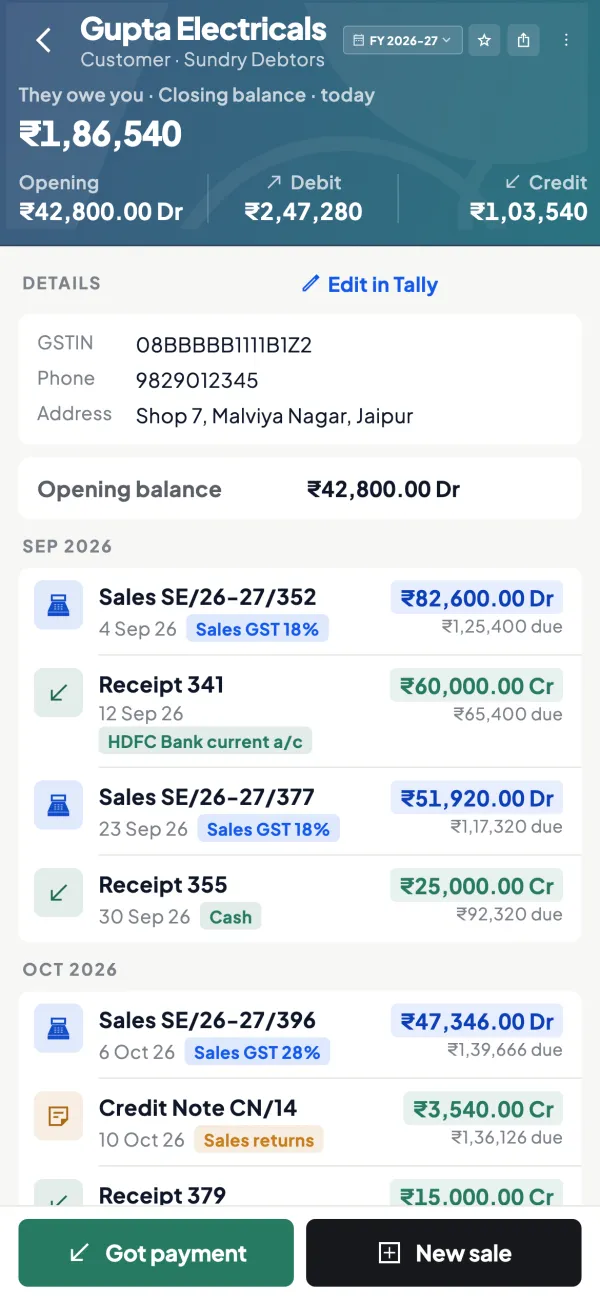
Credit notes and set rates
With writing back on, a credit or debit note can be created in Tally from the app; Tally validates it. Price lists fill rates automatically on orders, removing a common cause of disputes.
See Create Tally vouchers from your phone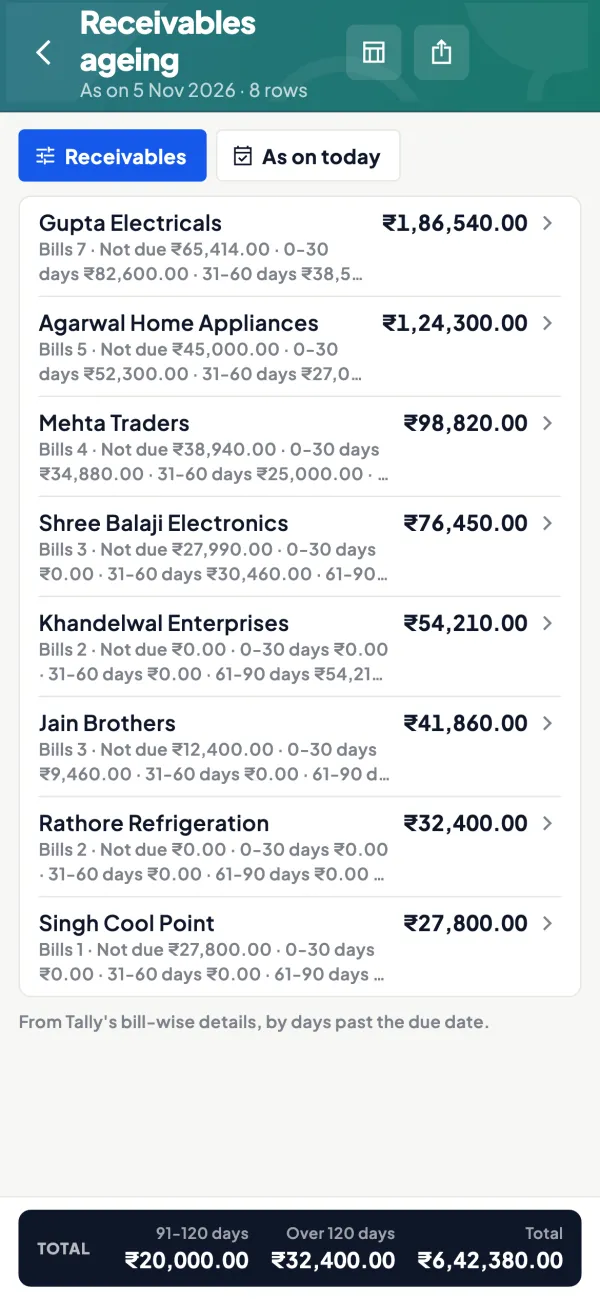
Questions people ask
Should the customer pay the undisputed part of a bill?
Can I edit a GST invoice after a dispute?
How long should resolving a disputed bill take?
What evidence helps settle a short-supply dispute?
What is the most common cause of disputed bills?
What should I do if a payment the customer made is not credited?
When should a dispute go to a lawyer?
Do MSME rules help with disputed payments?
This page is general information for Indian businesses, not tax, legal or financial advice. Rules and rates change — check the official portals or your CA before acting.