Running the business Collections
How to ask customers for payment
Ask early, ask specifically and ask the same way every time. A clear request for a named amount on a named date is more polite, and more effective, than vague hints about "pending hisaab".
- Shop owners selling on credit
- Distributors and wholesalers
- Salespeople who collect
- Accounts staff
- Small manufacturers
On this page 12
Why owners delay asking
Most owners do not want to spoil a relationship, especially with a dealer they have known for years. So they wait, the amount grows, and the conversation becomes harder. The truth is that a regular, polite reminder is normal business practice. Good customers expect it. It is the long silence followed by an angry call that damages relationships.
Before you ask: get your facts right
- Know the exact bills: number, date, amount, due date.
- Check that all receipts, credit notes and scheme discounts are posted. Asking for money the party has already paid is the fastest way to lose credibility.
- Have the statement ready to send. A clear ledger statement answers most questions before they are asked.
A simple phone script
Opening: "Namaste Sharma ji, Rakesh from Gupta Electricals. Is this a good time for two minutes?"
The ask: "Your bill 1452 of ₹86,400 dated 2 October was due on 1 November. I am sending the statement on WhatsApp. Can we expect the payment by this Friday?"
Close on a commitment: "So ₹86,400 by Friday, 8 November, by UPI or NEFT. I will note that. Thank you."
Notice three things: a specific bill, a specific amount and a specific date that the customer says out loud. Write down the promise and follow up the day after if it is missed.
Handling common replies
| They say | You reply |
|---|---|
| "Market is slow, my customers haven't paid." | "I understand. Can you do part today and the rest by the 20th? Let's fix both amounts." |
| "I'll send it next week." | "Which day should I note? I'll call that afternoon if it hasn't come." |
| "Your rate was wrong." | "Please tell me the item and the rate you expected. I'll check today. The other bills can be cleared meanwhile." |
| "I already paid." | "Could you share the UTR or cheque number? I'll match it right away." |
| "Talk to my accountant." | "Sure, please share his number. I'll send him the statement now." |
Part-payments and payment plans
For a larger overdue amount, a written plan is better than waiting for the whole sum. For example, ₹2,40,000 overdue becomes ₹60,000 every Saturday for four weeks. Confirm the plan on WhatsApp, record each receipt against the oldest bills, and keep new supply limited to what is paid for until the plan is complete.
When to stop supply
Decide the rule in advance, for example "no new dispatch if any bill is 30 days past due". Then it is a policy, not a personal decision. Tell the party politely before the order is held, not after the van is loaded. A written credit control policy helps here.
Asking in person, at the shop
For many trades, the salesperson's visit is still the best time to collect. A few habits make it work:
- Bring the statement on the phone and show the bills; do not rely on memory.
- Ask after the greeting and before taking the new order, not at the end when the owner is busy with customers.
- Do not argue in front of the dealer's customers or staff. If there is a dispute, note it and settle it on a call later.
- Give a receipt for every rupee collected, cash or cheque, and record it the same day.
- If the dealer pays part, thank them and confirm the date for the balance before leaving.
Link the visit to the order: a dealer who knows a new order will be dispatched once the old bill is cleared has a reason to pay today. Keep that link polite and consistent, and the dealer will come to expect it.
Asking with Tally and Cashflow OS
With Cashflow OS on top of TallyPrime, you can open any party on your phone, see bill-wise dues with ageing, and send the statement on WhatsApp in a few taps, as a Tally-style PDF or a simple Hindi हिसाब page. That means you have the facts in hand during the call. For written reminders you can adapt, see our payment reminder message templates.
Avoid these
Common mistakes
- MistakeWaiting months because you don't want to spoil the relationshipDo this instead
Send regular polite reminders from before the due date; the long silence then an angry call is what damages relationships.
- MistakeAsking for money the party has already paidDo this instead
Post all receipts, credit notes and scheme discounts first, and ask for the UTR or cheque number if they say they paid.
- MistakeEnding the call with 'please do it soon'Do this instead
Agree a specific amount and date, repeat it back, note it, and call the day after if it is missed.
- MistakeHolding the order after the van is loadedDo this instead
Tell the party politely before the order is held, under a written credit rule they already know.
Keep handy
Checklist
How to ask customers for payment — 7 checks. Tick them as you go.
In Cashflow OS
How Cashflow OS helps
Cashflow OS puts your TallyPrime books on every phone in the team. Where it fits this topic:
Bill-wise dues on your phone during the call
Open any party and see bill-wise outstanding with ageing, synced from Tally, so you have the facts in hand.
See Outstanding receivables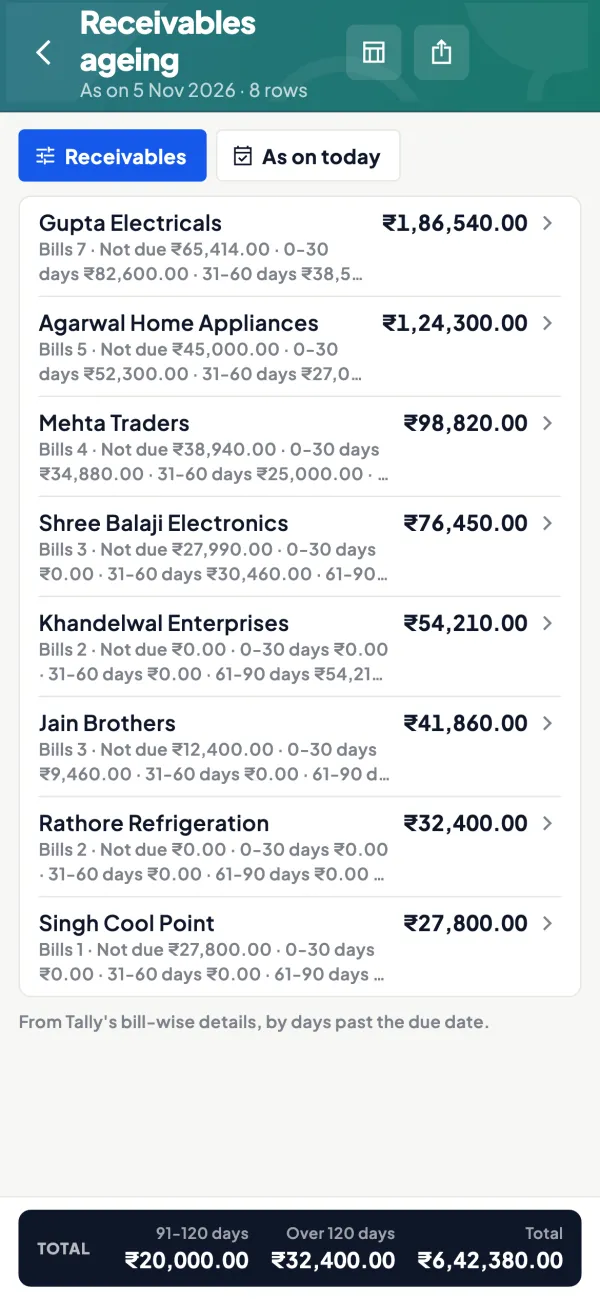
Statement on WhatsApp in a few taps
Send the party statement as a Tally-style PDF or a simple Hindi हिसाब page while you are still on the call.
See Party ledger statements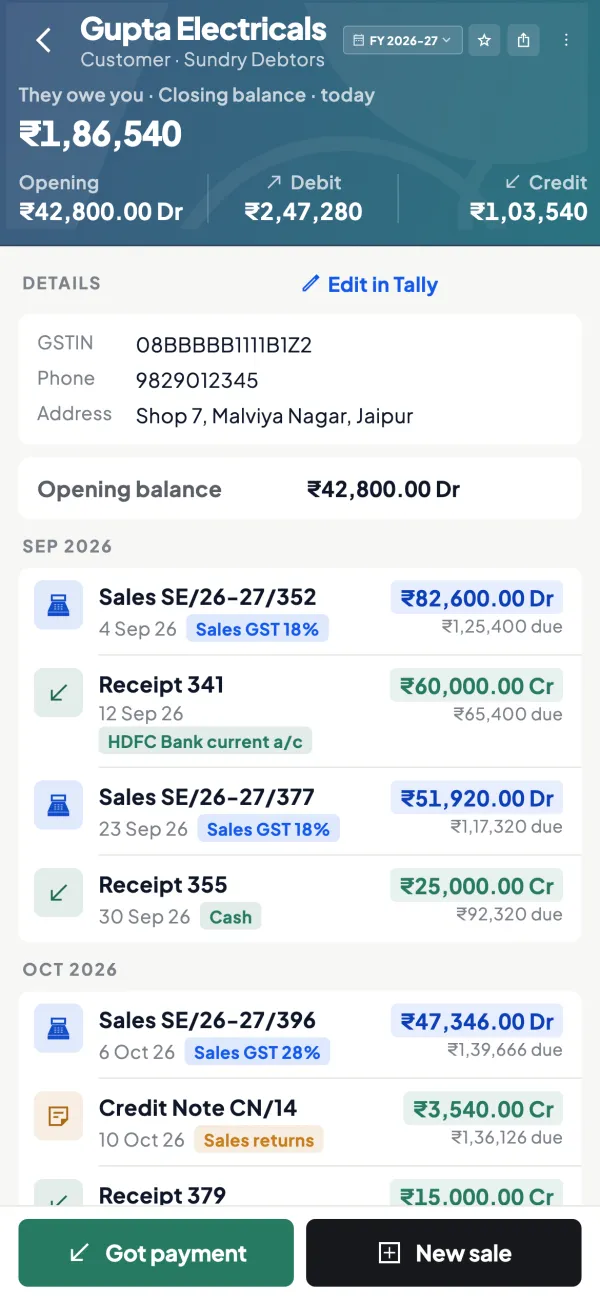
Questions people ask
Is it rude to send a reminder before the due date?
What time of day is best to call about payment?
Should the owner or staff ask for payment?
Should I accept post-dated cheques?
What should I say when a customer says the market is slow?
How should part-payments be recorded?
When is the best time to ask during a shop visit?
What if the customer disputes a rate on one bill?
This page is general information for Indian businesses, not tax, legal or financial advice. Rules and rates change — check the official portals or your CA before acting.