Running the business Returns
Returns and replacements process
Returns are part of trading, but unmanaged returns cause stock mismatches, party disputes and lost supplier claims. A written policy, inspection on arrival, a credit note or replacement invoice in the books, and a claim to the supplier where applicable keep everything in step.
- Distributors and wholesalers
- Electrical and lighting dealers
- Retailers
- Store and godown staff
- Accountants

On this page 11
Start with a written return policy
Most return disputes come from unclear terms. A one-page policy shared with dealers and printed on invoices should cover:
- Time limit: for example, damage or shortage to be reported within 48 hours of delivery; other returns within 15 days.
- Condition: unopened, original packing, with invoice reference.
- Non-returnable items: cut lengths, mixed paint, custom orders, expired or near-expiry goods where relevant.
- Defective goods: replaced, repaired or credited — and whether it goes through the brand's service centre.
- Who approves: salesperson cannot accept returns without office approval.
Types of returns and how to treat them
| Situation | Usual treatment |
|---|---|
| Wrong item or quantity sent | Take back; credit note or corrected invoice |
| Damaged in transit | Take back; credit note; claim from transporter or insurer if applicable |
| Manufacturing defect | Replace or credit; claim from supplier or brand |
| Slow-moving stock returned by dealer | Only if your policy allows; may be at a deduction |
| Expired or near-expiry goods | As per supplier's expiry return scheme, if any |
| Refused at delivery | Goods return with the vehicle; credit note or cancel bill per your CA's advice |
Step-by-step return process
- Request: customer reports the return with invoice number, item, quantity and reason; photos for damage.
- Approval: office approves or rejects against the policy and gives a return reference.
- Receipt: goods arrive with the reference; store staff count and inspect, and record condition — resaleable, damaged, defective.
- Accounting: issue a credit note against the original invoice for accepted returns; stock goes back into the right godown or a separate damaged-goods location.
- Replacement: if replacing, raise a fresh invoice for the replacement goods, so both movements are visible.
- Supplier claim: for defects, send the item or claim to the supplier and track it until you receive a credit or replacement.
- Close: share the updated party statement so the customer sees the credit.
GST on returns: the basics
A sales return after an invoice is generally handled by issuing a credit note that refers to the original invoice. The credit note reduces your output tax when reported in your GST return, within the time limit allowed for the financial year. If the buyer is registered, their input credit reduces too. See sales returns under GST and the credit note format.
If you cancel the invoice instead — for example, goods refused at the door on the same day — the treatment differs, and e-invoiced bills have their own cancellation window. Confirm your approach with your CA. This is general information, not tax advice.
A worked example
A lighting dealer sold 40 LED panels at ₹850 each (₹34,000 + GST) to a retailer. Four panels arrive cracked.
- Retailer reports the same day with photos; office approves return of 4.
- Four panels come back; store marks them damaged, not resaleable.
- Credit note for ₹3,400 + GST against the original invoice.
- Four new panels sent with a new invoice for ₹3,400 + GST.
- Transit damage claim filed with the transporter for ₹3,400.
The retailer's ledger shows the original bill, the credit and the new bill — and nets to what they actually received.
Track returns as a number
Look at returns monthly: by customer, by item, by reason and by salesperson. A rising return rate on one item points to a quality issue to raise with the supplier. A rising rate from one customer may mean over-selling. Damaged stock sitting in a corner should be counted and written down; see dead stock.
Returns with Tally and Cashflow OS
When writing back to Tally is switched on, an authorised user can create a credit note or debit note from the Cashflow OS phone or web app; Tally validates it and GST is worked out from the item and the party's state. The customer's ledger and bill-wise outstanding update after sync, and you can share the party statement as a PDF on WhatsApp so the customer sees the credit. See party ledger statements.
Avoid these
Common mistakes
- MistakeSalespeople accepting returns without approvalDo this instead
Require office approval and a return reference against the written policy before goods come back.
- MistakeSwapping goods without any entry in the booksDo this instead
Record a credit note for the returned goods and a new invoice for the replacement, so stock and the party ledger stay right.
- MistakePutting damaged returns back into saleable stockDo this instead
Move them to a separate damaged-goods godown or location and count and write them down as needed.
- MistakeForgetting to claim from the supplier or transporterDo this instead
Log every defect and transit damage claim and track it until you receive a credit or replacement.
Keep handy
Checklist
Returns and replacements process — 8 checks. Tick them as you go.
In Cashflow OS
How Cashflow OS helps
Cashflow OS puts your TallyPrime books on every phone in the team. Where it fits this topic:
Credit and debit notes from phone or web
When writing back is switched on, an authorised user can create a credit or debit note; Tally validates it and GST is worked out from the item and the party's state.
See Create Tally vouchers from your phone
Show the customer their credit
After sync, the party ledger and bill-wise outstanding update, and you can share the statement as a PDF on WhatsApp.
See Party ledger statements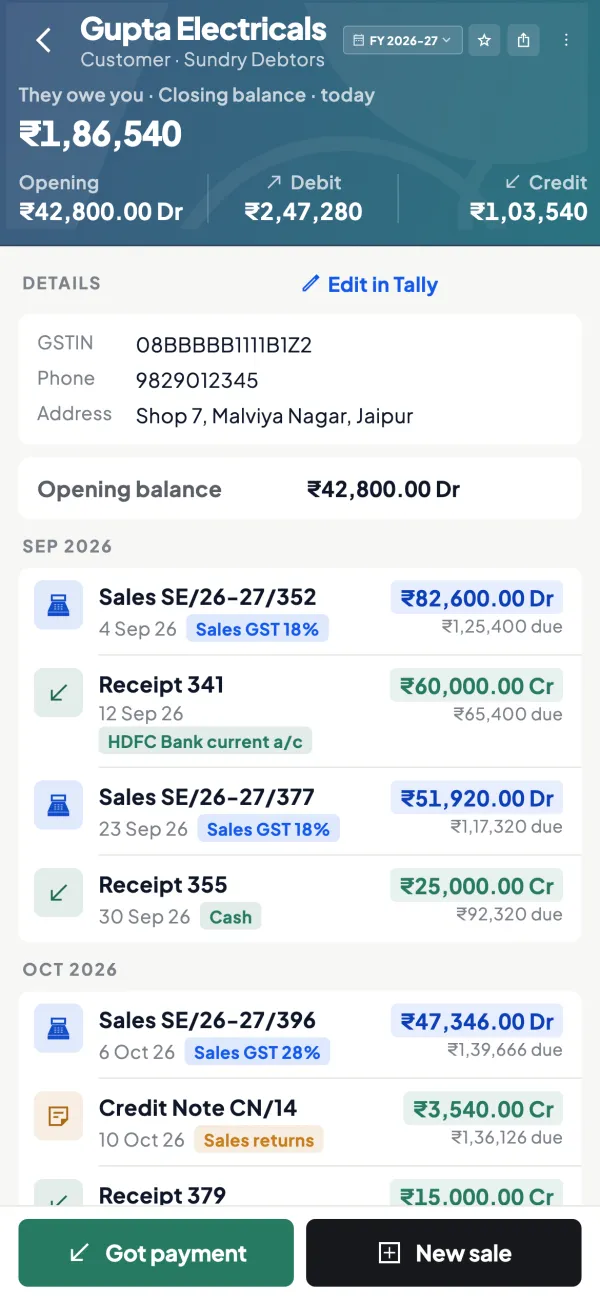
Questions people ask
Should I issue a credit note or cancel the invoice for a return?
Do I need to replace a defective item before the supplier replaces it?
Where should damaged returned stock go in Tally?
Is there a time limit for GST credit notes?
How soon should damage be reported?
Can I refuse returns of slow-moving stock?
Why track returns by item and customer?
Does the buyer's ITC change when I issue a credit note?
This page is general information for Indian businesses, not tax, legal or financial advice. Rules and rates change — check the official portals or your CA before acting.