GST GST documents
Sales returns under GST
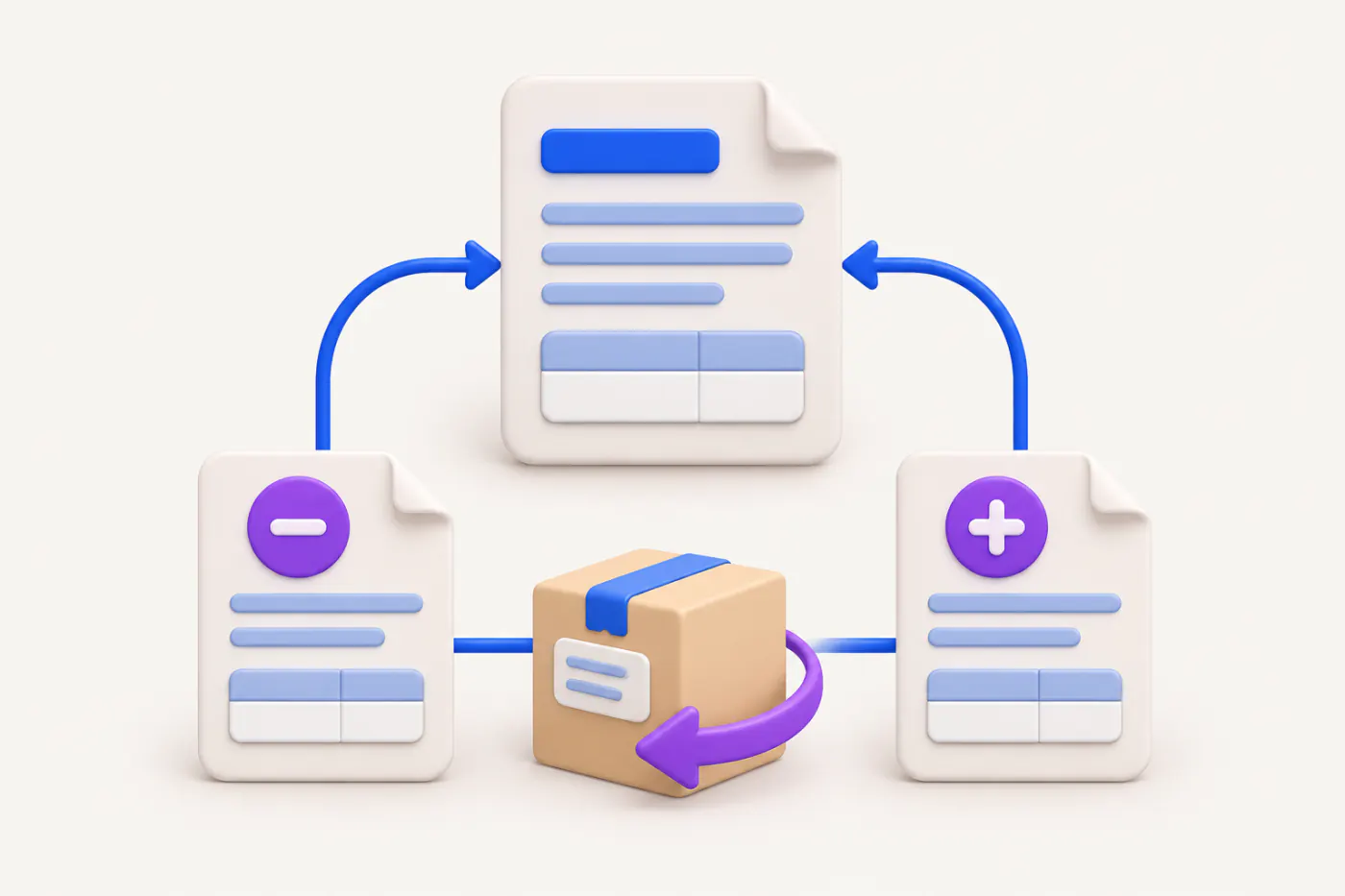
When a customer sends goods back, the supplier issues a credit note against the original invoice, reports it in GSTR-1, and reduces output tax, provided it is done within the time limit and the buyer reverses any credit taken.
- GST-registered traders
- Distributors and wholesalers
- Manufacturers
- Retailers handling returns
- Accountants preparing GSTR-1
On this page 11
The basic process
- Agree the return with the customer: which invoice, which items, how many, and why.
- Arrange movement of the goods back, with the right document (see below).
- On receipt, inspect and record the goods in stock (or in a damaged-goods location).
- Issue a credit note quoting the original invoice number and date.
- Report the credit note in GSTR-1 and reduce the sales figure in GSTR-3B for that period.
- Adjust the customer's ledger: refund, adjust against the next bill, or reduce the outstanding.
Worked example
A Nagpur paint distributor sold 200 tins at ₹1,500 each to a registered dealer in Wardha on 10 August: taxable ₹3,00,000, CGST ₹27,000, SGST ₹27,000, invoice total ₹3,54,000. On 5 September the dealer returns 20 damaged tins.
- Credit note: 20 × ₹1,500 = ₹30,000 taxable, CGST ₹2,700, SGST ₹2,700, total ₹35,400.
- Reported in September's GSTR-1 Table 9B against the dealer's GSTIN; the HSN line for paints is reduced by 20 tins and ₹30,000.
- September GSTR-3B: output tax reduced by ₹5,400.
- The dealer reverses ₹5,400 of input tax credit, since the credit note will appear in their GSTR-2B.
- Dealer's outstanding falls from ₹3,54,000 to ₹3,18,600.
Documents for the return journey
Goods going back still move on the road and need cover:
- Registered buyer returning goods: commonly sends them with a delivery challan, or issues their own document for the return, depending on how both parties' advisers prefer to treat it.
- Unregistered buyer: the supplier can generate the e-way bill and arrange the movement.
- E-way bill: required if the consignment value exceeds the e-way bill limit, generally ₹50,000, with the reason for transport recorded as sales return. See e-way bill basics.
A delivery challan is the usual document when goods move without a sale. Keep a copy with the credit note; it proves the goods actually came back.
Time limits
The credit note must be declared by the earlier of 30 November after the end of the financial year of the original sale, and the date you file the annual return for that year. A return in December 2026 of goods sold in January 2026 is fine; a return in December 2026 of goods sold in March 2025 is past the deadline.
Past the deadline you can still take the goods back and credit the customer commercially, but you cannot reduce the GST already paid. Some businesses treat such a late return as a fresh purchase from a registered customer, who then issues a tax invoice for it. Discuss with your CA which approach suits you.
Special cases
- Unregistered retail customer returns goods. Issue a credit note and reduce the B2C summary in Table 7 for that month (or report in Table 9B for B2C Large invoices).
- E-invoiced sale. If you are covered by e-invoicing, the credit note to a registered buyer must be reported for an IRN. Cancelling the original IRN is possible only within 24 hours, so returns after that need a credit note.
- Replacement, not refund. If a defective item is replaced free under warranty, there is usually no fresh sale and no credit note; record the movement with a challan. If the replacement differs in value, get advice.
- Partial return of a scheme invoice. If free goods or discounts were linked to quantity, recompute the credit note on the net price actually charged.
This is general information, not tax advice.
Common mistakes
- Recording the return as a negative sales invoice, which breaks the credit note series and confuses GSTR-1.
- Crediting the customer's account with a journal entry, with no GST credit note.
- Not putting returned stock back into inventory, so stock and books differ at year end.
- Issuing credit notes at the full original rate when the original invoice had a discount.
Returns with Tally and Cashflow OS
With writing to Tally switched on, an authorised user can create a credit note in TallyPrime from the Cashflow OS app, against the party and items, and Tally validates it. The party's ledger and bill-wise outstanding update after sync, so the salesperson and owner see the reduced balance, and the credit note shows in the GSTR-1 view. A delivery challan can also be prepared in the app.
Avoid these
Common mistakes
- MistakeEntering a return as a negative sales invoiceDo this instead
Use a credit note voucher so the credit note series and GSTR-1 stay clean.
- MistakeCrediting the customer by journal, no credit noteDo this instead
Issue a GST credit note against the original invoice, so output tax is reduced and the buyer reverses the credit.
- MistakeNot putting returned stock back in inventoryDo this instead
Record the goods on receipt, in stock or a damaged-goods location, so stock and books agree at year end.
- MistakeCredit note at full rate when the bill had a discountDo this instead
Work out the credit note on the net price actually charged on the original invoice.
Keep handy
Checklist
Sales returns under GST — 8 checks. Tick them as you go.
In Cashflow OS
How Cashflow OS helps
Cashflow OS puts your TallyPrime books on every phone in the team. Where it fits this topic:
Credit notes from the app
With writing into Tally switched on, an authorised user can create a credit note in TallyPrime from Cashflow OS against the party and items, and Tally validates it.
See Create Tally vouchers from your phone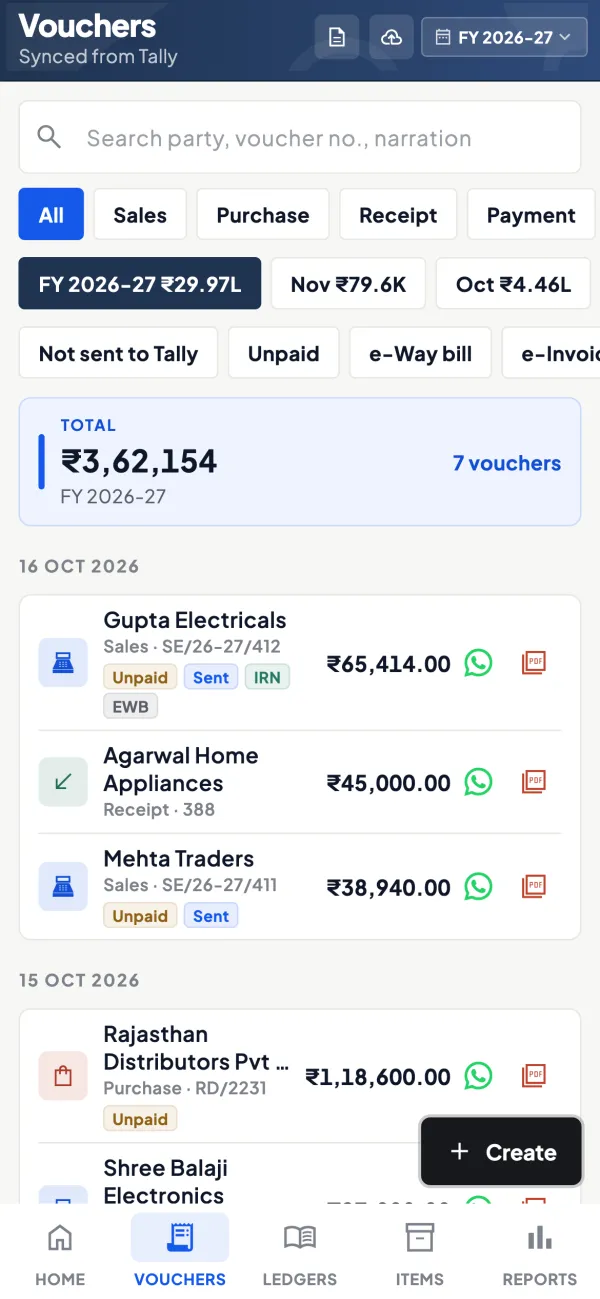
Return challans and updated balances
A delivery challan can be prepared in the app, and after sync the party's ledger and bill-wise outstanding show the reduced balance.
See Delivery challans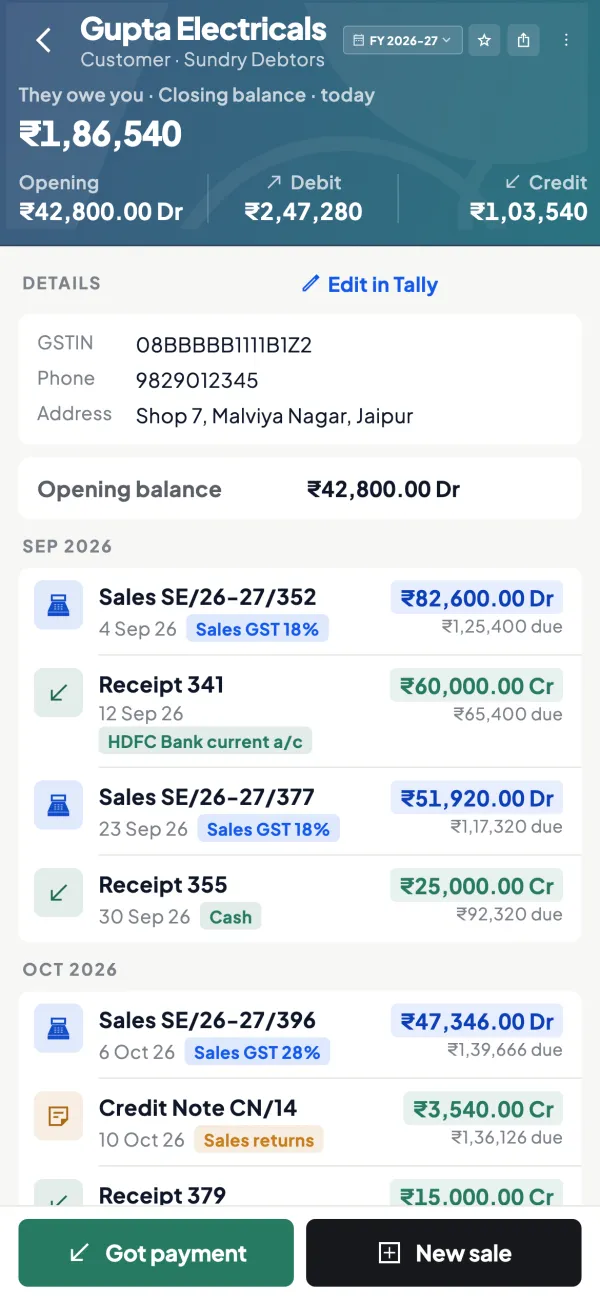
Questions people ask
Is GST refunded to the customer on a sales return?
Is a credit note needed for a return from an unregistered customer?
Can I issue a credit note before the goods come back?
Is an e-way bill needed for goods coming back?
What if the buyer has already claimed input tax credit?
Can I give a credit note after the time limit?
Does a sales return change the HSN summary?
Should returns reduce a salesperson's sales?
This page is general information for Indian businesses, not tax, legal or financial advice. Rules and rates change — check the official portals or your CA before acting.