Invoices & documents Delivery challans
Delivery challan under GST
A delivery challan is the document that moves goods when there is no sale at that moment: job work, goods on approval, stock sent to a branch, or a supply where the quantity is not yet known. It must carry a fixed set of details under Rule 55 of the CGST Rules.
- Manufacturers sending job work
- Traders sending goods on approval
- Businesses with branches
- Dispatch and godown staff
- Accountants
On this page 11
Where the delivery challan fits
Normally goods travel with a tax invoice. When there is no supply yet, or the invoice cannot be made at the time of removal, the law allows a delivery challan in its place. The cases are covered in detail in when is a delivery challan required. In short: goods sent for job work, goods moved for reasons other than supply, liquid gas where the quantity is not known at removal, and other notified cases.
A challan is not a bill. It creates no sale and no output tax by itself. But it is a GST document, so it follows numbering and content rules.
Fields a delivery challan must show
| Field | Example |
|---|---|
| Challan number and date | DC/25-26/0088, 10-11-2025 |
| Consigner name, address, GSTIN | Kumar Steel Fab, Faridabad, 06ABCDE1234F1Z9 |
| Consignee name, address, GSTIN if registered | Ravi Galvanisers (job worker), Ballabgarh, 06PQRSX5678K1Z3 |
| HSN and description | MS angles 40×40, HSN 7216 |
| Quantity | 2.4 tonnes (provisional where exact quantity is not known) |
| Taxable value | ₹1,56,000 |
| Tax rate and amount | Where the movement is to a consignee for supply; otherwise value only |
| Place of supply | For inter-state movement |
| Signature | Authorised signatory |
The number follows the same rule as invoices: consecutive, up to 16 characters, letters, digits, hyphen and slash only, and unique in the financial year. Use a separate series such as DC/ so it never collides with invoices. See invoice numbering rules.
Three copies, each with a job
- Original for consignee: travels with the goods and stays with the receiver.
- Duplicate for transporter: shown if the vehicle is checked.
- Triplicate for consigner: stays with you as proof of dispatch.
Mark the copy name on each. When the goods come back, as with job work, keep the return challan of the job worker stapled to your triplicate. That pair is your evidence that the stock left and returned.
Electronic copies are fine for your own records, but the copy travelling with the vehicle should be easy to show on demand: a printout or a clear PDF on the driver's phone with the e-way bill number written on it.
Delivery challan and the e-way bill
A challan does not replace an e-way bill. If the movement needs one under the e-way bill rules, the challan is the document declared in Part A, with document type set to delivery challan. Movements for job work across states generally need an e-way bill regardless of value; check current limits on the e-way bill portal. Read e-way bill basics for thresholds and who generates it.
This is general information, not tax advice.
Special case: one invoice, many trucks
When a machine or large order goes in completely or semi knocked-down form across several vehicles, the supplier issues the full tax invoice before the first consignment, then a delivery challan for each later consignment referring to that invoice. Each vehicle carries its challan and a certified copy of the invoice; the original invoice goes with the last consignment.
| Truck | Document carried |
|---|---|
| 1 | Challan DC/0091 + copy of invoice INV/0560 |
| 2 | Challan DC/0092 + copy of invoice INV/0560 |
| 3 (last) | Challan DC/0093 + original invoice INV/0560 |
Common challan mistakes
- Leaving the value blank. Even with no tax, the taxable value must be shown.
- Using the challan as a sale. If the goods are sold, a tax invoice is needed within the time allowed.
- No return tracking. Job-work goods not returned within the allowed period are treated as supplied by you. See GST on job work.
Doing this with Tally and Cashflow OS
Cashflow OS makes delivery challans as documents with your logo, letterhead and signature, using your Tally items and parties, and shares them as a PDF on WhatsApp or email. Where you track stock movement in Tally, a delivery note voucher can also be created from the phone through the connector. Cashflow OS can generate e-way bills for synced Tally vouchers on plans that include them; otherwise use the e-way bill portal or your existing process.
Avoid these
Common mistakes
- MistakeLeaving the value blank on the challanDo this instead
Show the taxable value even when no tax is charged on the movement.
- MistakeUsing a challan for a normal saleDo this instead
A normal sale needs a tax invoice at or before removal; challans are only for the cases the law allows.
- MistakeNot tracking job-work goods sent outDo this instead
Keep the job worker's return challan with your copy; goods not returned in the allowed time are treated as supplied by you.
- MistakeSharing a number series with invoicesDo this instead
Use a separate DC series, consecutive and unique for the financial year.
Keep handy
Checklist
Delivery challan under GST — 8 checks. Tick them as you go.
In Cashflow OS
How Cashflow OS helps
Cashflow OS puts your TallyPrime books on every phone in the team. Where it fits this topic:
Challans with your branding
Make delivery challans with your logo, letterhead and signature from Tally items and parties, and share them as a PDF on WhatsApp or email.
See Delivery challans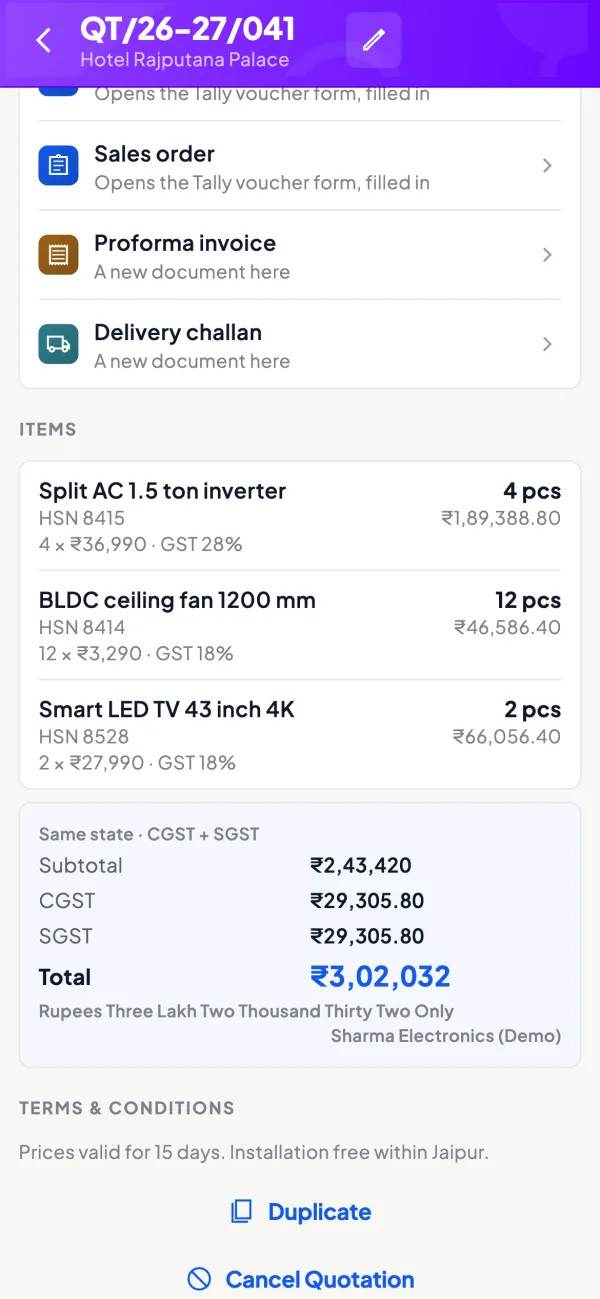
Delivery notes into Tally
Where stock movement is tracked in Tally, a delivery note voucher can be created from the phone through the connector.
See Create Tally vouchers from your phone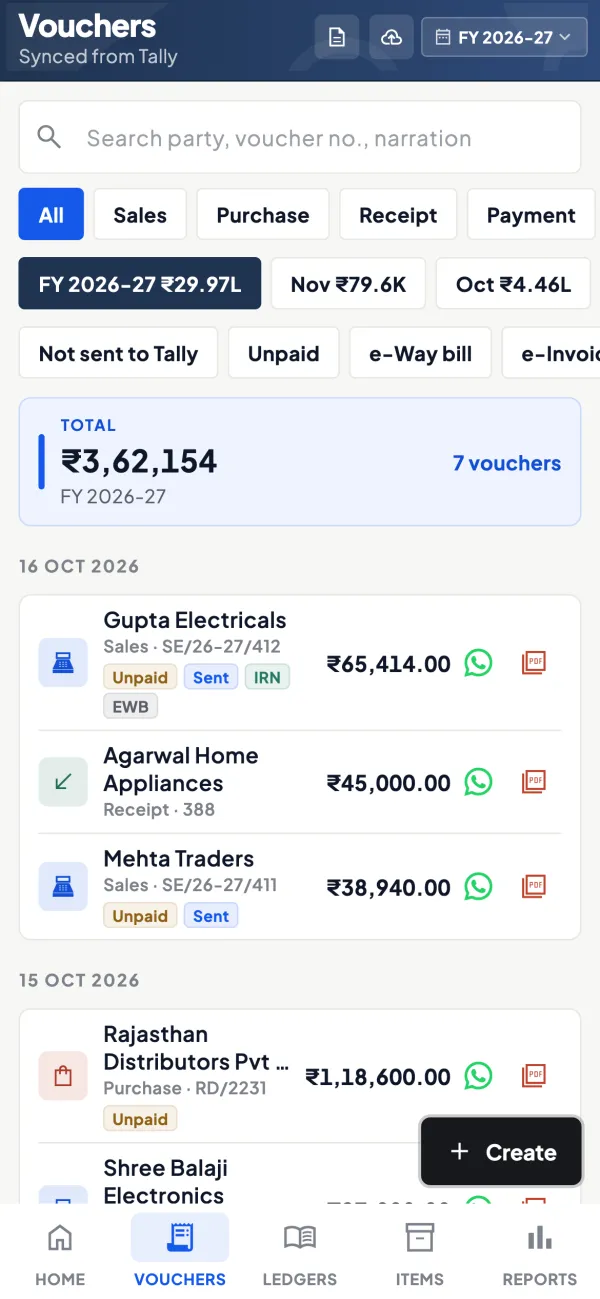
Questions people ask
Is GST charged on a delivery challan?
Can a delivery challan be handwritten?
Does a delivery challan appear in GSTR-1?
Can I send goods to a customer on a challan and invoice later?
Is a delivery challan needed for a branch transfer?
How long can job-work goods stay with the job worker?
Can the challan be shown on the driver's phone?
Does a challan need the buyer's GSTIN?
This page is general information for Indian businesses, not tax, legal or financial advice. Rules and rates change — check the official portals or your CA before acting.