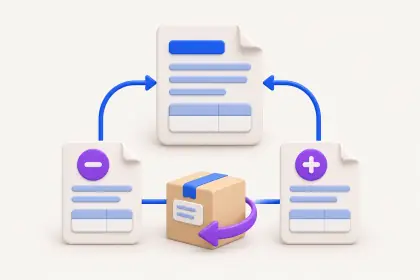
Invoices & documents Invoices
Invoice numbering rules under GST
A GST invoice number must be consecutive, no longer than 16 characters, use only letters, digits, a hyphen or a slash, and be unique within the financial year. Inside those limits you can design the series that suits your business.
- GST-registered businesses
- Multi-branch traders
- Billing staff and accountants
- Businesses starting e-invoicing
- Owners planning a new financial year

On this page 11
What the rule actually says
Rule 46 of the CGST Rules asks for a consecutive serial number, in one or multiple series, containing alphabets, numerals, the hyphen or dash (-) and the slash (/), not exceeding 16 characters, and unique for a financial year. The same rule applies to bills of supply, credit and debit notes, receipt vouchers and delivery challans.
Four points follow from that:
- Length: count every character, including slashes. 16 is the maximum.
- Characters: no spaces, underscores, hashes or brackets.
- Consecutive: numbers run in order within a series; gaps need an explanation, such as a cancelled invoice.
- Unique per financial year: the same number cannot appear twice between 1 April and 31 March. Starting again from 0001 in a new year is allowed.
This is general information, not tax advice.
Sample formats and their length
| Format | Example | Characters | OK? |
|---|---|---|---|
| Prefix/FY/number | INV/25-26/0001 | 14 | Yes |
| Branch-FY-number | JPR-2526-00045 | 14 | Yes |
| Plain number | 2526000123 | 10 | Yes |
| Long prefix | SHREEGANESH/25-26/1 | 19 | No, too long |
| With space | INV 25-26 0001 | 14 | No, spaces not allowed |
| With hash | INV#0001 | 8 | No, # not allowed |
Putting the financial year in the number is not required, but it makes the number unique across years at a glance and helps when a buyer quotes an old bill.
When to use more than one series
Multiple series are allowed and often sensible:
- By branch or godown: JPR/ for Jaipur, AJM/ for Ajmer, so each counter numbers its own bills without clashing.
- By document: INV/ for tax invoices, BOS/ for bills of supply, CN/ for credit notes, DC/ for delivery challans.
- By channel: a separate series for counter sales and for field orders.
Every series you use is reported in the documents-issued table of GSTR-1 with its from and to numbers, the total issued and the number cancelled. Too many series make that table tedious, so keep it to what you need. More on that in what is GSTR-1.
Extra care if you issue e-invoices
If your business is under e-invoicing, the Invoice Registration Portal rejects a document number already used by your GSTIN in the same financial year, even if the earlier IRN was cancelled. Its validation also does not accept numbers starting with 0, a slash or a hyphen, so begin your series with a letter or a non-zero digit. Cancelling and reissuing under the same number is therefore not possible; you issue a fresh number. See e-invoicing and IRN and confirm current validations on the e-invoice portal.
Gaps, cancellations and year change
Cancelled numbers
Do not reuse a cancelled number. Keep the cancelled invoice (all copies, marked cancelled) and report it in the cancelled count in GSTR-1.
Missing numbers
A jump from 0412 to 0415 with no record of 0413 and 0414 invites questions during audit or scrutiny. Find out why: a software glitch, a voided draft or a book left at another counter.
1 April
Reset the series or change the year part of the prefix. If you leave a number like INV/0001 running across years without a year marker, you must not restart it, or you will have two INV/0001 bills in different years that are hard to tell apart.
A quick numbering checklist
- Decide the series before 1 April and write them down.
- Count the characters of the longest number you will reach, not the first one. INV/25-26/9999 is 14; INV/25-26/10000 is 15.
- Use leading zeros so numbers sort correctly.
- Give each counter or salesperson their own series instead of sharing one paper book.
- Check the documents-issued summary every month before filing.
Doing this with Tally and Cashflow OS
In TallyPrime, each voucher type has its own numbering method, prefix and suffix, and you can set numbering to restart from a date such as 1 April. When a salesperson creates a sales voucher from Cashflow OS, the entry goes into Tally through the connector, so it follows the numbering you have set there; you do not maintain a second series in the app. Quotations, proformas, purchase orders and challans made as documents in Cashflow OS carry their own numbers separate from your tax invoices.
Avoid these
Common mistakes
- MistakeLong prefixes that cross 16 charactersDo this instead
Count the characters of the longest number you will reach, not the first one, and shorten the prefix if needed.
- MistakeReusing a cancelled invoice numberDo this instead
Keep the cancelled bill marked cancelled, report it in GSTR-1's cancelled count, and use the next number for the fresh bill.
- MistakeTwo branches sharing one series under the same GSTINDo this instead
Give each branch or counter its own prefix so numbers never clash.
- MistakeRestarting a series with no year markerDo this instead
If you restart each April, put the financial year in the prefix so INV/0001 of two years cannot be confused.
Keep handy
Checklist
Invoice numbering rules under GST — 7 checks. Tick them as you go.
In Cashflow OS
How Cashflow OS helps
Cashflow OS puts your TallyPrime books on every phone in the team. Where it fits this topic:
Phone entries follow Tally's numbering
Sales vouchers created from the app go into TallyPrime through the connector and take the numbering set there, so there is no second invoice series to manage.
See Create Tally vouchers from your phone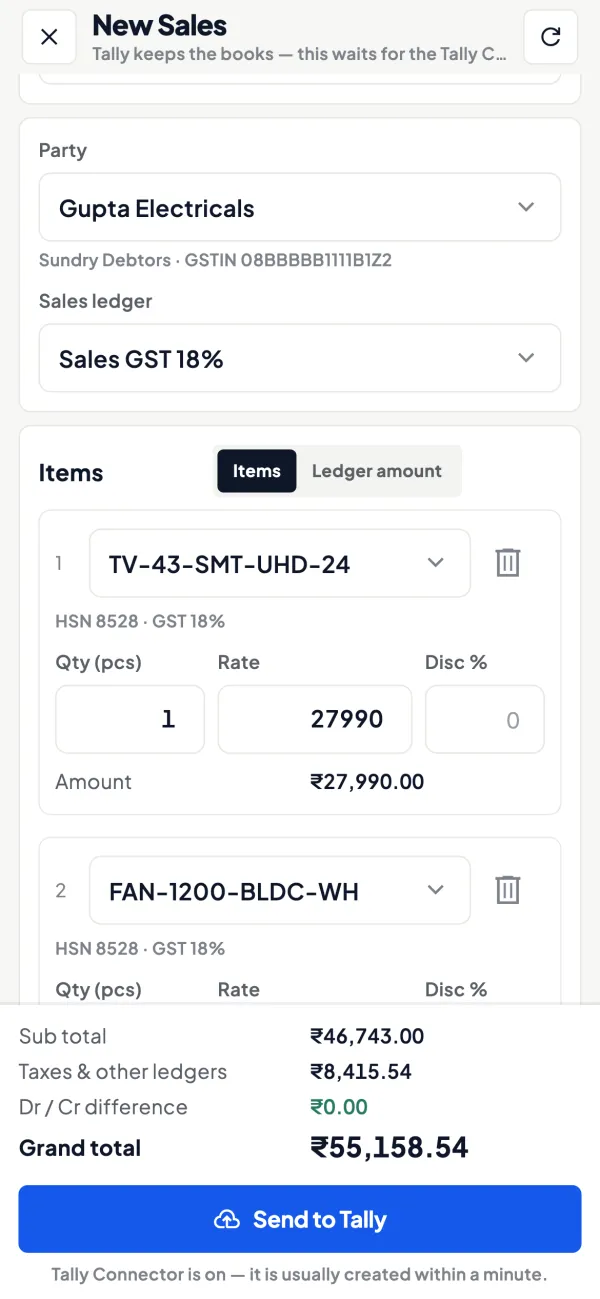
Separate numbers for documents
Quotations, proformas, purchase orders and challans made in Cashflow OS carry their own numbers, kept apart from your tax invoice series.
See Quotations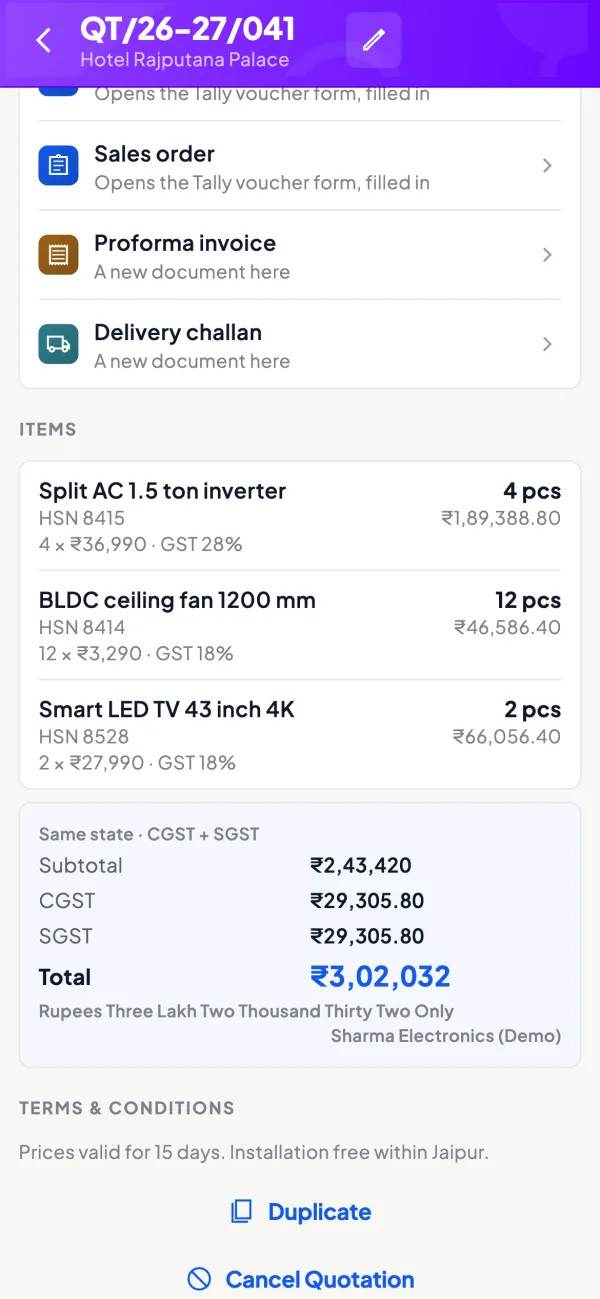
Questions people ask
Can two branches with the same GSTIN use INV/0001?
Are lowercase letters allowed?
Do I have to restart numbering every April?
Do quotations need GST-style numbering?
Do credit notes need their own series?
What if my software skipped a number?
Can I change my invoice prefix in the middle of a year?
Are delivery challans numbered under the same rule?
This page is general information for Indian businesses, not tax, legal or financial advice. Rules and rates change — check the official portals or your CA before acting.