
GST GST basics
GST on advances received
For goods, normal taxpayers do not pay GST when they receive an advance; tax is paid when the invoice is issued. For services, GST is payable on the advance in the month it is received, and adjusted when the invoice comes.
- Service providers and consultants
- Contractors and interior designers
- Traders taking order advances
- Manufacturers building to order
- Accountants filing GSTR-1

On this page 12
The rule in one table
| Goods | Services | |
|---|---|---|
| GST on advance received | Not payable (normal taxpayers) | Payable in the month of receipt |
| Document on receiving advance | Receipt in the books | Receipt voucher |
| GSTR-1 | Nothing at advance stage | Table 11A when received, 11B when adjusted |
| Tax paid when | Invoice is issued | Advance month, balance on invoice |
The relief for goods comes from a notification issued in 2017. For services, the law fixes the time of supply as the earlier of the invoice and the receipt of payment, so an advance triggers tax.
Goods: what to do with an advance
A Moradabad brassware exporter's domestic customer pays ₹2,00,000 in October for an order to be delivered and invoiced in December. No GST is payable in October. Record the money as an advance from the customer in the party ledger. In December, issue the tax invoice for the full value, say ₹4,00,000 + 18% = ₹4,72,000, pay GST of ₹72,000 through December's returns, and adjust the ₹2,00,000 against the invoice. The customer owes ₹2,72,000.
Keep track of advances that sit for months; they are often forgotten, and the customer's statement then shows a wrong balance.
Services: a worked example
An interior design consultancy in Pune receives ₹1,18,000 on 20 October as an advance for a project, with no invoice yet. The rate is 18% and the client is in Maharashtra.
- Treat the receipt as inclusive of tax: tax = ₹1,18,000 × 18 ÷ 118 = ₹18,000; value ₹1,00,000.
- Issue a receipt voucher showing the advance, the tax rate and the tax: CGST ₹9,000 + SGST ₹9,000.
- Pay ₹18,000 through October's GSTR-3B. Report it in October's GSTR-1 Table 11A.
- In November, issue the invoice for ₹3,00,000 + ₹54,000 GST. Report the invoice normally, and show adjustment of the advance in Table 11B for ₹1,00,000.
- November tax payable on this invoice: ₹54,000 − ₹18,000 already paid = ₹36,000.
If the rate is not known at the advance stage, tax is paid at 18%. If the place of supply cannot be determined, the advance is treated as an inter-state supply and IGST paid.
If the deal is cancelled
For services, if the advance was taxed and the work is cancelled before an invoice, issue a refund voucher when you return the money, and adjust the tax already paid through the advance adjustment table in the return for the month of refund. Without the refund voucher, there is no document to support reducing your liability.
For goods, there was no tax at advance stage, so a refund is simply a payment back to the customer.
Small excess receipts
Customers often pay a little more than the invoice, for example rounding up. Where a supplier receives up to ₹1,000 more than the invoice amount, the supplier can treat the date of the invoice for that excess as the time of supply, which avoids separate advance tax entries for tiny amounts. Larger excesses are treated like any other advance for services.
Advances in the books: a simple routine
- Record every advance against the customer's own ledger, never in a general "advances" account with no name.
- For services, mark advance receipts so your accountant can total the tax payable on them each month.
- When the invoice is raised, link the advance to it so the outstanding shows only the balance.
- At month end, list advances older than 90 days. Each one is either a delayed order, a cancelled deal needing a refund, or an entry posted to the wrong party.
This keeps customer statements correct and makes the Table 11 figures in GSTR-1 easy to pull out.
Common mistakes
- Paying GST on advances for goods, which is not required for normal taxpayers, and then forgetting to adjust it.
- Not paying GST on advances for services, then getting a notice when bank receipts are compared with returns.
- Adjusting advances in GSTR-3B but not reporting Tables 11A and 11B in GSTR-1, so the two returns differ. See GSTR-1 vs GSTR-3B differences.
- Treating a proforma invoice as the tax document. A proforma invoice asks for payment but does not by itself discharge GST.
This is general information, not tax advice.
Advances with Tally and Cashflow OS
In TallyPrime, advances are usually recorded as receipt vouchers against the party, and for services with the advance tax details. Cashflow OS shows these receipts and the party's ledger with bill-wise details on the phone, so a salesperson or owner can see which customers have paid ahead and how much is unadjusted. Cashflow OS can also create a proforma invoice to request the advance, and receipt vouchers can be posted to Tally from the app once writing is switched on.
Avoid these
Common mistakes
- MistakePaying GST on advances for goodsDo this instead
Normal taxpayers need not pay GST on goods advances. Record the money against the party and pay tax when you invoice.
- MistakeNot paying GST on advances for servicesDo this instead
Treat the receipt as tax-inclusive, issue a receipt voucher and pay the GST in that month's GSTR-3B.
- MistakeAdjusting advances in GSTR-3B but not in GSTR-1Do this instead
Report Tables 11A and 11B in GSTR-1 as well, so the two returns agree.
- MistakeParking advances in a general account with no partyDo this instead
Record every advance in the customer's own ledger and link it to the invoice when raised.
Keep handy
Checklist
GST on advances received — 7 checks. Tick them as you go.
In Cashflow OS
How Cashflow OS helps
Cashflow OS puts your TallyPrime books on every phone in the team. Where it fits this topic:
See who has paid ahead
Cashflow OS shows party ledgers with bill-wise detail from Tally, so the owner or salesperson can see which customers have advances and how much is still unadjusted.
See Party ledger statements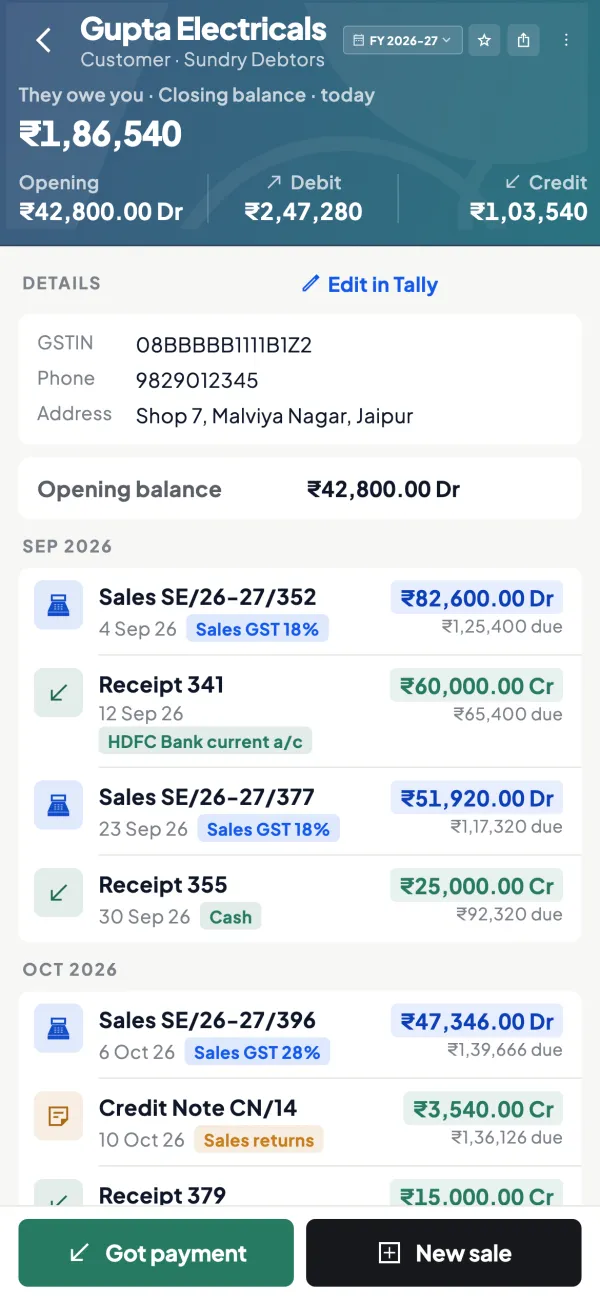
Ask for the advance, record the receipt
A proforma invoice made in Cashflow OS requests the advance with your bank and UPI details. With writing back on, the receipt voucher can be posted to Tally from the app.
See Proforma invoices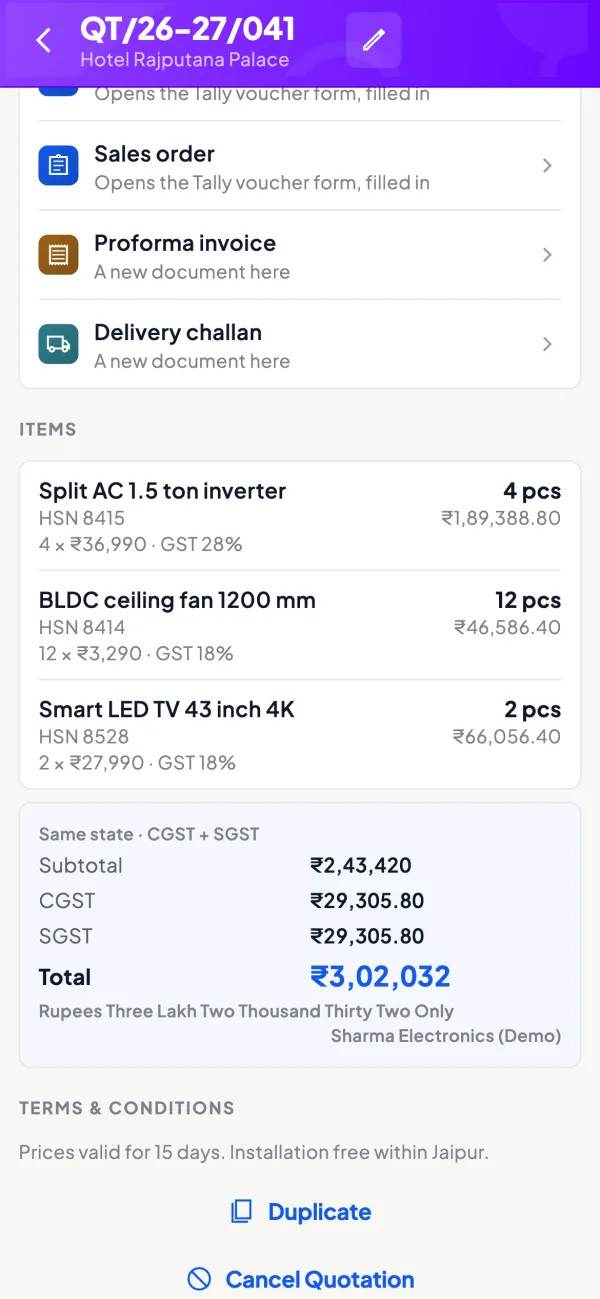
Questions people ask
Is GST payable on advance received for goods?
Is GST payable on advance received for services?
What rate applies if the service is not yet decided?
What is a receipt voucher under GST?
How do I work out the tax on a service advance?
What if the place of supply is not known when the advance comes in?
Does a small excess payment over the invoice count as an advance?
Is a proforma invoice enough when I take an advance?
This page is general information for Indian businesses, not tax, legal or financial advice. Rules and rates change — check the official portals or your CA before acting.



