
GST GST returns
GSTR-1 vs GSTR-3B: what is different and why they must match
GSTR-1 is the detailed list of your sales; GSTR-3B is the summary where you pay tax. The tax on sales in both should be the same for the period, and the portal flags you when it is not.
- GST-registered businesses
- Accountants and tax practitioners
- Distributors with credit notes
- Service providers taking advances
- Owners checking returns

On this page 11
The two returns side by side
| GSTR-1 | GSTR-3B | |
|---|---|---|
| Purpose | Report sales | Declare summary, claim ITC, pay tax |
| Level of detail | Invoice-wise for B2B, summary for small B2C | Totals only |
| Purchases and ITC | Not reported | Reported in Table 4 |
| Tax payment | None | Yes, credit and cash |
| Monthly due date | 11th | 20th |
| Who relies on it | Your buyers, for their GSTR-2B | Government, for tax collected |
For the basics of each, see what is GSTR-1 and what is GSTR-3B.
Why the figures drift apart
Most gaps come from a handful of causes:
- Credit notes shown in GSTR-1 Table 9B but not reduced in GSTR-3B, or the other way round.
- Invoices added after GSTR-1 was filed, for example a sales bill entered late, then included in GSTR-3B but left for next month's GSTR-1.
- Amendments to earlier invoices that change tax in the current period's GSTR-1.
- Advances for services taxed in GSTR-3B but not shown in Table 11 of GSTR-1.
- Typing totals by hand into GSTR-3B instead of using the pre-filled figures.
- Wrong tax head: an invoice booked as CGST/SGST in the books but IGST in GSTR-1 because the state was corrected only on the portal.
A worked reconciliation
A Pune distributor finds this for November:
| Item | Tax amount |
|---|---|
| Tax in GSTR-1 (invoices less credit notes) | ₹2,46,600 |
| Tax declared in GSTR-3B Table 3.1(a) | ₹2,55,600 |
| Difference | ₹9,000 |
Tracing it: one credit note of ₹50,000 taxable at 18% (₹9,000 tax) was uploaded in GSTR-1 but the accountant typed GSTR-3B from the sales register, which had the credit note dated 1 December. The fix: correct the date in the books so that both returns agree, or carry the reduction in December's GSTR-3B. Here GSTR-3B overpaid ₹9,000, which can be adjusted in a later GSTR-3B within the law's time limits.
If the gap had gone the other way, with GSTR-3B lower than GSTR-1, it would mean tax short-paid, and interest would apply on the shortfall.
Monthly reconciliation method
- Lock the month: no back-dated sales or credit notes after you start.
- Take three totals: books (sales register plus credit and debit notes), GSTR-1 summary, and GSTR-3B draft.
- Compare by tax head: IGST, CGST, SGST, cess. A gap in one head points to a state error.
- Compare by table: B2B, B2C, exports, credit notes. A gap in one table points to a classification error.
- List every difference with the invoice number and reason, and decide in which period it will be corrected.
- Keep the working sheet. It saves hours at annual return time.
The purchase side: GSTR-2B and Table 4
GSTR-1 holds no purchase data, so the second reconciliation every month is between your own purchase register, your GSTR-2B, and the ITC claimed in GSTR-3B Table 4. Here too the system compares figures: if ITC claimed in GSTR-3B is more than what GSTR-2B supports, beyond a tolerance, an intimation can be issued asking you to reverse or explain the excess.
A simple rule keeps you safe: ITC claimed should be the eligible part of GSTR-2B, plus any credit genuinely carried forward from earlier months that has now appeared, minus reversals. Keep a running list of bills claimed in a later month, with the month they were booked and the month they were claimed. At year end, this list explains most of the difference between your books and the annual return.
What the portal does about mismatches
The GST system compares the two returns. If tax declared in GSTR-3B is lower than the tax in GSTR-1 beyond a tolerance, you can get a system intimation asking you to pay the difference or explain it, and further filing of GSTR-1 can be blocked until you respond. The auto-filled sales in GSTR-3B are also being locked more tightly to GSTR-1 and GSTR-1A, so corrections are expected at the GSTR-1 stage. Check current rules on gst.gov.in, because this area has changed several times.
This is general information, not tax advice.
Spotting gaps early with Cashflow OS
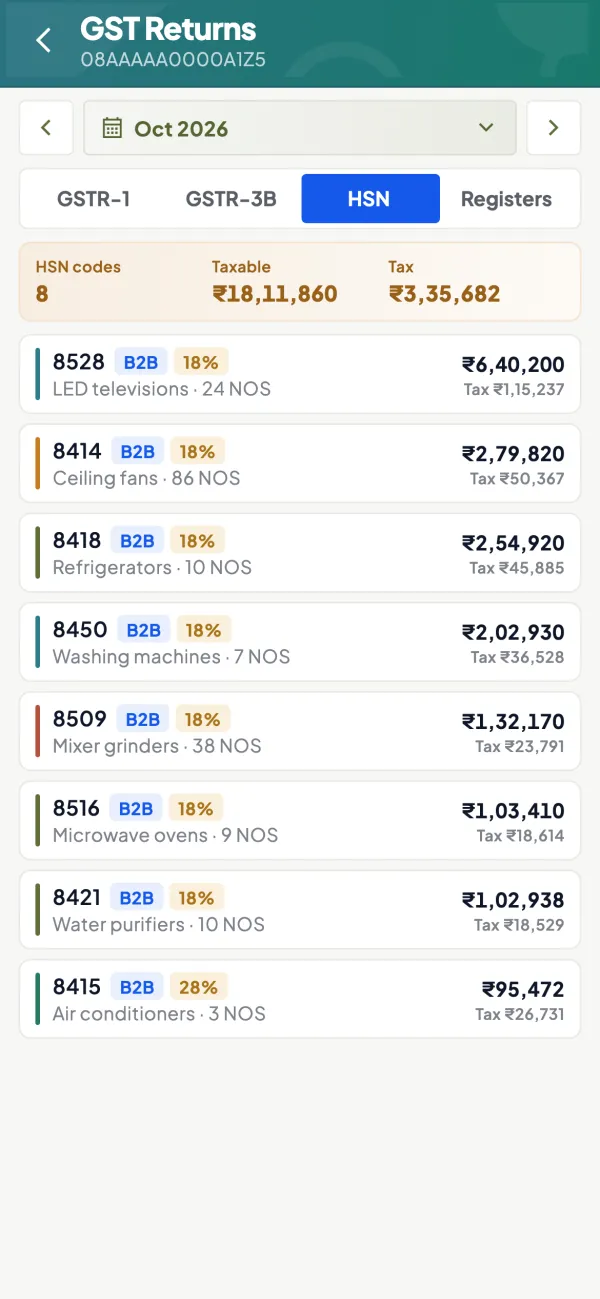
Because Cashflow OS builds both the GSTR-1 view and the GSTR-3B view from the same TallyPrime data, you can open them side by side for the same period and see where they differ. GSTR-1 tiles open the bill-wise list, so a stray credit note or a party with the wrong state shows up quickly. Corrections are made in Tally; filing stays on the GST portal.
Avoid these
Common mistakes
- MistakeTyping GSTR-3B totals by hand from the sales registerDo this instead
Use the pre-filled figures from GSTR-1 and check them against the books instead of retyping.
- MistakeCredit notes in GSTR-1 but not reduced in GSTR-3BDo this instead
Make sure each credit note is dated and reported in the same period in both returns.
- MistakeBack-dating sales after GSTR-1 is filedDo this instead
Lock the month before reconciling; add late bills through the next GSTR-1 or GSTR-1A and match GSTR-3B.
- MistakeCorrecting the state only on the portalDo this instead
Fix the party's state in the books too, so the tax head is the same in books and returns.
Keep handy
Checklist
GSTR-1 vs GSTR-3B: what is different and why they must match — 7 checks. Tick them as you go.
In Cashflow OS
How Cashflow OS helps
Cashflow OS puts your TallyPrime books on every phone in the team. Where it fits this topic:
Both views from the same data
Cashflow OS builds the GSTR-1 and GSTR-3B views from the same TallyPrime data, so you can open them for the same period and see where they differ.
See GST reports from your Tally data
Trace the gap bill by bill
GSTR-1 tiles open the bill-wise list, so a stray credit note or a party with the wrong state shows up quickly. Corrections are made in Tally; filing stays on the portal.
Questions people ask
Should GSTR-1 and GSTR-3B always match exactly?
Which return should I fix if they differ?
Does GSTR-1 affect my input tax credit?
What are the monthly due dates for GSTR-1 and GSTR-3B?
What happens if GSTR-3B tax is lower than GSTR-1?
Can I simply edit GSTR-3B to match my books?
Is overpaid tax in GSTR-3B lost?
How often should I reconcile the two returns?
This page is general information for Indian businesses, not tax, legal or financial advice. Rules and rates change — check the official portals or your CA before acting.



