GST GST for services
GST for service and repair businesses
A repair business supplies two things: the parts it fits and the work it does. How you bill them decides the GST rate, and services have their own rules on invoice timing and advances that goods sellers never deal with.
- Repair and service centres
- AC, appliance and electronics repair
- Vehicle workshops
- AMC providers
- Authorised brand service centres

On this page 11
Parts and labour: one supply or two?
When parts and labour are separately priced on the invoice, they are generally treated as separate supplies: parts at the goods' rate under their HSN, labour at the service rate under the SAC for repair and maintenance (heading 9987). When you charge a single price for a repair that includes parts, it is likely a composite supply, taxed at the rate of the principal supply, which is usually the service.
Example. An AC service centre replaces a compressor and repairs the unit.
| Line | Value | GST rate | GST |
|---|---|---|---|
| Compressor (goods) | ₹8,500 | Goods rate (say 18%) | ₹1,530 |
| Repair labour (service) | ₹1,500 | Service rate (say 18%) | ₹270 |
| Total | ₹10,000 | ₹1,800 |
Here both rates are the same, so the split does not change the tax. Where parts carry 5% and labour 18%, itemising matters. Confirm the current rates for your HSN and SAC on cbic-gst.gov.in.
When to issue the invoice
- For services, the tax invoice must be issued within 30 days of completing the service.
- For parts sold on their own, at or before delivery.
- Time of supply for services is generally the earlier of invoice date and payment date, so an advance can fix the tax point.
A practical rule: close the job card and raise the invoice the day the item is handed back. See job card and service invoice.
Advances
GST on advances for goods is not payable for most taxpayers, but GST on advances for services is. If a customer pays ₹5,000 in advance for a repair, issue a receipt voucher and pay GST on that advance in the month received. When the final invoice is raised, adjust the tax already paid. Details in GST on advances received.
Example. Advance ₹5,900 received for a repair at 18%: taxable value ₹5,000, GST ₹900 paid in the month of receipt. Final bill next month ₹11,800 (taxable ₹10,000, GST ₹1,800): pay only the balance ₹900 that month.
Annual maintenance contracts
An AMC is a service supplied over a period. If billed upfront, GST is due on the invoice. If billed in instalments (quarterly or monthly), each instalment is due on its invoice or payment. Parts included 'free' in a comprehensive AMC are part of the AMC price; parts charged extra go on separate lines. More on structuring in annual maintenance contracts.
Warranty repairs and replacements
Under warranty, the customer pays nothing, so there is no supply to the customer. The service centre usually bills the manufacturer or brand for the labour and sometimes for the parts, and charges GST on that bill. Parts supplied by the brand for free replacement and replacements under warranty have specific clarifications on ITC and tax. The treatment depends on who supplies the part and whether anyone pays for it, so set it up once with your CA. This is general information, not tax advice.
Common mistakes
- Billing everything as 'service charges' at one rate when parts carry a different rate.
- Not paying GST on advances for services.
- Jobs completed but invoiced weeks later, after the 30-day limit.
- Free replacements with no paper trail, so stock and ITC do not reconcile.
- Using HSN codes for labour instead of SAC.
Service jobs in Cashflow OS
Cashflow OS has a service jobs module for repair and pickup jobs. Staff open a job, add items or service charges as the work progresses, and close and invoice it, with the invoice posted to TallyPrime when writing back is switched on; Tally validates it and GST is worked out from the item and the party's state. Parts and labour stay separate lines because they are separate items. The jobs, invoices and GSTR-1 view are all available on the phone.
Avoid these
Common mistakes
- MistakeBilling parts and labour together as 'service charges'Do this instead
Put parts on their own lines with HSN and labour with the SAC, so each carries its correct rate.
- MistakeSkipping GST on repair advancesDo this instead
Issue a receipt voucher, pay GST on the advance in that month's GSTR-3B, and adjust it when the final invoice is raised.
- MistakeInvoicing finished jobs weeks after handoverDo this instead
Close the job card and raise the invoice the day the item goes back; the 30-day limit for services is easy to miss.
- MistakeWarranty replacements with no paperworkDo this instead
Record parts used under warranty and bill the brand where it pays, so stock and ITC reconcile. Set the treatment up with your CA.
Keep handy
Checklist
GST for service and repair businesses — 7 checks. Tick them as you go.
In Cashflow OS
How Cashflow OS helps
Cashflow OS puts your TallyPrime books on every phone in the team. Where it fits this topic:
Jobs from open to invoice
The service jobs module lets staff open a repair job, add items or service charges as work goes on, then close and invoice it. With writing back on, the invoice is posted to Tally.
See Service jobs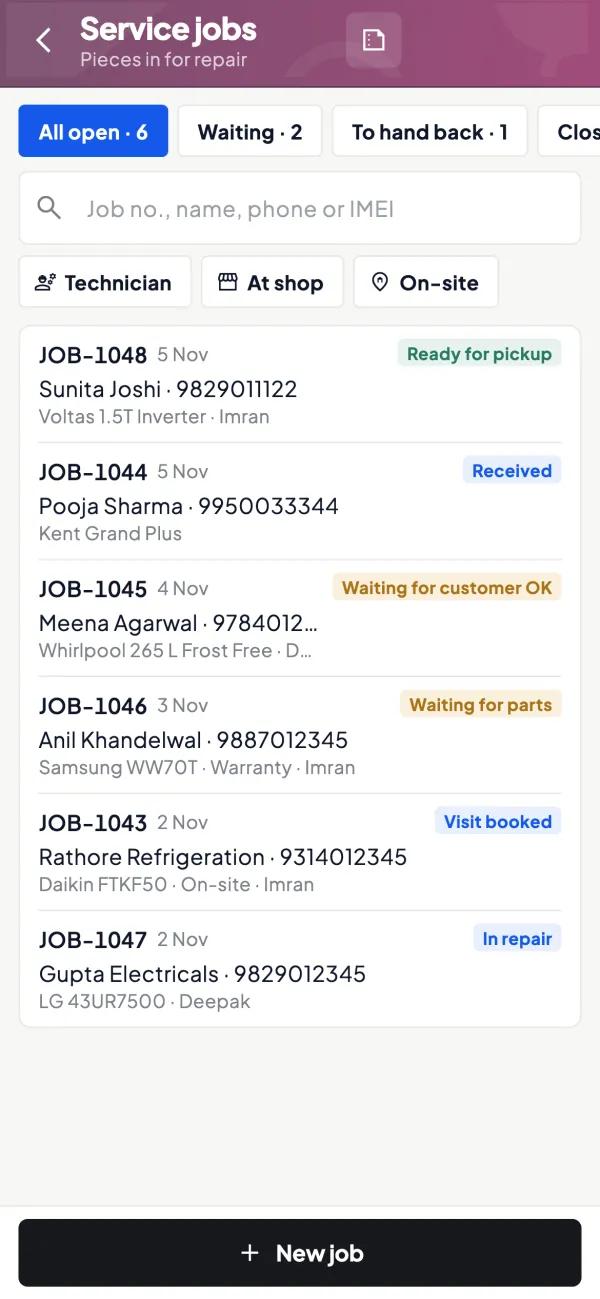
Check the month's GST on the phone
The GSTR-1 view prepared from your Tally data shows the month's invoices, with bill-wise and HSN-wise detail, so wrong codes or rates show up before filing.
See GST reports from your Tally data
Questions people ask
What is the SAC code for repair services?
Do I charge GST on advances for repair work?
Should parts and labour be billed separately?
Is GST charged on pickup and drop charges?
When must a repair business register for GST?
How soon must a service invoice be issued?
Is GST charged on an AMC paid upfront for the year?
Do I charge the customer GST on a free warranty repair?
This page is general information for Indian businesses, not tax, legal or financial advice. Rules and rates change — check the official portals or your CA before acting.