Running the business Trade schemes
Managing dealer schemes and discounts
Schemes and discounts drive dealer sales, but they are also where margin quietly leaks: wrong slabs applied, schemes claimed twice, credit notes never issued. The fix is to write every scheme down, apply it on the bill where possible, and settle the rest on a fixed calendar.
- Distributors and stockists
- Manufacturers with dealer networks
- Sales managers
- Accountants issuing credit notes
- Owners reviewing margins

On this page 11
Common types of dealer schemes
| Scheme | How it works | Usually settled |
|---|---|---|
| Trade discount | Fixed % off list price by dealer type | On the invoice |
| Quantity slab | Higher discount above a quantity or value | On the invoice |
| Free goods | Buy 10, get 1 free | On the invoice as a separate line |
| Target / turnover discount | % back if monthly or quarterly target is met | Credit note after the period |
| Cash discount | % off for paying within a few days | On receipt, by credit note |
| Display or gift scheme | Gift or payment for shelf space, trip on target | After the period |
Where the money leaks
- A salesperson promises a rate that is not in any written scheme.
- Slab discounts applied on order value before returns, so the dealer keeps the slab after returning goods.
- Target schemes calculated by hand from a spreadsheet, with errors that nobody checks.
- Cash discount allowed even though payment came late.
- Old schemes never formally closed, so dealers keep claiming them.
- Credit notes not issued on time, so the dealer deducts the amount from payment, and your ledger and theirs never match.
Worked example: layered discounts
List price of a ceiling fan: ₹2,400. Dealer type A gets 12% trade discount. Orders above 50 pieces get an extra 3% slab. The scheme says the slab is applied after the trade discount.
- After trade discount: 2,400 × 0.88 = ₹2,112
- After slab: 2,112 × 0.97 = ₹2,048.64
Note that 12% plus 3% layered is about 14.6% off list, not 15%. Write down whether discounts are layered or added, or you will have disputes on every bill.
Now the effect on your margin. If your landed cost is ₹1,850, your margin falls from ₹262 per piece at the trade rate to ₹198.64 with the slab, a drop of about 24% in rupee margin for a 3% extra discount. See gross margin vs markup for how to check this before announcing a scheme.
A scheme control checklist
- Every scheme has a written circular: code, products, dealer types, slabs, start and end dates, how it is settled.
- Trade and slab discounts go into a price list so they apply automatically on bills, not from memory.
- Target schemes are calculated from net sales after returns and credit notes.
- Cash discount is given only when payment is received within the stated days; check the receipt date, not the dealer's claim.
- Settlement credit notes are issued within a fixed number of days after the period closes.
- A monthly report shows total scheme cost as a % of sales, by scheme.
- Expired schemes are closed in writing and removed from the price list.
GST points to keep in mind
Discounts shown on the invoice reduce the taxable value. Discounts given after the sale, such as target schemes, need conditions to be met to reduce GST, and are usually passed by credit note. Free goods also need care. Our guide on GST on discounts and schemes explains these points; confirm your structure with your CA. This is general information, not tax advice.
Judging whether a scheme worked
After each scheme, compare three things with the same period last year or the period before the scheme:
- Extra sales: did volume rise, and by how much, for the scheme items?
- Scheme cost: total discounts, free goods at cost and credit notes issued.
- Hangover: did sales dip after the scheme because dealers stocked up early?
Example: a quarterly target scheme cost ₹2,40,000 in credit notes. Scheme items sold ₹38,00,000 against ₹30,00,000 a year earlier. At a 12% gross margin, the extra ₹8,00,000 of sales earned about ₹96,000 of gross profit, less than the scheme cost. Unless the scheme won new dealers or cleared stock you needed to clear, it lost money.
Applying schemes with Tally and Cashflow OS
Cashflow OS has price lists with dealer types such as A, B and C and layered discount rules, which fill rates automatically in quotations, sales orders and vouchers. Orders can be posted to TallyPrime with the right rates and GST, and credit notes can be created from the phone or web. That removes much of the manual rate-setting where leaks start. See price lists.
Avoid these
Common mistakes
- MistakeSalespeople promising rates no scheme allowsDo this instead
Keep approved rates in a price list and make anything lower need approval.
- MistakeWorking out target schemes on sales before returnsDo this instead
Calculate targets on net sales after returns and credit notes.
- MistakeLate or missing settlement credit notesDo this instead
Issue them within a fixed number of days after the period closes, so the dealer's ledger and yours match.
- MistakeOld schemes never formally closedDo this instead
Close expired schemes in writing and remove them from the price list.
Keep handy
Checklist
Managing dealer schemes and discounts — 8 checks. Tick them as you go.
In Cashflow OS
How Cashflow OS helps
Cashflow OS puts your TallyPrime books on every phone in the team. Where it fits this topic:
Layered discounts filled automatically
Price lists with dealer types such as A, B and C and layered discount rules fill rates automatically in quotations, sales orders and vouchers.
See Price lists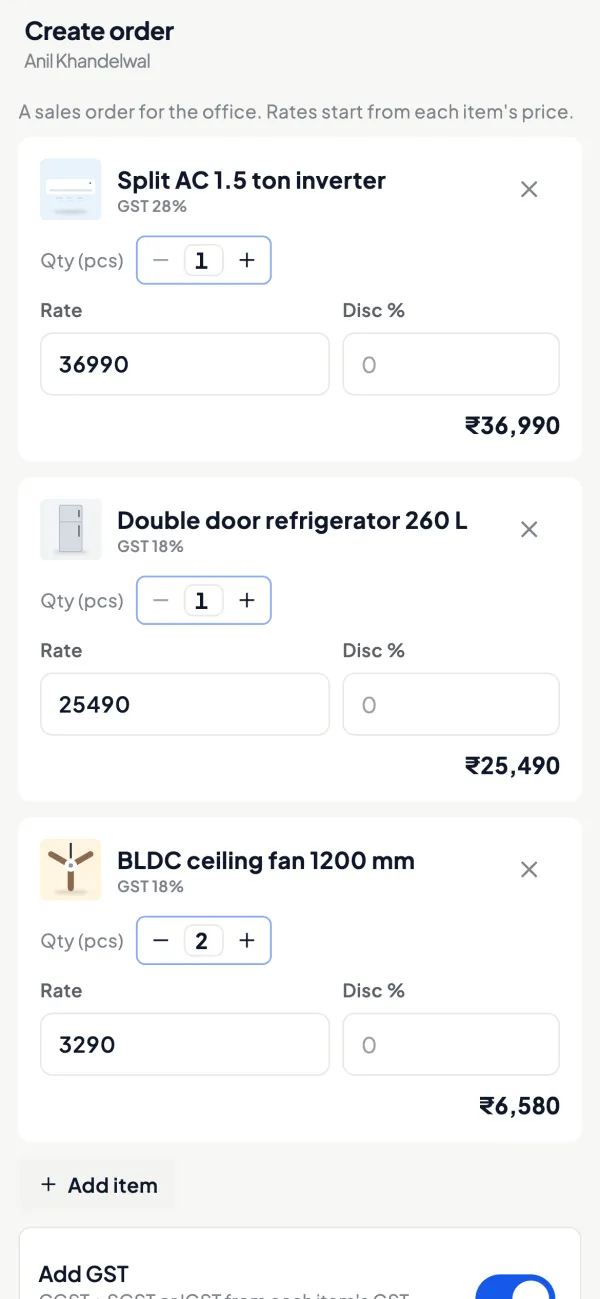
Orders and credit notes into Tally
Orders post to TallyPrime with the right rates and GST, and settlement credit notes can be created from the phone or web once writing back is on.
See Sales orders to Tally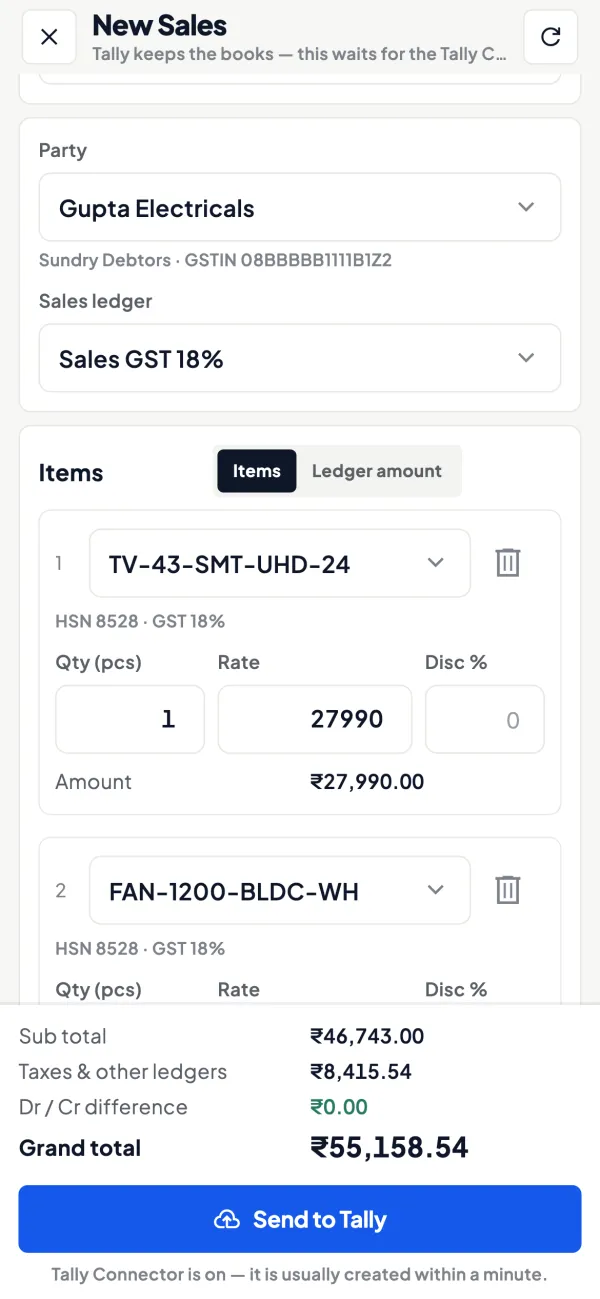
Questions people ask
Should scheme discounts be given on the invoice or by credit note later?
How do I stop salespeople offering unofficial discounts?
Are layered discounts the same as adding the percentages?
Are free goods under a scheme taxable?
How do I work out the true cost of a scheme?
Should every dealer get the same scheme?
What is a turnover discount?
What if a dealer deducts a scheme amount from payment?
This page is general information for Indian businesses, not tax, legal or financial advice. Rules and rates change — check the official portals or your CA before acting.