Electricals
Electrical goods distributors: wires, switches, schemes and beats
Wires, cables, switches, MCBs and accessories move through distributors to retailers and electricians. It is a high-SKU, scheme-heavy trade where field visits and retailer credit drive the business.
- Dealer rates fill themselves
- Beat orders straight to Tally
- Retailer dues bill by bill
- Works on top of your Tally
Start free trialBook a free demo
Works with your TallyPrime14-day free trialJaipur team, call +91 70738 53555

Built for electrical goods distributors
Who it’s for
- Wire and cable distributorsCoils by size and colour, with rates that follow copper
- Switchgear and MCB distributorsPoles, ratings and DBs across several brands
- Modular switch dealersPlates, finishes and colours for every series
- Electrical retail countersElectricians, homeowners and small contractors on credit
- Project and contractor suppliersBOQ quotations and phased deliveries to sites
- Stockists in smaller townsRetailers served on a weekly beat by two or three salesmen
- Conduit and accessories wholesalersLengths, boxes and pieces in high volume, low value
Pain → fix
The problems we fix
The everyday headaches of electrical goods distributors, and what changes when the books are on every phone.
- The problemEach retailer gets a different rate, from memory
Salesmen quote last month's rate, and small unapproved discounts eat the margin.
With Cashflow OSDealer types A, B, C fill the rate on every orderPrice lists with layered discount rules put the right rate on orders and documents, so nobody types it.
See how it works - The problemOrders written in a diary, phoned in at night
Items get missed, ratings get mixed up and the bill goes out a day late.
With Cashflow OSSalesman books the order on the phone, Tally gets itOrders from the staff app post to Tally as sales orders through the connector, with your approval first if you want it.
See how it works - The problemRetailers pay the newest bill and leave the oldest
The total looks manageable while three-month-old bills keep growing underneath.
With Cashflow OSBill-wise dues with ageing for every retailerOutstanding comes from Tally's bill-wise details, so you can chase specific bills, oldest first.
See how it works - The problemNo idea which shops the salesman actually visited
Beat days slip and you find out only when a retailer's orders stop.
With Cashflow OSRoute plans and visit check-in with locationAreas, route plans and recommended visits, with GPS check-in, notes and photos for every visit.
See how it works - The problemProject rates typed in Word, then lost by delivery
When copper moves between quotation and delivery, nobody can find which rate was promised.
With Cashflow OSQuotation with your letterhead, converted to an orderMake the quotation in the app, share the PDF on WhatsApp, then convert it into a sales order or a Tally invoice.
See how it works - The problemCollections reported days after the money came
Cash sits with the salesman while the retailer's ledger still shows the bill unpaid.
With Cashflow OSCollections recorded on the beat, seen the same dayThe salesman records what he collected from each retailer, and the owner sees it in the app.
See how it works
Features
How Cashflow OS works for electrical goods distributors
Price lists for A, B and C retailers
How it works. Set dealer types and layered discount rules once, for example a brand's list rate less an extra discount for A-type retailers. The rate fills on orders, quotations and vouchers.
- No rate typed by hand at the shop
- Same rate on the order, the quotation and the bill
- Change the rules when a brand revises its price list
In practiceSharma Electricals in Jaipur is an A-type retailer, so ten coils of 1.5 sq mm wire fill at the A rate on Ramesh's order without a call to the office.
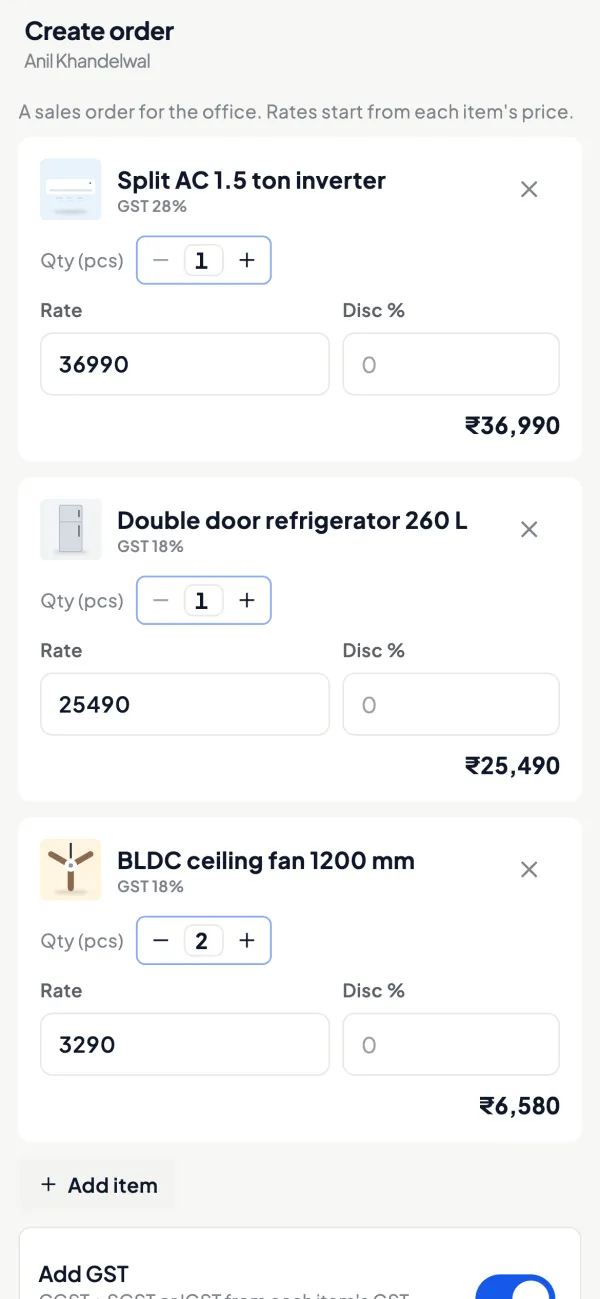
A Today screen for every salesman
How it works. Each salesperson opens the staff app to the day's customers, visits, orders and collections. They see items and their own retailers, not your accounts.
- The day's beat listed in one place
- Orders with lines and GST from the shop counter
- Your margins and books stay private
In practiceOn the Tuesday Sanganer beat, Vikas sees the retailers he has to attend, books orders for MCBs and modular plates, and records ₹18,500 collected from two shops.
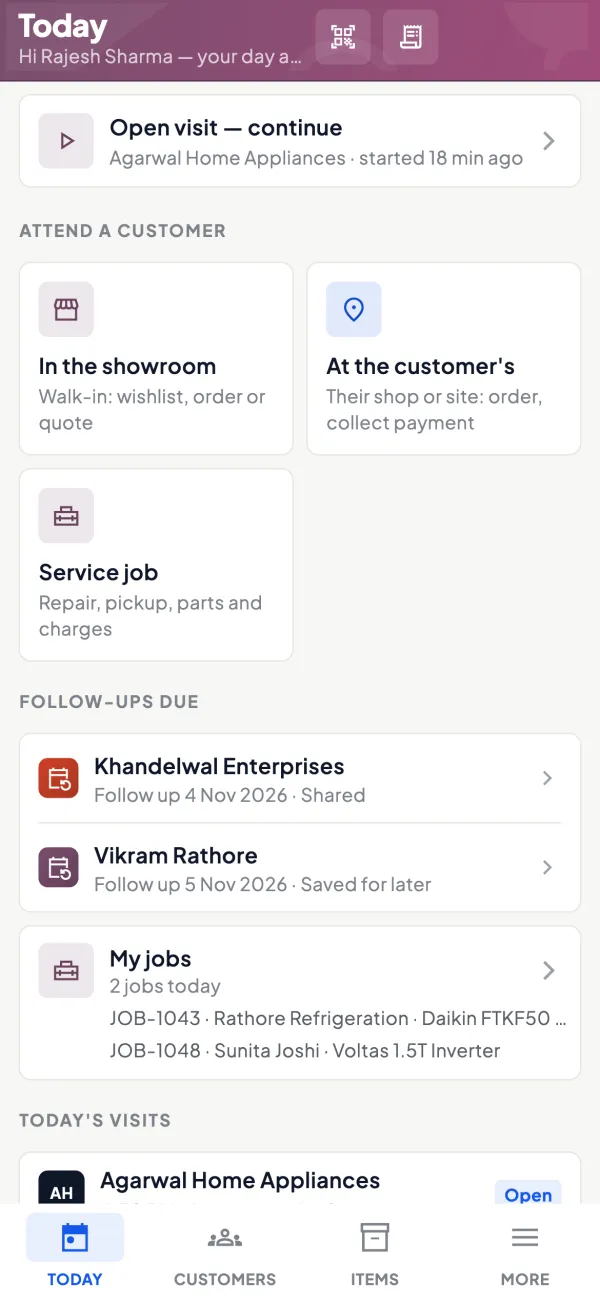
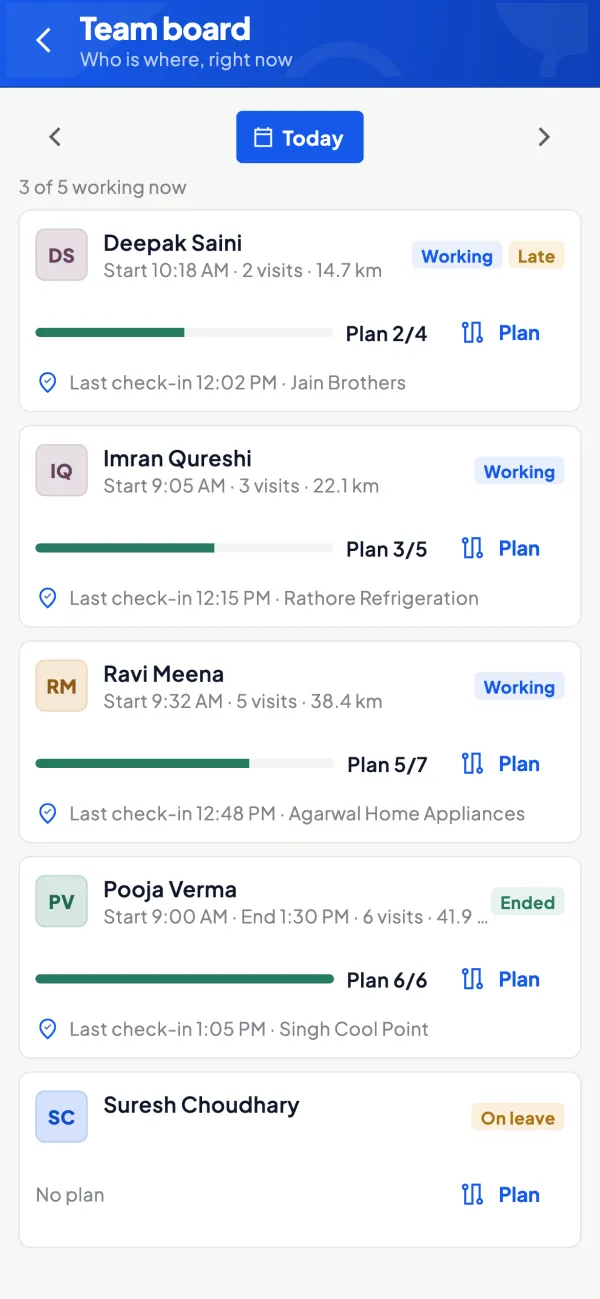
Retailer visits on a map
How it works. Retailer locations, areas and route plans sit on a map. Visits check in with GPS and a geofence, with notes and shelf photos.
- See which retailers were visited and when
- Recommended visits so quiet shops are not forgotten
- Attendance and performance view for the owner
In practiceThe owner sees that Kalyan Electric Stores has not been visited in three weeks and adds it to Friday's route for Deepak.
Outstanding that shows the old bills
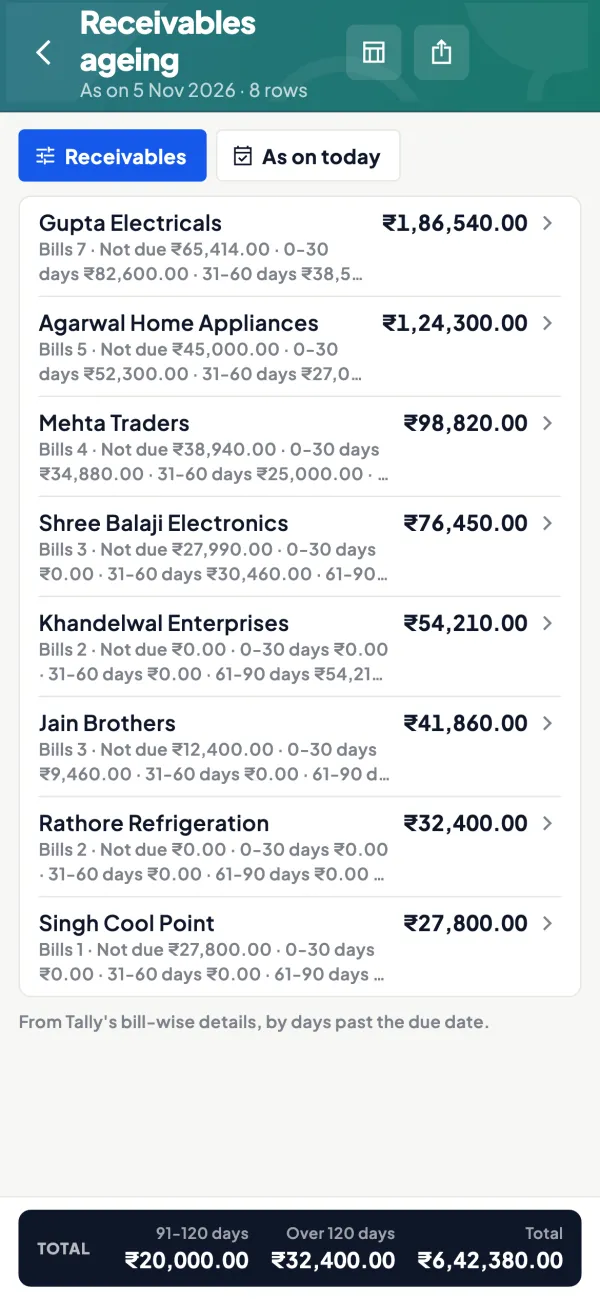
How it works. Bill-wise receivables with ageing come from Tally, retailer by retailer. Send a party statement on WhatsApp when a retailer disputes the balance.
- Oldest bills first, not just a total
- Ageing buckets to decide who gets more credit
- Statement on WhatsApp in Tally's format or Hindi
In practiceGupta Electric owes ₹1,86,400, of which ₹42,000 dates from August. The salesman asks for the August bills before booking a new order.
Quotations for contractors and projects
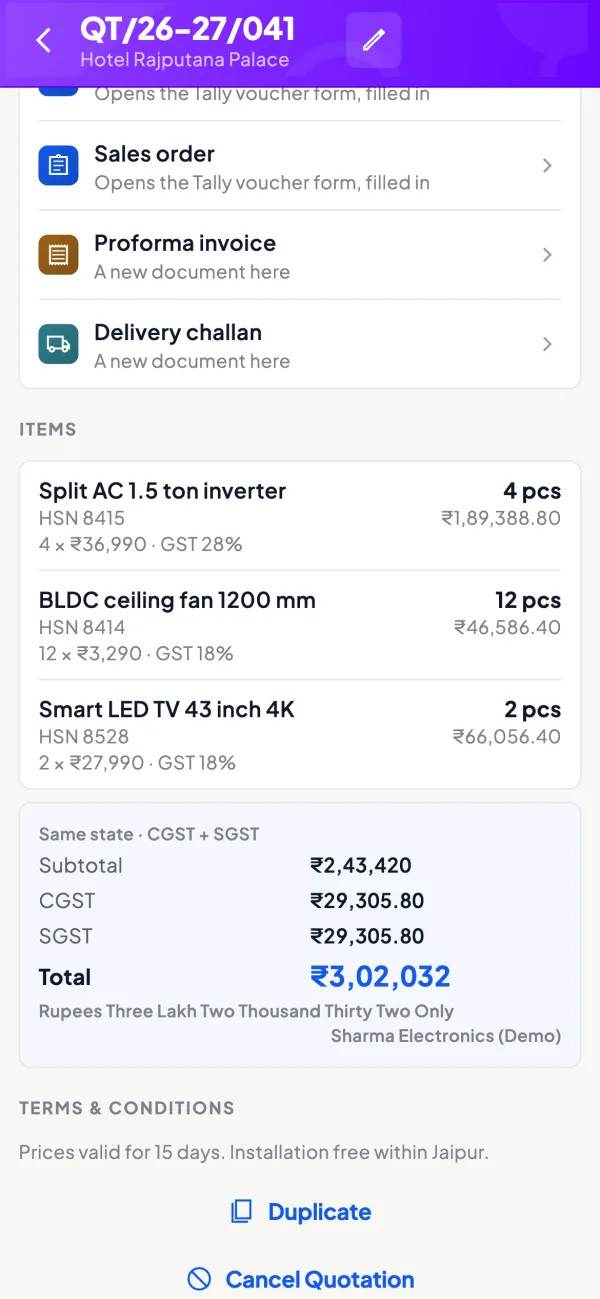
How it works. Build a brand-wise quotation with your logo, bank and UPI details and a validity date, share it as a PDF, and convert it when the contractor confirms.
- Validity date protects you when copper moves
- Converts to a sales order or Tally invoice
- No retyping between quote and bill
In practiceA ₹6,40,000 quotation for wires, DBs and switches for a 40-flat society goes on WhatsApp valid for 15 days, and becomes a sales order once approved.
Know your trade
A guide for electrical goods distributors
How the business works, where money gets stuck, and the GST points to watch.
The electrical goods chain
Brands of wires and cables, modular switches, MCBs and distribution boards, conduits, fans and lighting appoint distributors for a territory. Distributors stock the range, sell to retailers (electrical shops), institutional buyers and contractors, and sometimes directly to large electricians. Retailers sell to homeowners and electricians at the counter.
Distributors usually pay the brand within a fixed credit period and receive quarterly targets, cash discounts and product schemes. Retailers expect 15 to 45 days of credit, depending on the market and relationship. Electricians are the influencers: they decide the brand of switch or wire in most homes, and brands run loyalty programmes for them.
Stock: ratings, colours and coils
The same switch comes in several ratings, colours and plate finishes; wires come in coils of fixed length in many sizes and colours; MCBs vary by pole and rating. A distributor can easily carry thousands of SKUs. Units matter too: wires by coil or metre, conduits by length, small items by box and piece. Clean item names and Tally stock groups by product family save errors on every bill. Our guide to stock groups and categories explains how to set this up.
Wire rates follow copper prices, so brands revise price lists frequently. Old rates left in the system lead to underbilling.
Field sales and orders
Most distributor sales come from salespeople who visit retailers on a fixed beat, take orders, check stock on the shelf and collect payments. When orders are written in a diary and phoned in at night, items get missed, rates are wrong and collections are not recorded until days later. A structured beat plan, with each retailer visited on a fixed day, makes both orders and collections predictable.
Schemes and credit
Electrical distributors juggle several schemes at once: brand purchase targets, cash discounts for early payment, retailer offers and electrician rewards. If retailer schemes are passed on as invoice discounts in some cases and as credit notes in others, the retailer's ledger and your margin both become hard to read. Decide one method per scheme and record it consistently.
On credit, sort retailers into groups: those who pay within terms, those who pay late but reliably, and those who need attention. Supply the third group only against payment for older bills. The credit control policy guide has a template.
A sample price-list structure
| Customer type | Rate basis | Credit |
|---|---|---|
| A: large retailers | List less highest dealer discount | 30 days |
| B: regular retailers | List less standard discount | 21 days |
| C: small shops and electricians | List less small discount | Cash or 7 days |
This is only an example; your brand agreements and market decide the actual numbers. The point is that each salesperson should apply the same rule for the same type of customer.
GST points
Electrical goods are spread across several HSN codes and can carry different GST rates; confirm the current rate for each product on the GST portal. Scheme credit notes and post-sale discounts have their own GST treatment, so agree the method with your accountant. Retailers who are registered need correct GSTINs on bills to take input credit. This is general information, not tax advice.
Project and contractor sales
Beyond retail counters, many electrical distributors supply contractors working on housing societies, offices, hospitals and factories. These sales start with a bill of quantities from the consultant, move through a quotation with brand-wise rates, and end in phased deliveries over months. The contractor often asks for specific brands named in the tender, so the distributor may need to source items outside its usual range.
Project sales bring large volumes but also longer credit, retention, and rate disputes when copper prices move between quotation and delivery. Put a validity date on every quotation, state whether rates are firm or linked to the brand's price list on the date of dispatch, and get the contractor's purchase order before ordering from the brand. Keep each project's challans, invoices and receipts linked so you can show the contractor exactly what is pending on that project.
Cashflow OS for electrical distributors
Cashflow OS works on top of TallyPrime. Price lists let you set dealer types A, B and C with layered discount rules, so rates fill automatically on orders. Salespeople get a Today screen with customers to visit, record orders and collections, and check in with location; a salesperson sees items and their own customers, not the company's accounts. Orders post to Tally as sales orders, with approval if you want it. The owner sees retailer outstanding and team activity. See price lists.
This page is general information for Indian businesses, not tax, legal or financial advice. Rules and rates change — check the official portals or your CA before acting.
Set-up
Up and running in 4 steps
No new software to learn for your accountant — Tally stays as it is.
- 1
Install the Tally Connector on the PC where TallyPrime runs
- 2
Sign in to the app with your mobile number and scan the connector's QR
- 3
Set dealer types A, B and C and the discount rules for each brand
- 4
Invite salesmen with a link, give them the salesperson role and assign beats
Buyer’s checklist
What to look for in software for electrical goods distributors
Whatever you choose, check these before you commit.
- Handles thousands of items grouped by brand, product family, rating and colour
- Different rates for retailers, contractors and electricians without manual typing
- Orders booked at the shop reach your billing the same day, without retyping
- Bill-wise outstanding and ageing for each retailer, not just a running total
- Shows which retailers were visited, by whom and when
- Quotations with validity dates for project and contractor work
- Keeps your accounting software as the one set of books
- Salesmen see their own customers and items, not your accounts
Plans
Simple yearly plans
- 14-day free trial on your own books
- 3-year term saves up to 25%
- Premium modules (catalogue, field force, price lists, store…) priced extra
Start free trialGet the price for your business
Compare all plans- Growth₹3,000/year + GSTBooks, reports, outstanding and sharing
- Pro₹5,000/year + GSTEverything in Growth, plus entries into Tally
- Pro+₹7,000/year + GSTEverything in Pro, plus e-invoice and e-way bill
Why Cashflow OS
Why electrical goods distributors choose Cashflow OS
- Built on your TallyNo second set of books. The connector syncs TallyPrime and sends orders back into it.
- Rates you controlDealer types and layered discount rules decide the rate, not the salesman.
- One app for the beatVisits, orders and collections in the staff app, with location check-in.
- Approval before TallyFrontline orders can wait for your approval before they reach Tally.
- Language per personEach salesman picks English or Hindi.
- 14-day free trialTry it on your own Tally data before you pay anything.