Running the business Inventory
Reorder levels and safety stock
The reorder level is the stock quantity at which you place a new purchase order. It should cover sales during the supplier's lead time plus a safety buffer. Set it from your own sales data, item by item, and review it every few months.
- Distributors and wholesalers
- Retailers with many items
- Purchase managers
- Store and godown in-charges
- Spare parts dealers
On this page 12
The key terms
- Lead time: days from placing an order to having the goods on the shelf.
- Average daily sales: units sold in a period ÷ days in that period.
- Safety stock: extra units held for sales spikes and late deliveries.
- Reorder level: the stock level that triggers a new order.
- Reorder quantity: how much to order each time.
The formulas
Reorder level = (average daily sales × average lead time) + safety stock
A simple, widely used safety stock formula:
Safety stock = (maximum daily sales × maximum lead time) − (average daily sales × average lead time)
Also useful:
- Minimum stock ≈ safety stock (do not let stock go below this).
- Maximum stock = reorder level + reorder quantity − (minimum daily sales × minimum lead time).
Worked example: a fast-moving switch
From the last three months' data:
- Average daily sales: 20 pieces; highest day in a normal week: 30 pieces
- Supplier lead time: usually 7 days; at worst 10 days
Safety stock = (30 × 10) − (20 × 7) = 300 − 140 = 160 pieces
Reorder level = (20 × 7) + 160 = 300 pieces
When stock drops to 300, place the order. If the switch costs ₹85, the safety stock alone is ₹13,600 of cash. That is the price of not running out.
This formula can give a large buffer, because it assumes the worst sales and worst lead time at once. For low-value fast items that is fine. For costly items, a smaller buffer and closer watching may be better.
How much to order
Practical approaches:
- Cover a fixed period: order enough for, say, 15 or 30 days of sales. Simple and common.
- Supplier minimums: round up to cartons or the supplier's minimum order.
- Economic order quantity (EOQ): √(2 × annual demand × cost per order ÷ yearly holding cost per unit). Useful when ordering costs are significant, such as freight per consignment.
Example EOQ: annual demand 7,200 pieces, ₹1,500 cost per order (freight and handling), holding cost ₹17 per piece per year (about 20% of ₹85). EOQ = √(2 × 7,200 × 1,500 ÷ 17) ≈ 1,127 pieces, roughly 56 days of sales.
Not every item needs the same care
Use ABC classification by annual sales value:
| Class | Typical share | How to manage |
|---|---|---|
| A | Few items, most of the value | Weekly review, tight reorder levels, close supplier follow-up |
| B | Middle | Fortnightly review, formula-based levels |
| C | Many items, little value | Monthly review, generous buffers, fewer orders |
Never set reorder levels for items that have stopped selling; check the dead stock list first.
Keeping levels current
- Recalculate every quarter, and before the season for seasonal items.
- Recheck when a supplier changes, because lead times change too.
- Look at stock-outs: an item that ran out twice needs a higher level or a faster supplier.
- For multi-godown businesses, set levels per location; see Tally godowns and multi-location stock.
Quick check: is your reorder level right?
- Stock regularly falls to zero before the new order arrives: the level is too low or the lead time is longer than you think.
- Stock never falls much below the reorder level before the delivery arrives: the safety stock is larger than you need.
- Orders are placed far more often than the reorder quantity suggests: sales have grown, so recalculate.
Look at three months of stock movement for your top items to see which pattern applies.
Using Tally data and Cashflow OS
TallyPrime lets you record reorder levels on stock items and holds the sales history you need for these calculations. Cashflow OS shows stock and item summaries from Tally on your phone and web, and exports them to Excel, which is a quick way to work out average daily sales by item. Purchase orders can be raised from the phone and posted to Tally. See purchase orders.
Avoid these
Common mistakes
- MistakeOne reorder level for every itemDo this instead
Use ABC classification: tight levels and weekly review for A items, generous buffers and monthly review for C items.
- MistakeSetting levels once and never revisitingDo this instead
Recalculate every quarter, before seasonal peaks and whenever a supplier or its lead time changes.
- MistakeSetting reorder levels for items that stopped sellingDo this instead
Check the dead stock list first and remove or lower levels for items with no recent sales.
- MistakeAssuming the usual lead time always holdsDo this instead
Track actual lead times and use the longest recent one in the safety stock formula until the supplier is reliable.
Keep handy
Checklist
Reorder levels and safety stock — 8 checks. Tick them as you go.
In Cashflow OS
How Cashflow OS helps
Cashflow OS puts your TallyPrime books on every phone in the team. Where it fits this topic:
Stock data to calculate levels
Stock and item summaries from Tally are on your phone and web and export to Excel, a quick way to work out average daily sales by item.
See Reports in Excel and PDF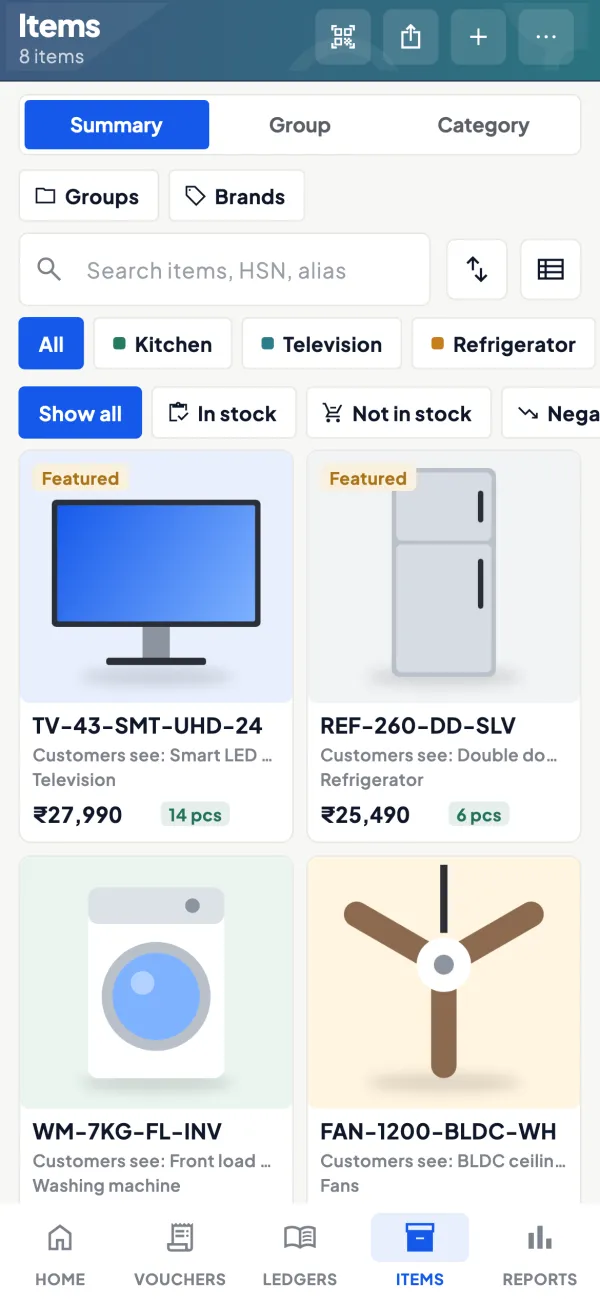
Raise purchase orders from the phone
When stock reaches the reorder level, raise a purchase order from the phone and post it to Tally through the connector.
See Purchase orders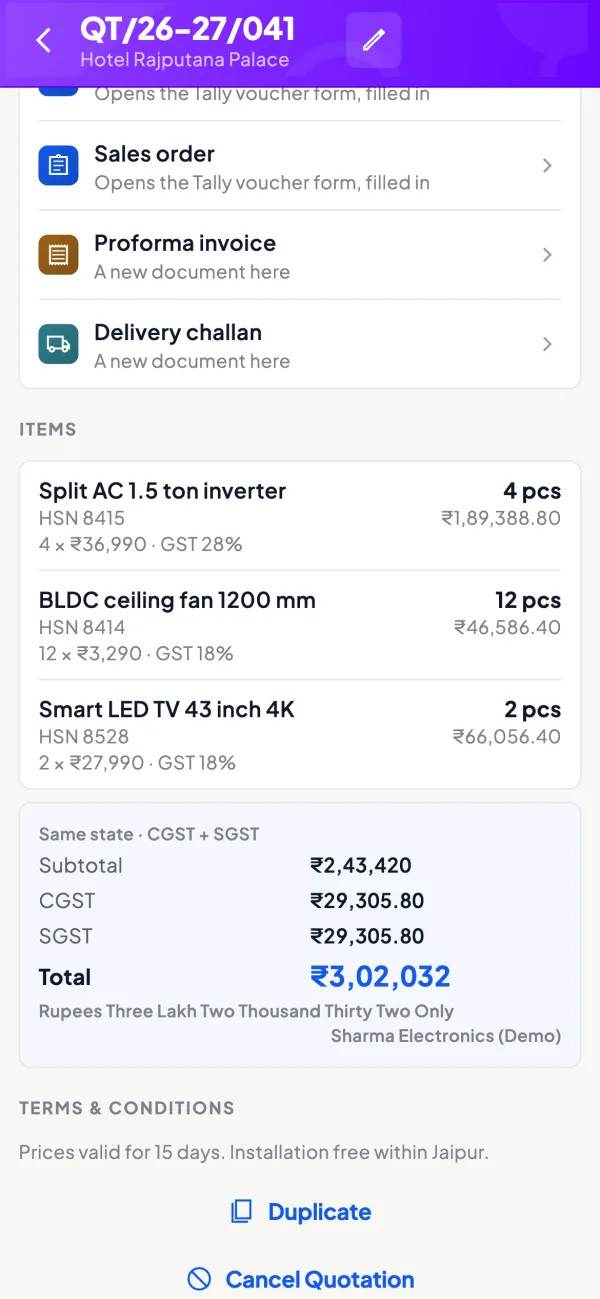
Questions people ask
What is the difference between reorder level and minimum stock?
How often should reorder levels be updated?
Do small retailers need these formulas?
What if my supplier's lead time is unpredictable?
What is lead time?
When is EOQ useful?
How do I know my safety stock is too high?
Can Tally store reorder levels?
This page is general information for Indian businesses, not tax, legal or financial advice. Rules and rates change — check the official portals or your CA before acting.