Running the business Field sales
Measuring salesperson performance
Judge salespeople on a small set of numbers that cover effort, results and money actually collected. Sales value alone hides too much: it rewards pushing stock on credit and ignores customers who quietly stopped buying.
- Distributors with field salespeople
- FMCG and pharma stockists
- Sales managers
- Business owners reviewing staff
- Wholesalers with beat plans
On this page 11
The eight metrics
| Metric | Formula | What it tells you |
|---|---|---|
| Visit compliance | Visits done ÷ visits planned | Is the beat being followed? |
| Productive call rate | Visits with an order ÷ visits done | Are visits turning into business? |
| Average order value | Order value ÷ number of orders | Size of each order |
| Lines per order | Item lines ÷ orders | Is the full range being sold? |
| Sales vs target | Net sales ÷ target | Overall result, after returns |
| Collection efficiency | Collected ÷ amount due in the month | Is the money coming in? |
| Active outlets | Outlets that ordered this month ÷ outlets assigned | Coverage of the territory |
| New outlets | First-time buyers this month | Growth |
A worked example
Two salespeople, same month:
| Amit | Suresh | |
|---|---|---|
| Net sales | ₹18,00,000 | ₹15,50,000 |
| Visits done / planned | 210 / 300 | 285 / 300 |
| Productive calls | 120 | 190 |
| Lines per order | 3.1 | 5.4 |
| Collected / due | ₹10,80,000 / ₹17,00,000 | ₹14,20,000 / ₹15,00,000 |
| Active outlets | 68 of 140 | 121 of 140 |
On sales alone, Amit looks better. But he visited 70% of plan, collected about 64% of what was due, and fewer than half his outlets ordered. His sales likely come from a few large dealers on stretched credit. Suresh visited 95% of plan, collected about 95% and kept 86% of outlets active. Suresh's territory is healthier, and Amit's needs a conversation about coverage and collections.
Getting the data right
- Use net sales after returns and credit notes, not order value booked.
- Map each customer to one salesperson in your books, for example with a cost centre or a field on the party. See Tally cost centres for salespeople.
- Record collections against the salesperson who collected them, the same day.
- Record visits as they happen, not from memory at month end.
Using the numbers fairly
- Compare each person with their own previous months first, then with others in similar territories.
- Account for things outside their control: a big dealer closing, a supply shortage, a new area.
- Share the numbers weekly, not as a surprise at appraisal time.
- Link part of pay to the metrics you care about; see salesperson incentive structures.
Finally, celebrate the right things. Recognising the person with the best collection efficiency or the most new outlets, not just the biggest sales total, tells the whole team what the business values.
Setting up a simple weekly scorecard
Put the eight metrics on one sheet per salesperson, one column per week, with the target in the first column. Keep it visible to the salesperson as well as the owner.
| Metric | Target | Week 1 | Week 2 |
|---|---|---|---|
| Visit compliance | 90% | 86% | 93% |
| Productive call rate | 60% | 55% | 62% |
| Lines per order | 5 | 4.2 | 4.8 |
| Collection efficiency | 90% | 78% | 88% |
| New outlets | 1 a week | 0 | 2 |
Set your own targets from your best people's normal weeks, not from outside figures. Colour or circle anything below target and discuss only those in the weekly review. This keeps the meeting short and focused on what can change next week.
Lines per order deserves special attention. A salesperson selling only the three items a dealer asks for is an order-taker; one who introduces the dealer to the rest of the range grows the account.
Metrics that mislead
- Orders booked instead of net sales: rewards orders that are later cancelled or returned.
- Calls made by phone counted as visits: inflates compliance without any shop presence.
- Total collections without overdue context: collecting easy current bills while old dues grow looks good on paper.
- Comparing territories of very different size: a city salesperson and a rural one cannot be judged on the same sales number.
Choose definitions once, write them down, and use them for every person.
Performance view in Cashflow OS
When visits, orders and collections are recorded in the Cashflow OS staff app, the owner gets a performance view of the field team, alongside visit check-ins with location, notes and photos. Orders posted to TallyPrime keep the sales figures in your books. Reports export to Excel for the weekly review. See field force tracking and staff app.
Avoid these
Common mistakes
- MistakeJudging salespeople on sales value aloneDo this instead
Add collection efficiency, active outlets and lines per order so pushing stock on credit does not look like good work.
- MistakeCounting orders booked instead of net salesDo this instead
Measure sales after returns and credit notes, so cancelled or returned orders do not inflate anyone's result.
- MistakeCounting phone calls as visitsDo this instead
Count only visits made at the shop, ideally recorded on the spot with a check-in, so visit compliance means presence.
- MistakeSaving the numbers for the yearly appraisalDo this instead
Share a simple scorecard every week, discuss only what is below target, and give people time to correct course.
Keep handy
Checklist
Measuring salesperson performance — 8 checks. Tick them as you go.
In Cashflow OS
How Cashflow OS helps
Cashflow OS puts your TallyPrime books on every phone in the team. Where it fits this topic:
Visits, orders and collections in one view
Salespeople record visits with GPS check-in, notes and photos, take orders and log collections in the staff app; the owner sees a performance view of the field team.
See Field force tracking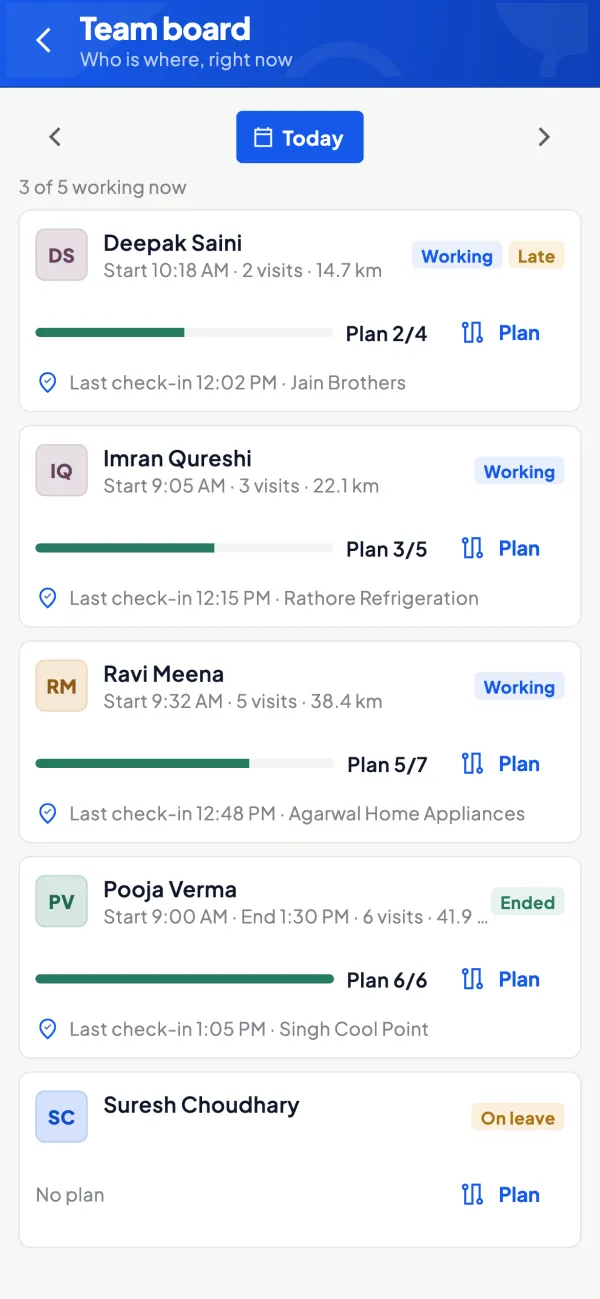
Sales figures that come from your books
Orders post to TallyPrime as sales orders, so net sales and outstanding for each party come from Tally, and reports export to Excel for the weekly review.
See Sales orders to Tally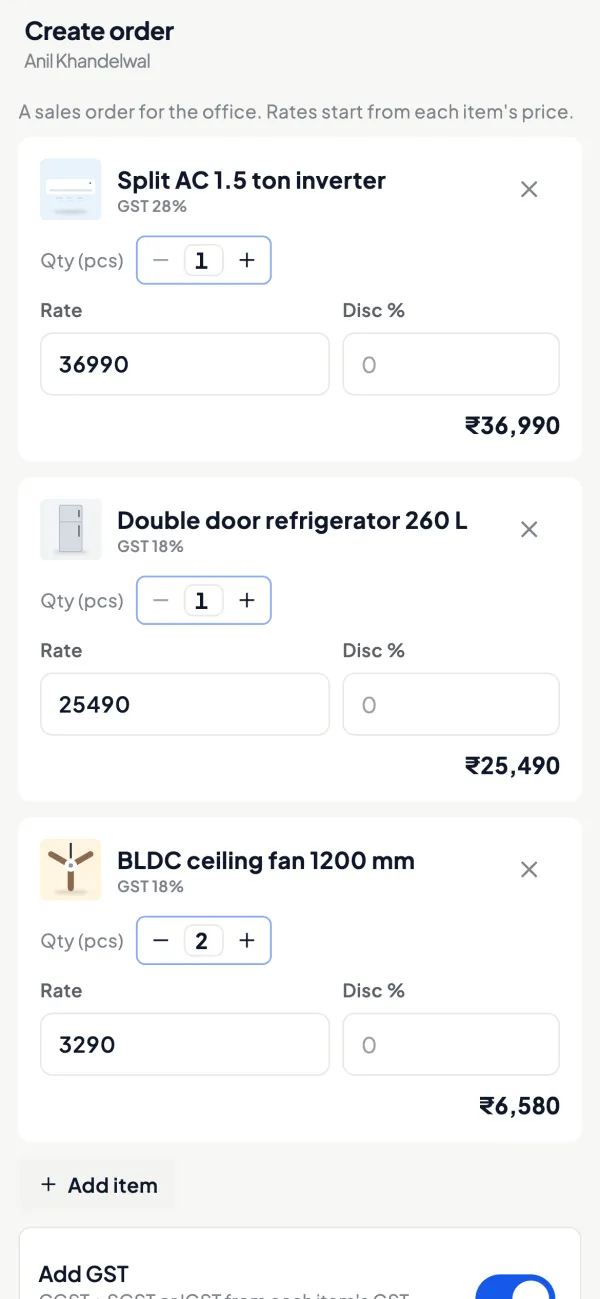
Questions people ask
What is a productive call?
Should collections count towards a salesperson's performance?
How often should performance be reviewed?
What is visit compliance?
How do I measure performance if salespeople share customers?
What is collection efficiency?
Should new outlets and active outlets both be tracked?
How do I set fair targets?
This page is general information for Indian businesses, not tax, legal or financial advice. Rules and rates change — check the official portals or your CA before acting.