
Running the business Field sales
Managing a field sales team
A field sales team works best with three things: a clear territory and visit plan for each person, a simple daily report of visits, orders and collections, and a weekly review where the owner looks at the numbers with them.
- Distributors with salesmen
- FMCG and pharma companies
- Manufacturers with dealer networks
- Sales managers
- Owners running field teams

On this page 11
Start with territories and customer lists
- Give every salesperson a named list of customers and an area. Overlapping territories create fights over credit for orders.
- Group customers into areas a person can cover in a day; these become their beats.
- Classify customers by value, for example A (top 20% of sales), B and C, and set visit frequency accordingly: weekly for A, fortnightly for B, monthly for C.
- Mark prospect shops in each area, not just existing customers, so growth is part of the plan.
A daily routine that works
- Morning: the salesperson sees today's beat, the customers to visit, their outstanding and any pending orders.
- At each shop: check stock, take the order, collect payment or a firm date, note any complaint.
- Between visits: orders go to the office as they are taken, not in a pile at 7 pm.
- Evening: a short summary: visits done, orders, collections, new shops, issues.
The aim is not to monitor every minute, but to get orders processed the same day and spot problems while they are small.
What to measure
Keep it to a few numbers everyone understands. Our guide to measuring salesperson performance covers these in detail.
- Planned visits vs completed visits.
- Productive calls (visits that produced an order).
- Order value and number of lines per order.
- Collections against the overdue amount in their territory.
- New active customers this month.
The weekly review
Thirty minutes per person, every week, same day. Look at:
- Last week's numbers against plan.
- The five biggest overdue customers in their area and the agreed next step for each.
- Customers who have not ordered for 30 days or more.
- One thing that went well and one problem to solve.
A short, regular review does more than a long monthly meeting, because the problems are still fresh.
Common mistakes
- Setting only a sales target. Without a collection target, salespeople push credit to dealers who do not pay.
- Letting salespeople quote their own rates. Use a fixed price list with approval for exceptions.
- Collecting cash without a receipt or a same-day entry.
- Judging people only on the monthly total, which hides whether they are visiting all their customers.
- Incentives paid on orders that are later returned or never paid. See salesperson incentive structures.
Hiring and the first month
A new salesperson's first month decides a lot. A simple plan:
- Week 1: learn the product range, price list, schemes and credit policy; spend two days with the accounts team to understand how orders, bills and receipts flow.
- Week 2: ride along with an experienced salesperson on their beats.
- Week 3: take over a smaller beat, with the senior person joining for the first visits.
- Week 4: full territory, with a daily evening call to discuss issues.
Introduce the new person to each major customer in person. Dealers are wary of a new face asking for payment, and a proper handover protects collections.
When a salesperson leaves, do the reverse: collect pending orders and promises, get a written handover of any cash or cheques, and visit key customers with the replacement within two weeks.
Running the team with Cashflow OS
Cashflow OS has a field force module and a staff app. Salespeople get a Today screen with customers to attend, visits, orders and collections. You can set dealer locations, areas and route plans, see recommended visits, and have visits checked in with location, notes and photos. Orders are taken with price-list rates and GST and posted to TallyPrime, with approval if you want it. A salesperson sees items and their own customers, not the company's accounts. The owner gets a performance view. See field force tracking.
Avoid these
Common mistakes
- MistakeSetting only a sales targetDo this instead
Add a collection target, so salespeople do not push credit to dealers who will not pay.
- MistakeLetting salespeople quote their own ratesDo this instead
Use a fixed price list, and make any lower rate need approval.
- MistakeCollecting cash with no same-day entryDo this instead
Record every collection the same day with a receipt to the customer; prefer UPI or bank transfer to the company.
- MistakeOverlapping territoriesDo this instead
Give each person a named list of customers and areas, so credit for orders is never disputed.
Keep handy
Checklist
Managing a field sales team — 7 checks. Tick them as you go.
In Cashflow OS
How Cashflow OS helps
Cashflow OS puts your TallyPrime books on every phone in the team. Where it fits this topic:
A Today screen for every salesperson
The staff app shows customers to attend, visits, orders and collections. A salesperson sees items and their own customers, not the company's accounts.
See Staff app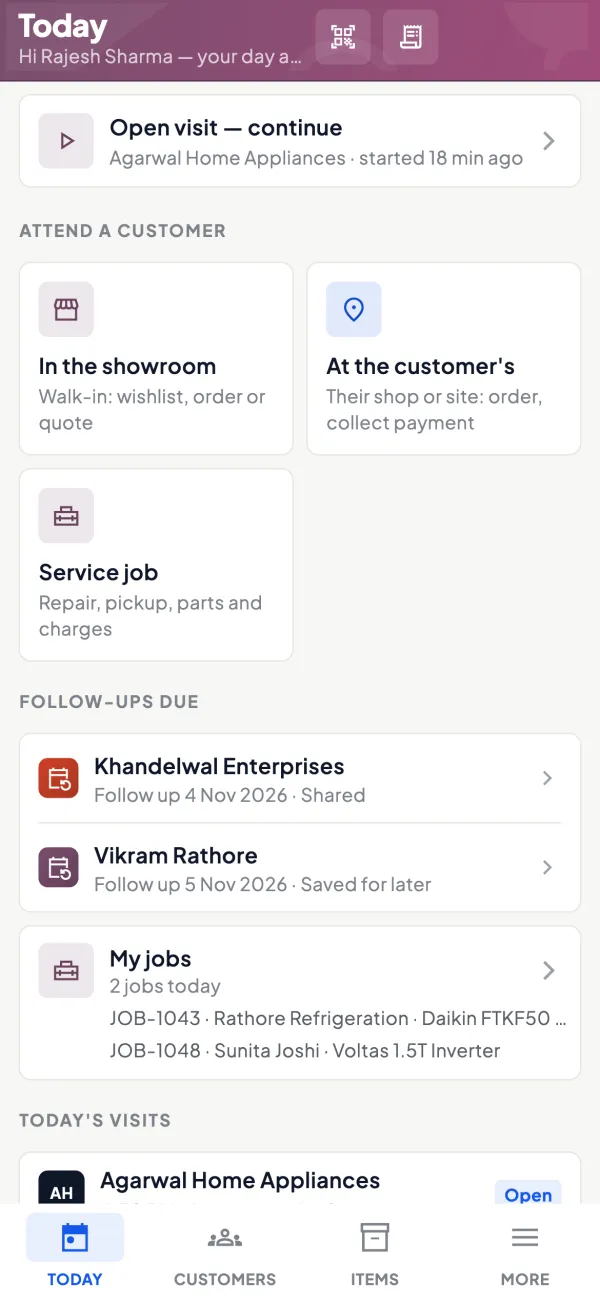
Visits, routes and performance
Set dealer locations, areas and route plans, check visits in with GPS location, notes and photos, and see the team's performance as owner.
See Field force tracking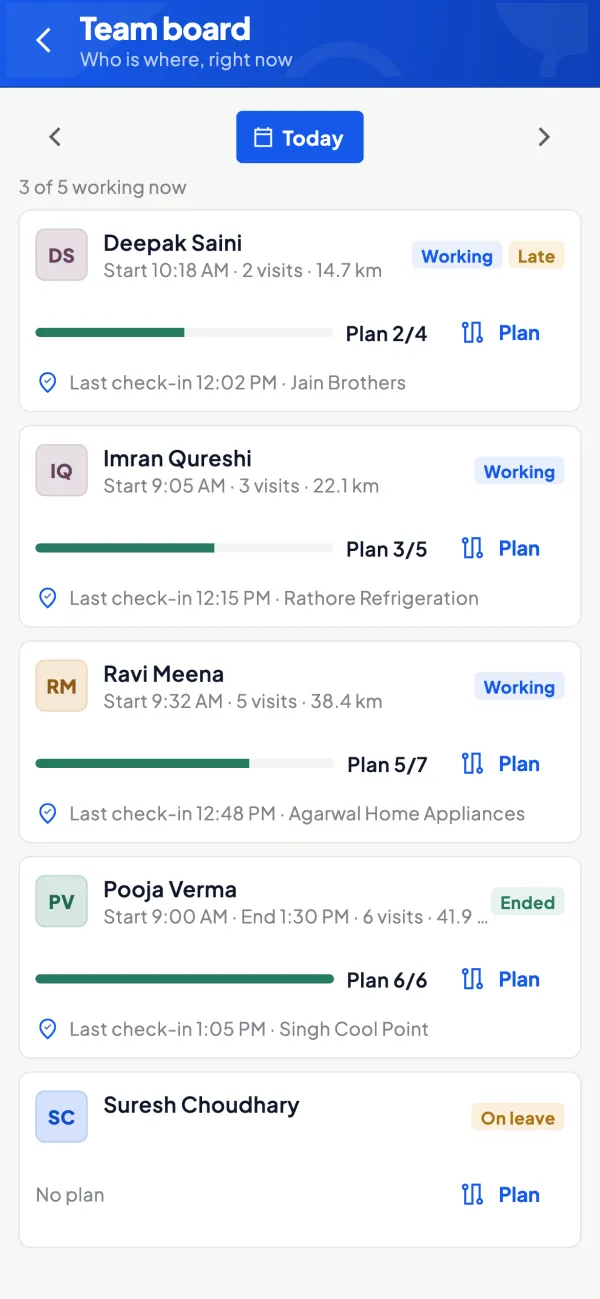
Questions people ask
How many shops can a salesperson visit in a day?
Should salespeople collect cash?
Is location tracking acceptable to salespeople?
How do I stop salespeople from taking customers with them when they leave?
How should a field team handle returns and complaints?
How should I set incentives for salespeople?
How often should a salesperson visit each customer?
Should salespeople see a customer's outstanding?
This page is general information for Indian businesses, not tax, legal or financial advice. Rules and rates change — check the official portals or your CA before acting.