
Running the business Field sales
Salesperson incentive structures
A good incentive pays for sales that are collected, rewards the behaviour you want (coverage, range, new outlets), and is simple enough that every salesperson can work out their own payout. Complicated schemes get gamed or ignored.
- Distributors and stockists
- Business owners
- Sales managers
- Field salespeople
- HR and payroll staff

On this page 11
Fixed and variable pay
Most field roles combine a fixed salary with a variable part. A common starting point is a variable component around 15–30% of total expected pay. Too little and it does not motivate; too much and people chase short-term orders and leave when a month goes badly. Decide what suits your trade and the experience of your team.
Also decide what the fixed part covers: travel allowance, phone and daily expenses are often paid separately from salary and incentive. Keeping them separate stops expense claims from becoming a hidden part of the incentive.
Pay on collected sales, not booked orders
The single most useful rule: incentive is earned on sales that are collected, or on sales minus the amount still overdue beyond terms. This stops salespeople from pushing stock to dealers who will not pay.
Example: sales of ₹12,00,000 in the quarter, of which ₹1,50,000 is still overdue more than 30 days at quarter end. Incentive is calculated on ₹10,50,000. If that ₹1,50,000 is collected next quarter, it is added back then.
A sample structure you can adapt
| Component | Weight | How it is paid |
|---|---|---|
| Collected sales vs target | 60% | Slabs below |
| Collection of overdue in territory | 20% | % of overdue (as at month start) collected |
| Active outlets | 10% | Paid if 80% of assigned outlets order |
| New outlets | 10% | Fixed amount per new outlet with two paid orders |
Slabs on collected sales vs target
| Achievement | Payout of the 60% part |
|---|---|
| Below 80% | Nil |
| 80–99% | Pro-rata (e.g. 90% achievement = 90%) |
| 100–119% | 100% plus 1.5× on the excess |
| 120% and above | Capped at 130% |
Worked example
Target incentive for the month: ₹10,000 (₹6,000 sales, ₹2,000 collections, ₹1,000 active outlets, ₹1,000 new outlets).
- Collected sales ₹9,50,000 vs target ₹10,00,000 = 95%. Payout ₹6,000 × 95% = ₹5,700.
- Overdue at month start ₹4,00,000, collected ₹3,00,000 = 75%. Payout ₹2,000 × 75% = ₹1,500.
- Active outlets 104 of 120 = 87%, above 80%. Payout ₹1,000.
- Two new outlets qualified at ₹500 each = ₹1,000.
Total incentive: ₹9,200. The salesperson can check every line themselves.
Rules to write down
- Returns and credit notes reduce sales in the month they are issued.
- Sales to a party that later defaults are reversed when written off.
- Orders at rates below the price list, without approval, do not count.
- Targets are set before the month starts and not changed mid-month.
- Payout date, for example by the 10th of the following month.
- Scheme reviewed every six months.
The data for every component comes from the metrics in measuring salesperson performance. Incentives paid to employees are part of salary for TDS purposes; check with your CA. This is general information, not tax advice.
Mistakes that break incentive schemes
- Too many components. If a salesperson cannot explain their payout, they will not change behaviour for it.
- Changing targets after a good month. Nothing kills trust faster. Change targets only at the planned review.
- Paying late. An incentive paid three months later feels like a bonus, not a reward for this month's work.
- Rewarding month-end loading. If dealers are pushed to take stock on the 30th and return it on the 5th, net sales after returns stops that.
- Ignoring team effects. Where dealers are shared or a supervisor helps close, a small team component avoids arguments over credit.
Test a new scheme on the last three months' actual data before announcing it. If the payouts look wrong for people you know performed well or badly, fix the design first.
Getting the numbers from Tally and Cashflow OS
If each customer is linked to a salesperson in TallyPrime, Cashflow OS can show sales and bill-wise outstanding for those customers on the phone and web, with ageing to see what is overdue. Salespeople record collections and visits in the staff app, and the owner sees a performance view. Export reports to Excel to run the incentive calculation. See collections and managing a field sales team.
Avoid these
Common mistakes
- MistakeToo many components in the schemeDo this instead
Keep to about four parts that each salesperson can work out from their own numbers.
- MistakeChanging targets after a good monthDo this instead
Set targets before the month starts and change them only at the planned review.
- MistakePaying incentives months lateDo this instead
Fix a payout date, such as the 10th of the next month, so the reward follows the work.
- MistakeRewarding month-end loading of dealersDo this instead
Pay on collected sales net of returns, so stock pushed on the 30th and returned on the 5th earns nothing.
Keep handy
Checklist
Salesperson incentive structures — 8 checks. Tick them as you go.
In Cashflow OS
How Cashflow OS helps
Cashflow OS puts your TallyPrime books on every phone in the team. Where it fits this topic:
Sales and dues for each salesperson's customers
If customers are linked to salespeople, their sales and bill-wise outstanding with ageing show on phone and web; export to Excel for the payout sheet.
See Reports in Excel and PDF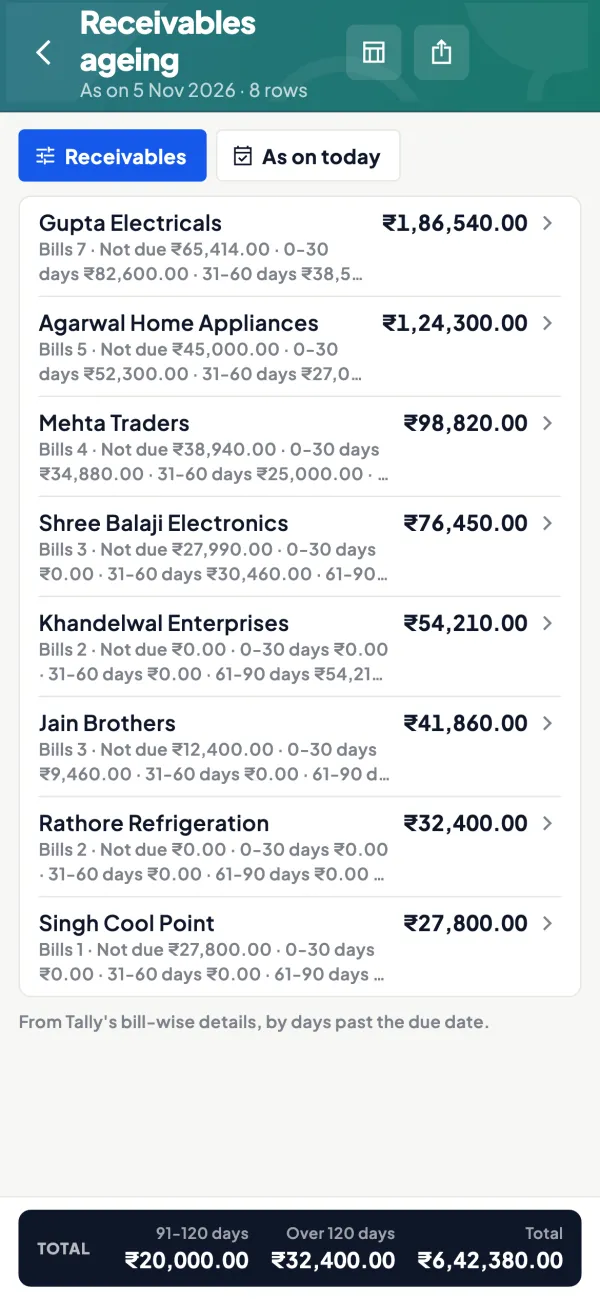
Collections and visits from the field
Salespeople record collections and visits in the staff app, and the owner sees a performance view for the team.
See Collections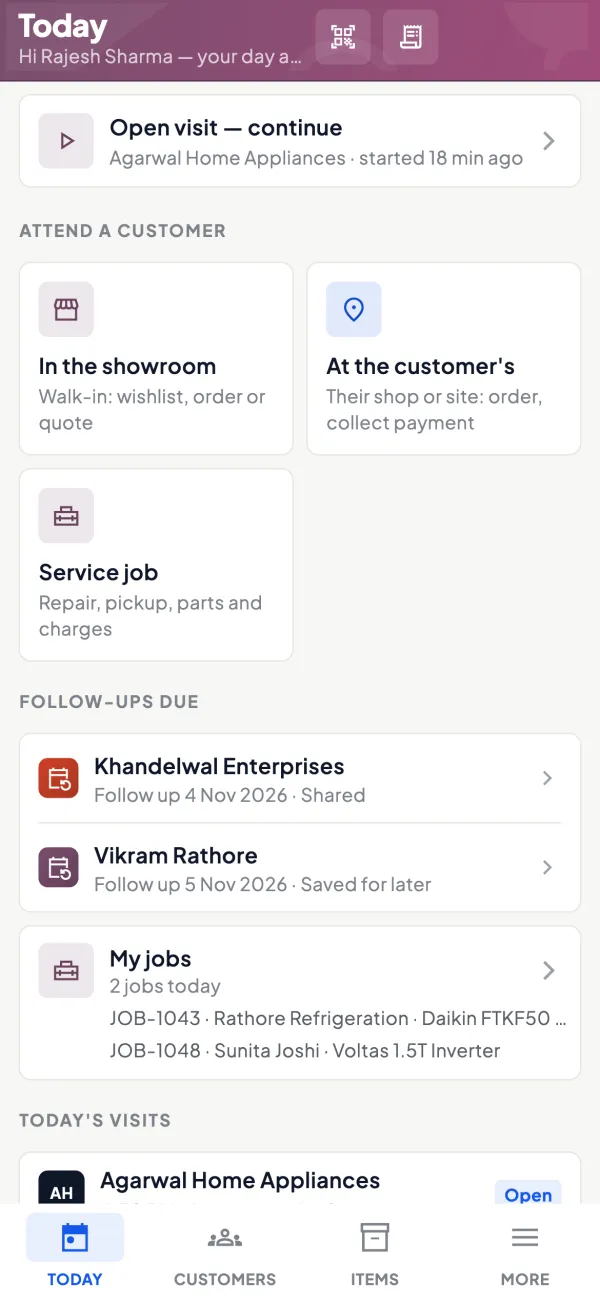
Questions people ask
Should incentives be paid monthly or quarterly?
Should there be a cap on incentives?
How do I set fair targets for different territories?
Should new salespeople be on the same incentive scheme?
Should incentives be paid on margin instead of sales?
What happens when a salesperson leaves mid-quarter?
Do collections made by the office count?
Are sales incentives taxable for the employee?
This page is general information for Indian businesses, not tax, legal or financial advice. Rules and rates change — check the official portals or your CA before acting.