Glossary Business
Gross margin
Definition
Gross margin is the share of sales left after the cost of the goods sold, calculated as (sales − cost of goods sold) ÷ sales × 100.

Example
A Pune electrical shop sold ₹10,00,000 of goods before GST in October, and those goods cost it ₹8,20,000. Gross profit is ₹1,80,000 and gross margin is 18%. If rent, salaries and other expenses come to ₹1,20,000, the remaining ₹60,000 is the shop's profit before interest and tax.
Gross margin in TallyPrime and in Cashflow OS
Where to find itIn TallyPrime
TallyPrime's Profit and Loss account shows gross profit after trading items such as sales, purchases, direct expenses and stock. It depends on a correct closing stock value.
 On your phoneIn Cashflow OS
Cashflow OS shows Profit and Loss and stock summaries from the synced Tally data, with Excel and PDF export.
See how it works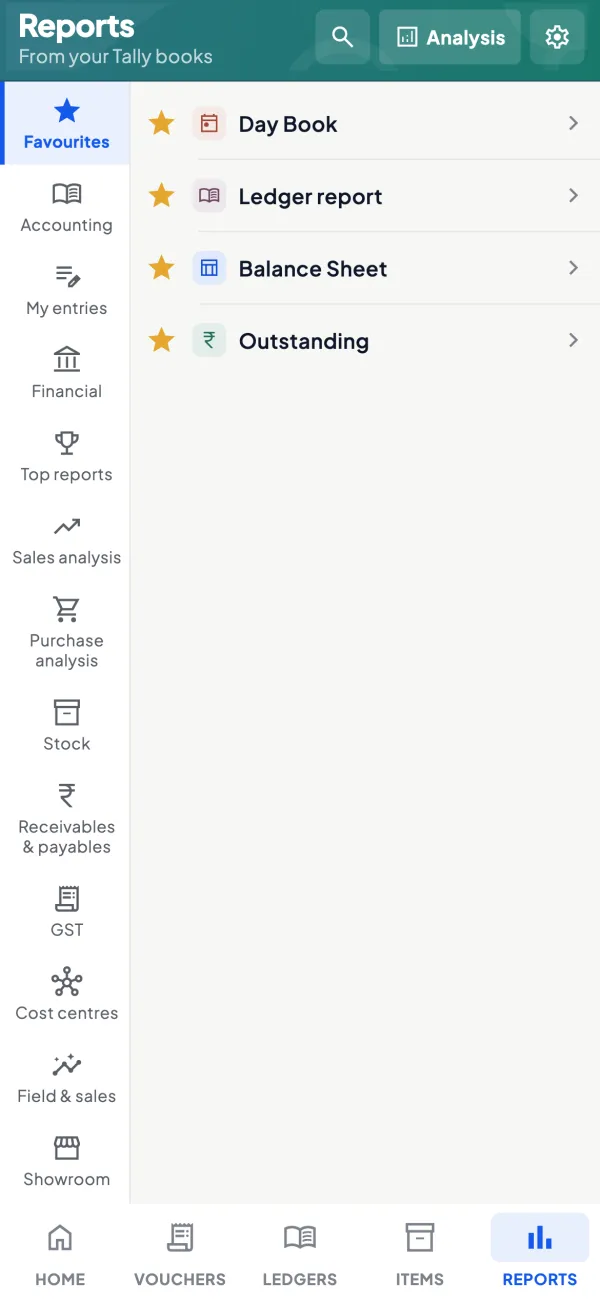
Common misunderstandings
- Watch outConfusing margin with markup: adding 25% to cost gives a 20% margin, not 25%.
- Watch outIncluding GST in sales or cost. Work on values before GST.
The formula
Gross profit = sales − cost of goods sold
Gross margin % = gross profit ÷ sales × 100
Cost of goods sold is opening stock plus purchases and direct costs (such as freight inward) minus closing stock. GST you can claim as credit is not part of cost, and GST on sales is not part of sales.
Example
A hardware shop buys a tool for ₹800 and sells it for ₹1,000 before GST. Gross profit is ₹200. Gross margin is ₹200 ÷ ₹1,000 = 20%. Markup is ₹200 ÷ ₹800 = 25%. People mix these up, and it costs money: a shop that wants a 25% margin but adds 25% to cost earns only 20%.
| Markup on cost | Gross margin on sales |
|---|---|
| 10% | 9.1% |
| 20% | 16.7% |
| 25% | 20% |
| 50% | 33.3% |
More in gross margin vs markup.
Why it matters
Gross margin pays for everything else: rent, salaries, freight out, interest and the owner's profit. If the shop's expenses are 14% of sales, a 20% margin leaves 6%; a 2% extra discount wipes out a third of that. Checking margin by product group, customer or salesperson shows where discounts and schemes are eating profit. See pricing strategy for traders.
Where it shows up in TallyPrime
TallyPrime's Profit and Loss account shows gross profit as the line between trading items (sales, purchases, direct expenses, stock) and indirect expenses. Item-wise and group-wise profit reports show gross profit per item when stock is valued properly. Gross margin is only as good as the closing stock figure, so a wrong stock value gives a wrong margin. Cashflow OS shows Profit and Loss and stock summaries from the synced Tally data.
Related terms
Working capitalTrial balanceStock groupCost centreAll terms A–Z
Questions about Gross margin
What is a good gross margin?
Does gross margin include GST?
Is gross margin the same as net profit?
How do I convert markup to margin?
Why did my gross margin jump suddenly?
This page is general information for Indian businesses, not tax, legal or financial advice. Rules and rates change — check the official portals or your CA before acting.