Glossary Business
Working capital
Definition
Working capital is the money tied up in daily operations: current assets such as stock, debtors and cash, minus current liabilities such as creditors and short-term dues.

Example
An Indore FMCG distributor has ₹18,00,000 of stock, ₹24,00,000 of debtors and ₹3,00,000 in the bank, against ₹20,00,000 of creditors and ₹10,00,000 of cash credit. Its working capital is ₹15,00,000. Collecting ₹5,00,000 of overdue debtors frees that cash without any new loan.
Working capital in TallyPrime and in Cashflow OS
Where to find itIn TallyPrime
TallyPrime's Balance Sheet shows Current Assets and Current Liabilities as groups; the difference between them is working capital. Correct grouping of loans and advances matters.
 On your phoneIn Cashflow OS
Cashflow OS shows the Balance Sheet, receivables, payables, stock and a cashflow forecast from the synced Tally data on the phone and web.
See how it works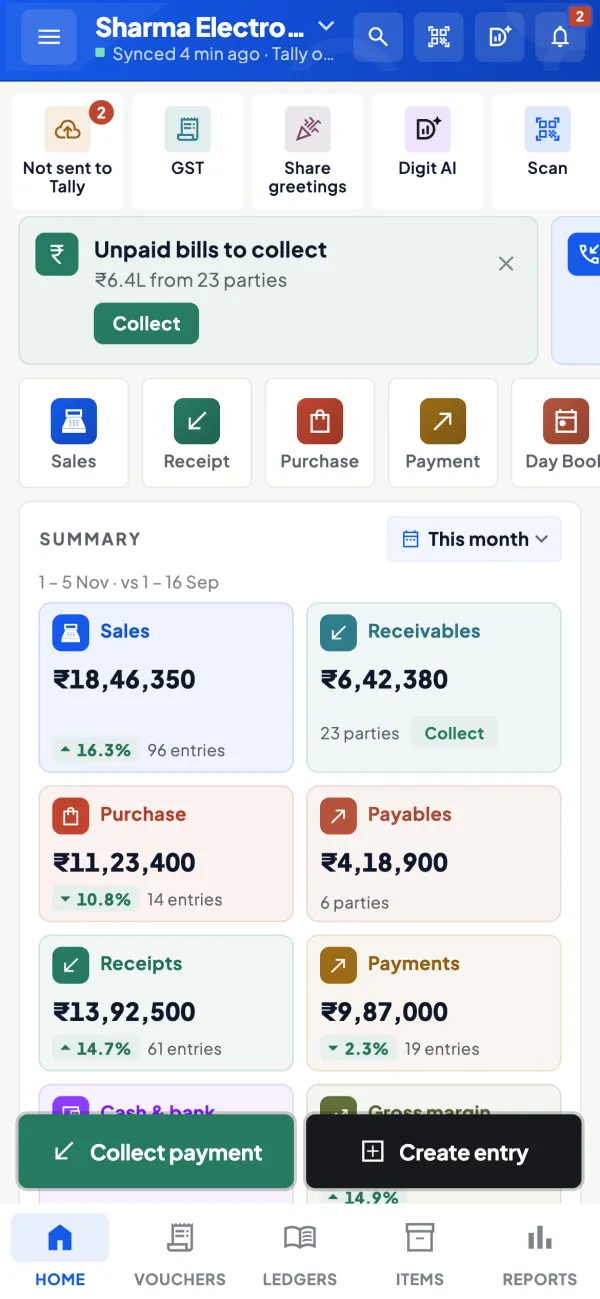
Common misunderstandings
- Watch outTreating profit as cash. A profitable business can run short when debtors and stock pile up.
- Watch outFunding long-term assets from trade money, which squeezes day-to-day cash.
The formula
Working capital = current assets − current liabilities
Current assets are things that turn into cash within a year: stock, debtors, cash and bank, short-term advances. Current liabilities are dues payable within a year: creditors, short-term loans, taxes payable, expenses due. A positive figure means the business has its own money or long-term funds supporting day-to-day trade. A negative one means suppliers or short-term borrowing are funding it.
Example
| Item | Amount |
|---|---|
| Stock | ₹28,00,000 |
| Debtors | ₹35,00,000 |
| Cash and bank | ₹4,00,000 |
| Creditors | (₹30,00,000) |
| Cash credit and GST payable | (₹15,00,000) |
| Working capital | ₹22,00,000 |
This distributor needs ₹22,00,000 of its own or long-term money to keep trading. If debtors stretch by 15 days on monthly sales of ₹60,00,000, another ₹30,00,000 gets tied up, which is more than the whole working capital. That is why collections matter as much as sales.
What moves it
- Slower collections raise debtors and the need for working capital.
- Buying more stock than needed, or holding dead stock, does the same.
- Longer supplier credit lowers it, but only while suppliers agree.
- Profits kept in the business add to it; drawings and asset purchases from trade money reduce it.
Our guide on the working capital cycle shows how to count it in days, and cash flow management for MSMEs covers what to do about it.
Where it shows up in TallyPrime
TallyPrime's Balance Sheet shows Current Assets and Current Liabilities as groups, so the two totals are there on one screen; the difference is your working capital. Check that loans and advances are placed in the right groups, or the figure will mislead. Cashflow OS shows the Balance Sheet, receivables, payables and stock from the synced Tally data on the phone, along with a cashflow forecast.
Related terms
Questions about Working capital
Is more working capital always better?
What is a working capital loan?
How is working capital different from profit?
What is the working capital cycle?
How can I reduce the working capital I need?
This page is general information for Indian businesses, not tax, legal or financial advice. Rules and rates change — check the official portals or your CA before acting.