Running the business Income tax
TDS basics for business owners
TDS (tax deducted at source) means that when your business makes certain payments — to contractors, professionals, landlords, agents and employees — you deduct a part as tax, pay it to the government, and report it. The payee gets credit for it against their own tax.
- Companies, firms and LLPs
- Proprietors above the audit limit
- Businesses paying rent or contractors
- Accountants handling TDS
- Owners whose customers deduct TDS

On this page 11
How TDS works, in four steps
- Deduct: when you pay or credit a bill that falls under TDS, you deduct tax at the applicable rate and pay the party the balance.
- Deposit: you pay the deducted tax to the government using your TAN, generally by the 7th of the following month (March deductions have a later date, usually 30 April).
- File: you file a quarterly TDS statement listing each deduction with the payee's PAN.
- Certify: you issue TDS certificates to payees; the deduction also appears in their tax credit statement on the income-tax portal.
See the glossary entry for TDS for a short definition.
Which payments usually attract TDS
For a typical trading or service business, the common ones are:
| Payment | Examples |
|---|---|
| Salary | Staff salaries above the taxable level |
| Contractors | Transporters, labour contractors, printing, repairs under contract, advertising |
| Professional and technical fees | CA, lawyer, consultant, software developer |
| Rent | Shop, godown, office, machinery or vehicle hire |
| Commission and brokerage | Agents, brokers |
| Interest | Interest on unsecured loans from relatives or others |
| Purchase of goods | Applies to larger buyers purchasing above a limit from one seller |
Each has its own threshold below which TDS is not required, and its own rate, which can differ for individuals and companies. These change from time to time, so check the current table on incometax.gov.in or with your CA.
Does TDS apply to my business?
Companies, firms and LLPs generally have to deduct TDS on the payments above once thresholds are crossed. Proprietors and HUFs usually come under many of these TDS duties once their turnover crossed the tax audit limit in the previous year, though some categories (such as certain rent payments) can apply on different conditions. If you are unsure, ask your CA — the cost of getting it wrong is higher than the cost of asking.
Note: from 1 April 2026 the Income-tax Act, 2025 replaced the 1961 Act. The TDS system continues, but section numbers, form numbers and some thresholds were reorganised. Use your CA and the income-tax portal for the current references.
A worked example
Your business pays a transport contractor (a firm) ₹1,20,000 for October freight. Assume the payment crosses the threshold and an illustrative TDS rate of 2% applies.
| Item | ₹ |
|---|---|
| Freight bill | 1,20,000 |
| TDS deducted (illustrative 2%) | 2,400 |
| Paid to contractor | 1,17,600 |
| TDS deposited by 7 November | 2,400 |
In your books, freight is still ₹1,20,000 as an expense. The contractor's account is credited ₹1,20,000, debited ₹1,17,600 for payment and ₹2,400 for TDS, leaving nil. The TDS payable ledger shows ₹2,400 until you deposit it. Where GST is charged on the bill, TDS is usually worked out on the value excluding GST if GST is shown separately — confirm with your CA.
What happens if you get it wrong
- Not deducting or late deducting: interest for the delay, and part or all of the related expense can be disallowed in your income-tax computation until the TDS is paid.
- Late deposit: interest for each month or part of a month of delay.
- Late quarterly statement: a fee per day of delay, and possible penalty.
- Wrong PAN of payee: payee does not get credit; you may be asked to deduct at a higher rate where PAN is missing.
Most of these are avoidable with a monthly routine.
A monthly TDS routine
- Collect PAN of every contractor, professional, landlord and agent before the first payment.
- Set up TDS details on their ledgers in Tally so deductions are calculated when bills are entered.
- In the first week of each month, list TDS deducted last month and deposit it before the due date.
- Each quarter, reconcile TDS ledgers with challans and file the statement.
- Issue certificates to payees on time.
- Check that TDS deducted by your customers on your bills appears in your own tax credit statement — mismatches cost you tax credit.
TDS also touches GST in some cases (for government and certain notified buyers), which is different from income-tax TDS; see TDS and TCS under GST.
This is general information, not tax advice.
Checking TDS ledgers with Cashflow OS
Cashflow OS does not calculate, deposit or file TDS. It does sync your Tally ledgers, so the owner can open the TDS payable ledgers and check balances against deposits, look at a party's ledger to see deductions, and export ledger reports to Excel for the accountant or CA. See financial reports.
Avoid these
Common mistakes
- MistakePaying contractors before collecting their PANDo this instead
Collect PAN before the first payment; a missing PAN can mean a higher deduction and no credit for the payee.
- MistakeDepositing TDS late every monthDo this instead
List last month's deductions in the first week and deposit before the due date; delay attracts interest.
- MistakeNever checking TDS deducted by customersDo this instead
Match your TDS receivable with your tax credit statement each quarter and chase customers whose entries are missing.
- MistakeUsing old section numbers in new filingsDo this instead
Confirm references under the Income-tax Act, 2025 with your CA and the income-tax portal.
Keep handy
Checklist
TDS basics for business owners — 7 checks. Tick them as you go.
In Cashflow OS
How Cashflow OS helps
Cashflow OS puts your TallyPrime books on every phone in the team. Where it fits this topic:
TDS ledgers on the phone
Open the TDS payable ledgers synced from Tally and check balances against deposits; Cashflow OS does not calculate, deposit or file TDS.
See Financial reports from Tally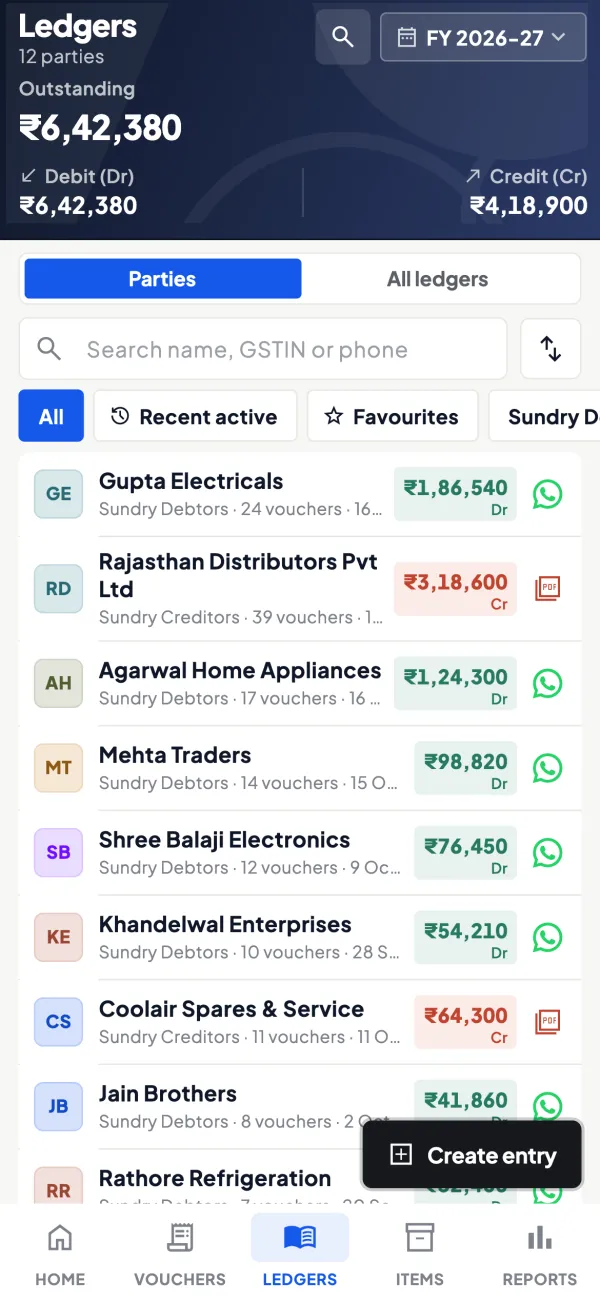
Ledger reports for your CA
Export ledger reports to Excel or PDF so the accountant or CA can reconcile TDS without asking for screenshots.
See Reports in Excel and PDF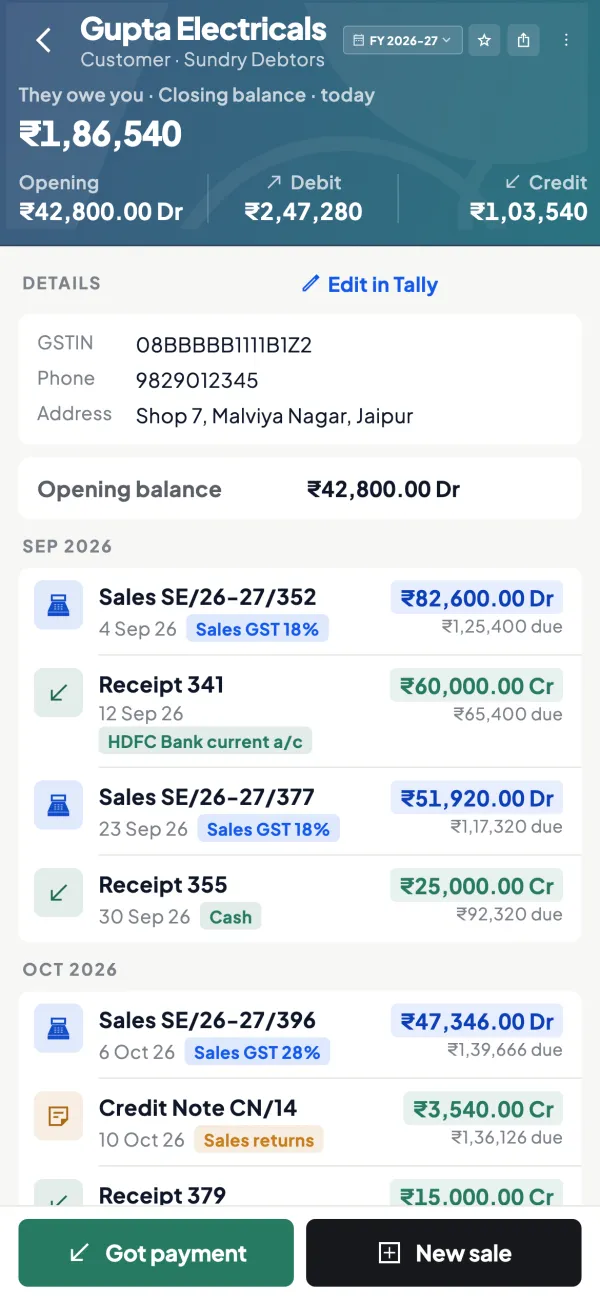
Questions people ask
What is the due date for depositing TDS?
Do I need a TAN to deduct TDS?
Is TDS calculated on the amount including GST?
What if my customer deducts TDS from my payment?
Did the new Income-tax Act change TDS?
Is TDS an extra cost for my business?
What happens if I forget to deduct TDS?
Is GST TDS the same as income-tax TDS?
This page is general information for Indian businesses, not tax, legal or financial advice. Rules and rates change — check the official portals or your CA before acting.