
Running the business Starting up
Compliance checklist for a new business
A new business in India needs a handful of registrations at the start and a steady rhythm of filings afterwards. Which ones apply depends on your structure, state, trade and size — use this list to plan with your CA, not as a final word.
- New business owners
- First-time founders
- Proprietors and partners
- Small traders and shops
- Accountants onboarding clients

On this page 12
Step 1: choose the structure
| Structure | Typical fit | Main ongoing filings |
|---|---|---|
| Proprietorship | Single owner, simple trading | Owner's income-tax return; GST if registered |
| Partnership firm | Two or more owners, family businesses | Firm's return; partnership deed; registration with the state registrar is advisable |
| LLP | Partners wanting limited liability | Annual filings with the registrar plus income-tax |
| Private limited company | Raising capital, larger operations | Statutory audit, annual filings, board meetings plus income-tax |
The structure affects tax, liability and paperwork. Decide it with your CA before registering anything else.
Step 2: registrations at the start
- PAN for the business (firm, LLP, company). A proprietor uses their own PAN.
- Current bank account in the business name.
- GST registration if turnover is expected to cross the threshold, or if you make inter-state supplies of goods, sell through e-commerce platforms, or fall in other compulsory categories. Many businesses register voluntarily so B2B buyers can claim input credit. See GST registration threshold.
- TAN if you will deduct TDS — on salaries, rent, contractors or professionals.
- Udyam registration to be recognised as an MSME. See Udyam registration benefits.
- Shops and establishments registration under your state's law, for shops, offices and godowns.
- Professional tax registration in states that levy it.
- Trade licence from the local municipal body where required.
Step 3: trade-specific licences
| Trade | Licence or registration commonly needed |
|---|---|
| Food, beverages, dairy, bakery | FSSAI registration or licence |
| Medicines, pharma distribution | Drug licence (wholesale or retail) |
| Import or export | Importer-Exporter Code (IEC) |
| Fertilisers, seeds, pesticides | State dealer licences |
| Weighing or measuring instruments in trade | Legal metrology compliance and stamping |
| Factories and manufacturing | Factory licence, pollution board consents where applicable |
Check with your trade association and CA — some licences take weeks.
Step 4: when you hire
- EPF registration is generally required once you reach 20 employees, and ESI once you reach 10 employees in covered areas. Thresholds and coverage can change, so confirm current rules.
- Deduct TDS on salaries above the taxable level.
- Professional tax deduction in states that levy it.
- Keep appointment letters, attendance and wage records as required by state labour laws.
The recurring compliance calendar
| Frequency | What | Typical timing |
|---|---|---|
| Monthly | TDS deposit | By the 7th of the next month |
| Monthly / quarterly | GSTR-1 and GSTR-3B | Monthly filers around the 11th and 20th; quarterly options under QRMP |
| Monthly | PF and ESI contributions, if registered | Mid-month |
| Quarterly | TDS statements | After each quarter |
| Quarterly | Advance tax instalments | Mid-June, September, December, March |
| Yearly | Income-tax return, tax audit if applicable, GST annual return if applicable, registrar filings for LLPs and companies | After the year ends on 31 March |
Dates differ by taxpayer type and can be extended. See the GST compliance calendar and confirm on gst.gov.in and incometax.gov.in.
Keep a compliance folder from day one
New owners often lose time hunting for a certificate when a bank, a large customer or a tender asks for it. Create one folder — physical and digital — with:
- Copies of every registration certificate: PAN, GST, Udyam, shop licence, trade licences, TAN.
- Partnership deed, LLP agreement or company incorporation documents.
- Rent agreement and electricity bill for each premises (often needed for registrations).
- Login details register kept securely by the owner — which portal, which mobile number and email it is linked to.
- Renewal dates for licences that expire, such as FSSAI, drug licence or trade licence.
Link every portal to a mobile number and email that the business controls, not to a staff member who may leave. Losing access to the GST or income-tax portal through an old staff phone number is a common and avoidable problem.
Habits that keep a new business compliant
- Keep business and personal money in separate accounts from day one.
- Raise a proper invoice for every sale; keep every purchase bill.
- Enter transactions weekly, not at year-end.
- Keep a one-page calendar of due dates on the wall or phone.
- Meet your CA quarterly. Note: from 1 April 2026 the Income-tax Act, 2025 applies, so older guides may quote outdated section numbers.
This is general information, not tax or legal advice.
Starting with Tally and Cashflow OS
Most CAs in India work with TallyPrime, so starting your books there keeps things simple. Cashflow OS connects to Tally through a small connector on the Tally PC and gives you the books on your phone and the web: sales, receipts, outstanding, P&L, Balance Sheet, and GSTR-1 and GSTR-3B views with JSON download for the GST portal. Filing itself is done on the portal. A 14-day free trial is available. See GST reports.
Avoid these
Common mistakes
- MistakeLinking GST or income-tax portals to a staff member's phoneDo this instead
Use a mobile number and email the business controls, so access is not lost when someone leaves.
- MistakeMixing personal and business moneyDo this instead
Open a current account in the business name on day one and run all business money through it.
- MistakeEntering transactions only at year endDo this instead
Enter weekly and keep every bill; year-end catch-up leads to missed ITC and wrong returns.
- MistakeRelying on old guides for section numbersDo this instead
The Income-tax Act, 2025 applies from 1 April 2026, so confirm sections and due dates on the official portals.
Keep handy
Checklist
Compliance checklist for a new business — 8 checks. Tick them as you go.
In Cashflow OS
How Cashflow OS helps
Cashflow OS puts your TallyPrime books on every phone in the team. Where it fits this topic:
Books on the phone from day one
Keep books in TallyPrime and see sales, receipts, outstanding, P&L and Balance Sheet on the phone and web through the connector.
See Financial reports from Tally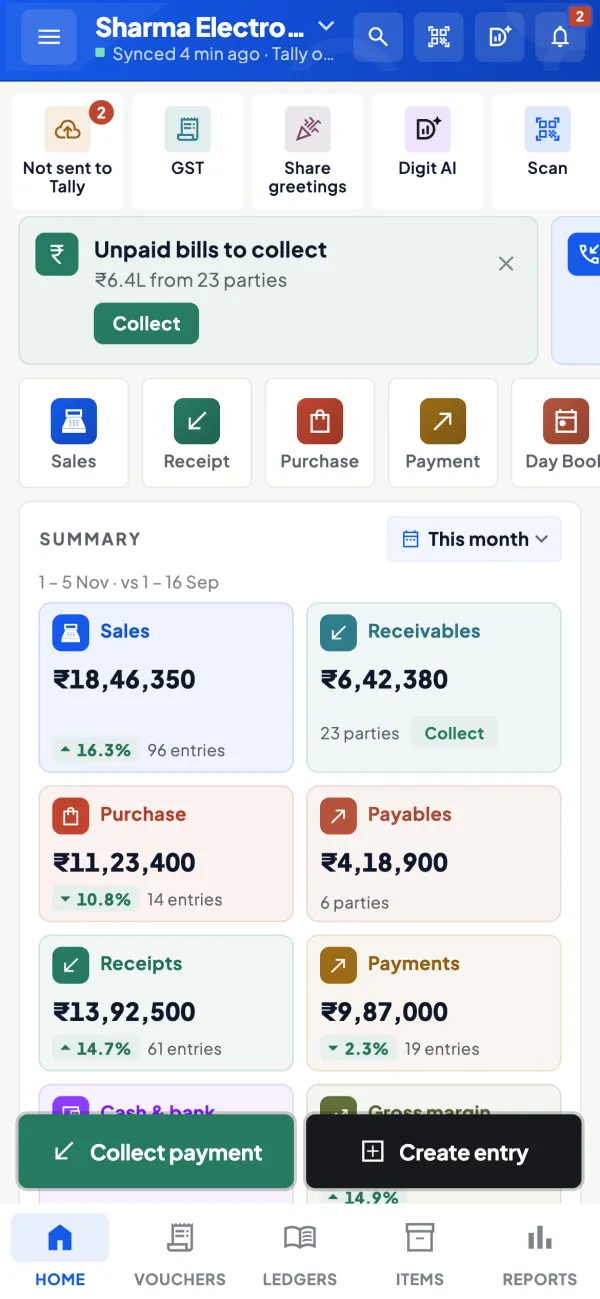
GST views before filing
GSTR-1 and GSTR-3B views prepared from Tally data, with JSON download for the GST portal, where the return is filed.
See GST reports from your Tally data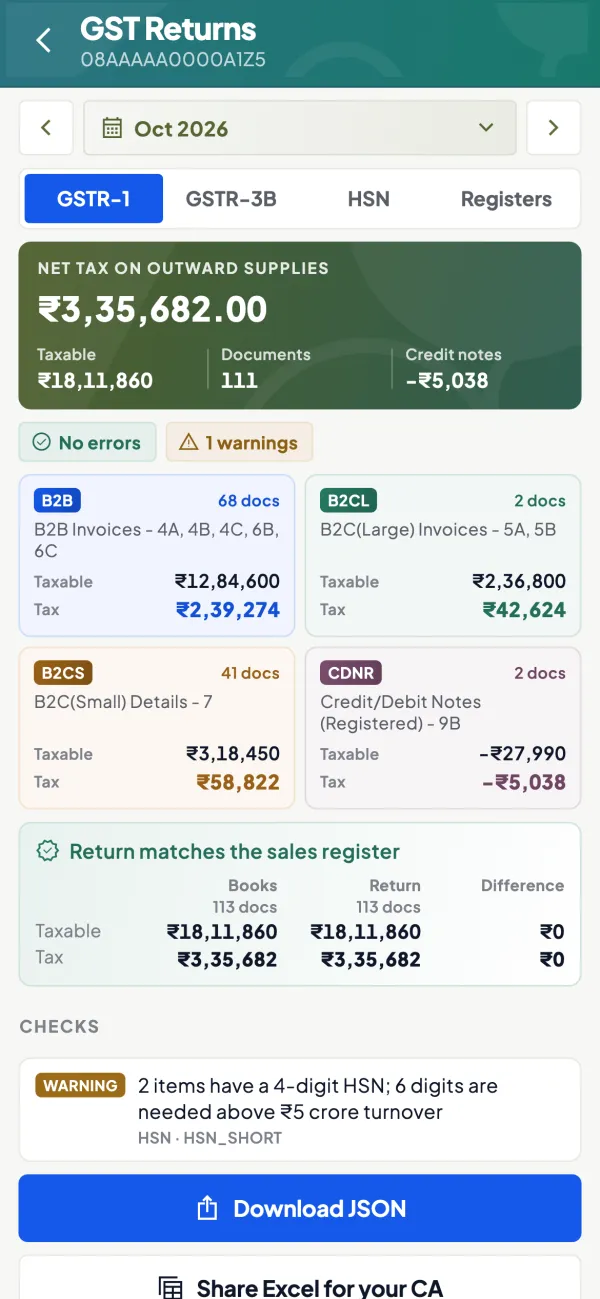
Questions people ask
Is GST registration compulsory for a new business?
Do I need a TAN as a proprietor?
Is Udyam registration mandatory?
Which registration should I do first?
Do I need a shop licence for a home office?
When do PF and ESI apply?
Is an Importer-Exporter Code needed for exports of services?
How often should a new business meet its CA?
This page is general information for Indian businesses, not tax, legal or financial advice. Rules and rates change — check the official portals or your CA before acting.