GST GST due dates
GST compliance calendar for MSMEs
Most small businesses have the same GST rhythm every month: sales return by the 11th (or 13th quarterly), tax return by the 20th (or 22nd/24th quarterly), and a handful of yearly dates. Set them once and work backwards.
- MSME owners
- Accountants handling GST
- QRMP filers
- Composition dealers
- CAs managing many clients

On this page 11
The monthly cycle for regular filers
| Date (following month) | What | Who |
|---|---|---|
| 10th | GSTR-7 (TDS) and GSTR-8 (TCS) | TDS deductors and e-commerce operators |
| 11th | GSTR-1 | Monthly filers |
| 13th | IFF (optional) for months 1 and 2 of the quarter | QRMP filers |
| 14th | GSTR-2B generated | Everyone, for ITC matching |
| 20th | GSTR-3B and payment | Monthly filers |
| 25th | PMT-06 payment for months 1 and 2 | QRMP filers |
Due dates are standard but the government extends them from time to time, and dates falling on holidays are not automatically moved. Check gst.gov.in each month.
Quarterly filers under QRMP
Businesses with aggregate turnover up to ₹5 crore can opt for QRMP. After each quarter:
- GSTR-1 by the 13th of the month after the quarter.
- GSTR-3B by the 22nd or 24th, depending on the state of registration (two groups of states).
Tax is still paid monthly through PMT-06 for the first two months. See QRMP scheme and GST payment challan.
Composition dealers
- CMP-08 (statement-cum-challan): by the 18th of the month after each quarter.
- GSTR-4 (annual return): by 30 April after the financial year.
Yearly and half-yearly dates
| Date | What |
|---|---|
| Before the first export of the year | LUT for exports without payment of IGST |
| Before the year starts (by notified date) | QRMP / composition opt-in or opt-out; GTA forward-charge declaration |
| 25 April and 25 October | ITC-04 for job work (half-yearly for turnover above ₹5 crore; annual, by 25 April, for others) |
| 30 November | Last date to fix previous year's GSTR-1 errors, claim missed ITC and issue GST credit notes (or annual return date, if earlier) |
| 31 December | GSTR-9 and, where applicable, GSTR-9C for the previous year |
Working backwards: an internal calendar
Filing dates are deadlines, not plans. A practical internal calendar for a monthly filer:
- 1st–3rd: enter all last-month sales, credit notes and purchases; bank reconciliation.
- 4th–6th: review the GSTR-1 data in your software; fix GSTINs, HSN and uncertain entries.
- 7th–9th: file GSTR-1 early so buyers see their credit.
- 14th–16th: download GSTR-2B and match with purchases.
- 17th–18th: finalise GSTR-3B, deposit cash.
- 19th: file GSTR-3B.
Missing dates costs money; see GST interest and late fees.
Example: a QRMP retailer's quarter
A retailer with turnover of ₹3 crore files quarterly. For the April–June quarter:
| Date | Task |
|---|---|
| 25 May | PMT-06 for April |
| 25 June | PMT-06 for May |
| 13 July | GSTR-1 for the quarter |
| 22 or 24 July | GSTR-3B for the quarter, paying June's tax and any shortfall |
If the retailer uses the fixed-sum method and paid ₹90,000 in cash in the previous quarter's GSTR-3B, the pre-filled challan for each of April and May is generally 35% of that, ₹31,500. Under self-assessment it pays the actual net tax for each month instead. If a few B2B customers want monthly ITC, the retailer can upload their invoices through IFF by 13 May and 13 June.
Setting reminders that work
- Put each date in the shared calendar of both the owner and the accountant, with a reminder five days ahead.
- Keep a one-page tracker per month: return, date filed, ARN, tax paid, by whom.
- Watch gst.gov.in news for extensions, but never plan around one.
- If your CA files, agree the date by which you will hand over complete data.
Other dates on the same desk
The accountant handling GST usually also handles income-tax TDS (deposit by the 7th of the following month, with quarterly returns), advance tax instalments and payroll dues. Put all of them on one calendar. This is general information, not tax advice.
Keeping the month on time with Cashflow OS
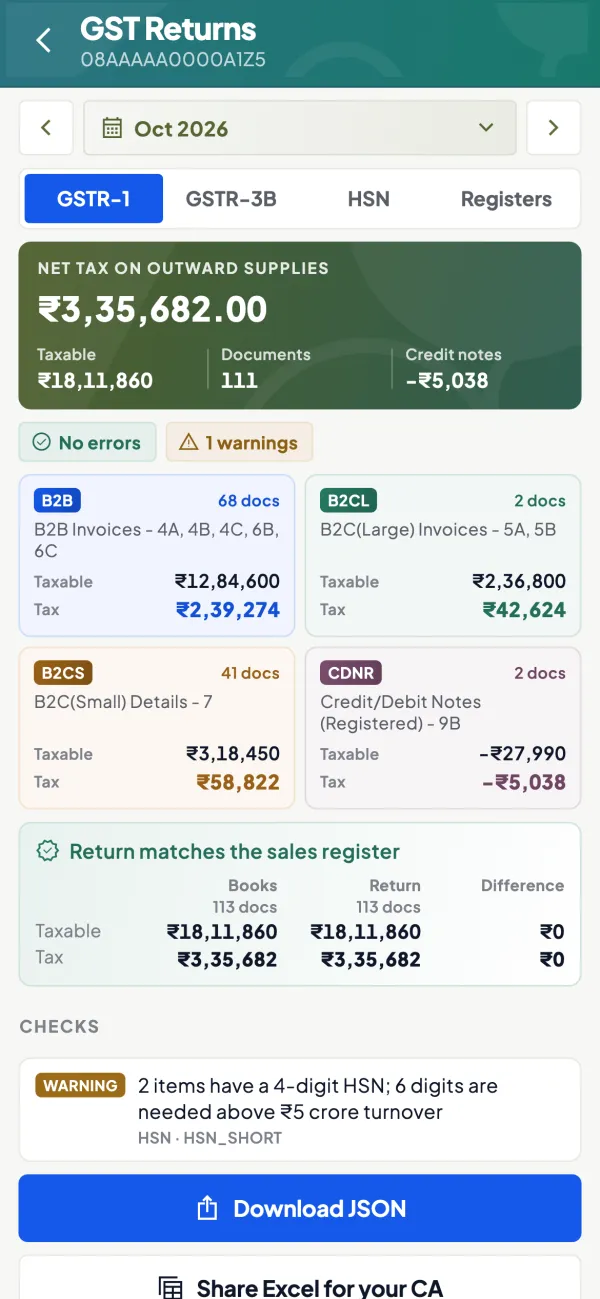
The owner rarely misses a due date because of the portal; it is usually because the books are not ready. Cashflow OS shows sales, purchases, receipts and payments from your Tally data on the phone, and its GSTR-1 and GSTR-3B views let the owner see the month's figures as soon as entries are made, so questions get asked on the 5th rather than the 19th. Filing remains on the GST portal.
Avoid these
Common mistakes
- MistakePlanning work around the due date itselfDo this instead
Set an internal calendar: close books by the 3rd, review by the 6th, file GSTR-1 early, GSTR-3B a day before due.
- MistakeCounting on extensionsDo this instead
Extensions do happen but are not guaranteed; watch gst.gov.in news and file on your own plan.
- MistakeAssuming Sunday due dates move automaticallyDo this instead
They do not move on their own. File before the date unless an extension is notified.
- MistakeForgetting PMT-06 in QRMP monthsDo this instead
Pay PMT-06 for months 1 and 2 of each quarter by the 25th, or interest can follow.
Keep handy
Checklist
GST compliance calendar for MSMEs — 8 checks. Tick them as you go.
In Cashflow OS
How Cashflow OS helps
Cashflow OS puts your TallyPrime books on every phone in the team. Where it fits this topic:
The month's numbers as entries are made
Sales, purchases, receipts and payments from Tally are on the phone, and GSTR-1 and GSTR-3B views show the month's figures early, so questions come up on the 5th rather than the 19th.
See GST reports from your Tally data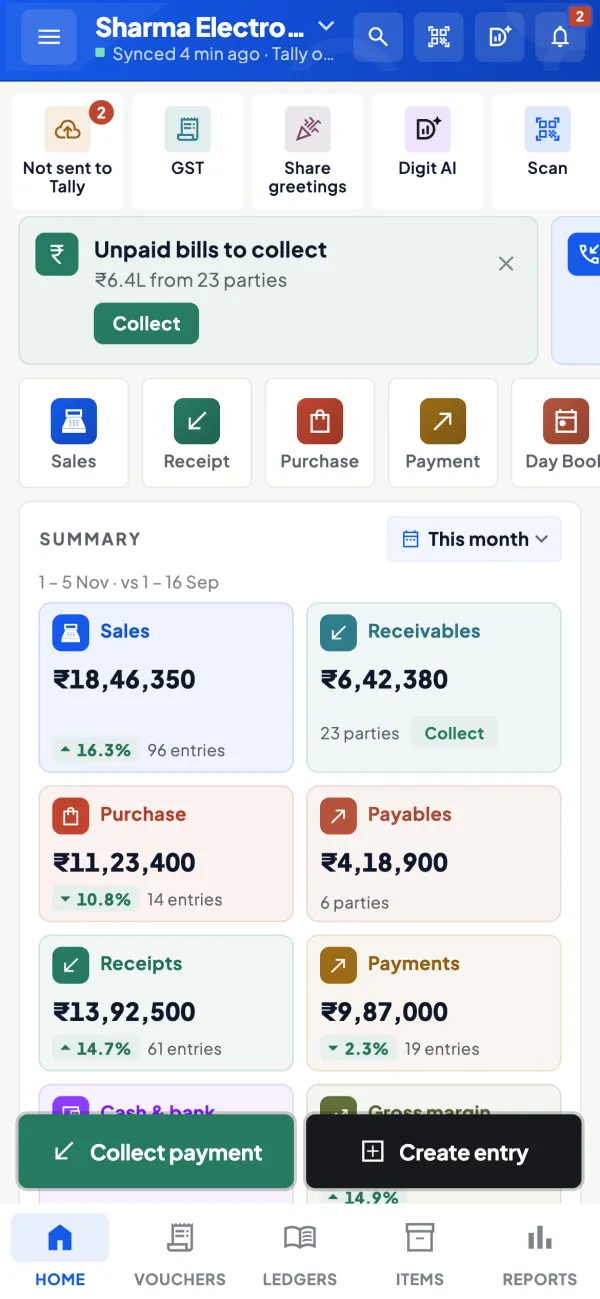
Daily summary for the owner
An evening summary of the day's sales, receipts, payments and purchases keeps the owner aware of whether books are being kept up to date.
See Tally on mobile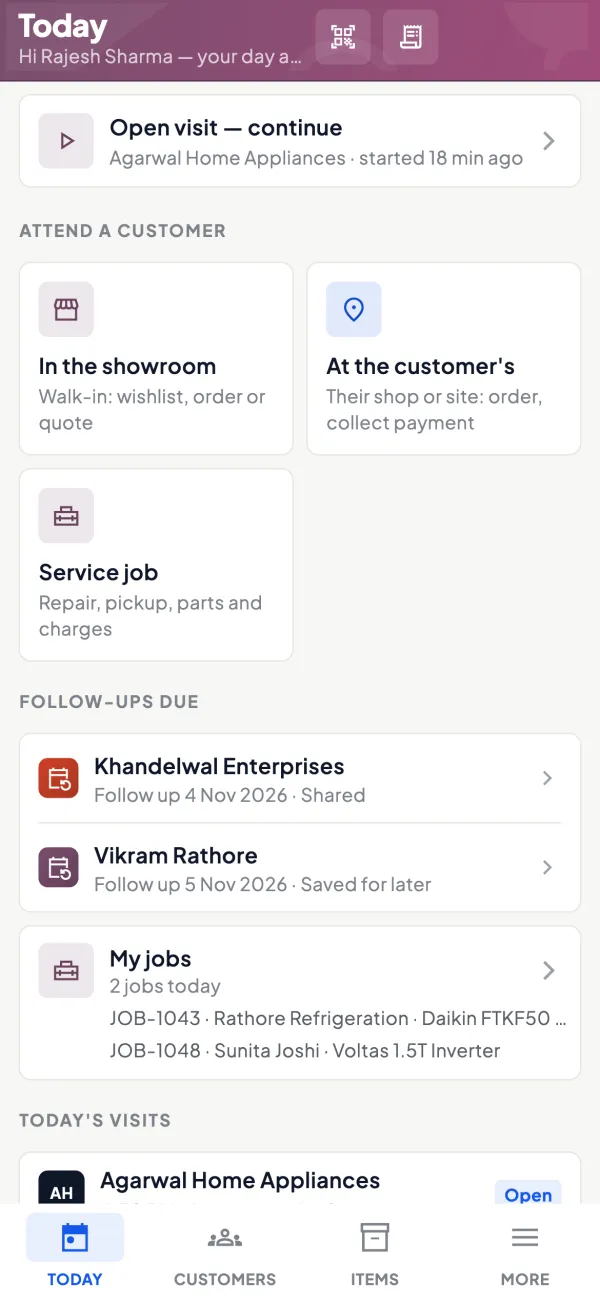
Questions people ask
What is the due date for GSTR-1?
What is the due date for GSTR-3B?
When is GSTR-9 due?
What is IFF?
Do due dates move if they fall on a Sunday?
When is GSTR-2B available?
When is CMP-08 due for composition dealers?
Who must file ITC-04?
This page is general information for Indian businesses, not tax, legal or financial advice. Rules and rates change — check the official portals or your CA before acting.