GST GST returns
GSTR-1 due dates and late fee
Monthly filers file GSTR-1 by the 11th of the next month and QRMP filers by the 13th after the quarter. File late and you pay a per-day late fee, and your buyers wait for their credit.
- Monthly GSTR-1 filers
- QRMP quarterly filers
- Small traders filing nil returns
- Accountants and tax practitioners
- Businesses with B2B buyers

On this page 10
The due dates at a glance
| Who | Return | Usual due date |
|---|---|---|
| Monthly filer | GSTR-1 for the month | 11th of the next month |
| QRMP filer | GSTR-1 for the quarter | 13th of the month after the quarter |
| QRMP filer (optional) | IFF for month 1 and month 2 | 1st to 13th of the next month |
So for a monthly filer, November sales are due by 11 December. For a quarterly filer, the January–March quarter is due by 13 April. The government extends dates from time to time, especially after portal problems or natural disasters, so always confirm on gst.gov.in. The quarterly route is explained in the QRMP scheme.
How the late fee is calculated
The late fee runs for every day from the day after the due date until the day you file. The general per-day rates are:
- Return with sales: ₹50 per day, made up of ₹25 CGST and ₹25 SGST (or UTGST).
- Nil return: ₹20 per day, ₹10 CGST and ₹10 SGST.
The total is capped. The cap for nil returns is low, and for other returns it rises with your aggregate turnover band. These caps are set by notification and have been revised before, so check the current figures on cbic-gst.gov.in before you rely on them.
The late fee is calculated by the portal, and it has to be paid in cash from the electronic cash ledger. Input tax credit cannot be used to pay it.
Worked examples
Example 1: monthly filer, sales in the month. October GSTR-1 was due on 11 November and was filed on 25 November. Days late: 14. Late fee: 14 × ₹50 = ₹700 (₹350 CGST + ₹350 SGST).
Example 2: nil return. A small trader with no sales in a month files 9 days late. Late fee: 9 × ₹20 = ₹180.
Example 3: very late filing. A return filed 200 days late would work out to ₹10,000 at ₹50 a day, but the turnover-based cap applies, so you pay only up to the cap for your band.
There is no interest on a late GSTR-1 itself, because GSTR-1 does not carry a tax payment. Interest arises on late tax paid through GSTR-3B.
What else happens when GSTR-1 is late
- Your buyers lose credit for that period. Their GSTR-2B will not show your invoices until you file, so they cannot claim the input tax credit. Good customers notice this quickly.
- Later returns get stuck. The portal does not let you file a GSTR-1 while an earlier one is pending, so one missed month blocks the next.
- Mismatch notices. When GSTR-1 and GSTR-3B do not agree for long, the system flags it and can restrict further filings until you explain or fix the gap.
- Time limit. The law now provides that returns cannot be filed after three years from their due date. Confirm how this applies on the portal; do not let old returns pile up.
- Registration risk. Continued non-filing of returns can lead the officer to start cancellation of registration.
A simple routine to never miss the date
- By the 3rd of each month, finish entering last month's sales invoices and credit notes.
- By the 5th, check every B2B party's GSTIN and state.
- By the 7th, run your GSTR-1 data, compare totals with the sales register, and send it to your accountant.
- File by the 10th, a day before the due date, to leave room for portal slowdowns.
- Note the acknowledgement number in a simple register with the date filed.
Many filers wait for the last day, which is exactly when the portal is slowest. Filing two days early is the cheapest insurance against a late fee.
This is general information, not tax advice.
Keeping the data ready with Tally and Cashflow OS
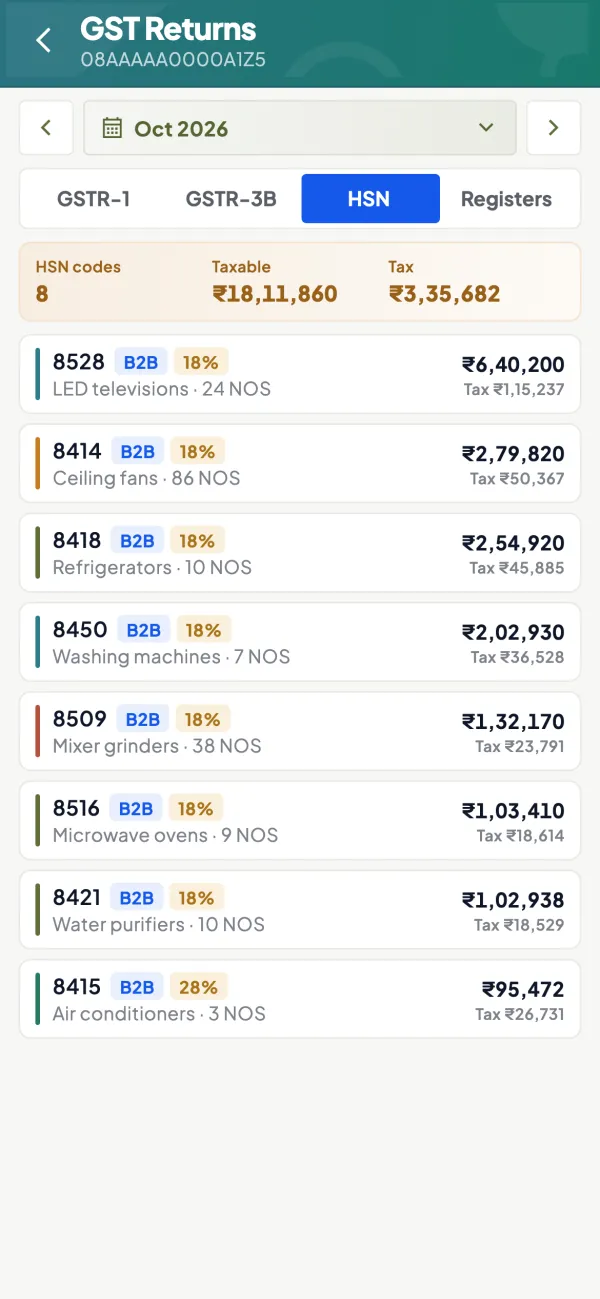
Cashflow OS shows a GSTR-1 view built from your TallyPrime data, so the owner or accountant can see the month's B2B, B2C and HSN totals on the phone any time during the month, not only on filing day. The tiles open bill-wise detail to find a missing GSTIN early, and the JSON can be downloaded for upload on the portal. Filing itself is still done on the GST portal.
Avoid these
Common mistakes
- MistakeFiling GSTR-1 on the last dayDo this instead
File by the 10th, a day before the due date, to leave room for portal slowdowns.
- MistakeAssuming a holiday moves the due dateDo this instead
The date stays as notified unless the government extends it; check the portal.
- MistakeSkipping nil returnsDo this instead
File nil returns on time; the late fee is lower but still applies.
- MistakeLetting old returns pile upDo this instead
Clear pending returns quickly; later returns are blocked and the three-year filing limit can apply.
Keep handy
Checklist
GSTR-1 due dates and late fee — 7 checks. Tick them as you go.
In Cashflow OS
How Cashflow OS helps
Cashflow OS puts your TallyPrime books on every phone in the team. Where it fits this topic:
GSTR-1 view all month
Cashflow OS shows a GSTR-1 view built from your TallyPrime data, so the month's B2B, B2C and HSN totals can be checked on the phone well before filing day.
See GST reports from your Tally data
Find a missing GSTIN early
Tiles open bill-wise and HSN-wise detail, and the JSON can be downloaded for upload on the portal. Filing itself is done on the GST portal.
Questions people ask
Is the GSTR-1 late fee waived for nil returns?
Can I pay the GSTR-1 late fee from input tax credit?
Is there interest on a late GSTR-1?
What if the due date falls on a holiday?
What is the GSTR-1 due date for a quarterly filer?
What is IFF?
Where is the GSTR-1 late fee paid?
How is the late fee split between CGST and SGST?
This page is general information for Indian businesses, not tax, legal or financial advice. Rules and rates change — check the official portals or your CA before acting.