GST GST basics
GST composition scheme
The composition scheme lets small businesses pay GST at a low flat rate on turnover and file simpler returns. In exchange they cannot collect GST from buyers, cannot claim input tax credit, and cannot sell across state lines.
- Small retailers
- Kirana and hardware shops
- Small manufacturers
- Restaurants not serving alcohol
- Small service providers

On this page 12
Who can opt in
The general limits, which are set by notification and should be confirmed on cbic-gst.gov.in:
- Traders, manufacturers and restaurants: aggregate turnover up to ₹1.5 crore in the previous financial year. A lower limit applies in some special category states.
- Service providers and mixed suppliers under the separate services composition option: turnover up to ₹50 lakh.
- A goods composition dealer may also supply some services, up to 10% of turnover or ₹5 lakh, whichever is higher.
Turnover is counted across all registrations under the same PAN in India, and if one registration opts in, all must.
Who cannot opt in
- Those making inter-state outward supplies of goods.
- Manufacturers of certain notified goods, such as ice cream, pan masala and tobacco products.
- Suppliers of goods not taxable under GST, such as alcoholic liquor for human consumption.
- Casual taxable persons and non-resident taxable persons.
- Those supplying through e-commerce operators who collect tax at source, subject to the relaxation for goods introduced in 2023; check the current conditions.
Rates of tax
| Category | Total rate (CGST + SGST) |
|---|---|
| Traders (on turnover of taxable supplies) | 1% |
| Manufacturers | 1% |
| Restaurants not serving alcohol | 5% |
| Service providers under the services option | 6% |
This tax comes out of your own pocket. You cannot show it on the bill or recover it from the buyer. You also pay tax under reverse charge at the normal rate where it applies, and tax on imports of services, without credit.
Worked comparison
A hardware retailer in Bhopal has annual sales of ₹1,20,00,000 (excluding tax), almost all to walk-in customers, and buys stock for ₹1,02,00,000 plus 18% GST.
Under composition: tax = 1% of ₹1,20,00,000 = ₹1,20,000, paid from margin. GST paid on purchases, ₹18,36,000, becomes part of cost.
Under normal GST: output tax 18% of ₹1,20,00,000 = ₹21,60,000, collected from customers. Credit ₹18,36,000. Cash paid ₹3,24,000, but that is collected from customers, not from margin.
The real comparison is price. Under composition, the retailer's cost per item is higher by the GST on purchases, and the shelf price includes it. Under normal GST, the retailer adds 18% on the bill. For a shop selling mainly to consumers who do not claim credit, composition often means lower paperwork for a similar final price. For a business selling to registered buyers, composition is usually a poor fit, because buyers get no credit and will prefer a regular supplier.
Documents and returns
- Issue a bill of supply, not a tax invoice, with the words "composition taxable person, not eligible to collect tax on supplies". See bill of supply under GST.
- Display "composition taxable person" at the place of business.
- CMP-08: quarterly statement and payment, generally by the 18th of the month after the quarter.
- GSTR-4: annual return. Its due date was 30 April and has been moved to 30 June from FY 2024-25; confirm on gst.gov.in.
- No monthly GSTR-1 or GSTR-3B.
Opting in and out
- Opt in before the start of the financial year by filing CMP-02 on the portal. New registrants can choose it at the time of registration.
- When opting in, stock on hand on which you claimed credit has to be accounted for and the credit reversed.
- If turnover crosses the limit during the year, you move out of the scheme from that day and must apply within the set time to switch to normal registration.
- You can also opt out voluntarily during the year by filing the withdrawal form. On moving out, you can claim credit on stock held on that day, subject to conditions.
A buyer checking your GSTIN on the portal will see that you are a composition dealer.
This is general information, not tax advice.
Common mistakes
- Charging GST on the bill while registered under composition. The tax collected must still be paid, and penalties can follow.
- Selling to a customer in another state, even once. Inter-state sales are not allowed under the scheme.
- Counting only taxable sales against the limit. Exempt sales are part of aggregate turnover.
- Claiming credit on purchases in the books, which composition dealers cannot do.
Using Cashflow OS as a composition dealer
Cashflow OS reads whatever is in TallyPrime, so a composition business still gets sales, purchases, outstanding, party statements and stock on the phone. The GSTR-1 and GSTR-3B views are meant for regular taxpayers; composition returns are prepared and filed on the portal by you or your accountant.
Avoid these
Common mistakes
- MistakeCharging GST on the bill under compositionDo this instead
Issue a bill of supply with the composition wording; tax wrongly collected must still be paid and penalties can follow.
- MistakeMaking even one inter-state saleDo this instead
Inter-state outward supplies of goods are not allowed under the scheme. Check every out-of-state order.
- MistakeCounting only taxable sales for the limitDo this instead
Aggregate turnover includes exempt sales, across all registrations under the same PAN.
- MistakeClaiming ITC on purchases in the booksDo this instead
Composition dealers cannot claim ITC; GST on purchases is part of cost.
Keep handy
Checklist
GST composition scheme — 8 checks. Tick them as you go.
In Cashflow OS
How Cashflow OS helps
Cashflow OS puts your TallyPrime books on every phone in the team. Where it fits this topic:
Your business on the phone
Cashflow OS reads what is in TallyPrime, so a composition business still gets sales, purchases, outstanding and stock on the phone.
See Tally on mobile
Statements for customers on credit
Party statements can be shared on WhatsApp as a PDF or a simple Hindi हिसाब page. Composition returns are prepared and filed on the portal.
See Party ledger statements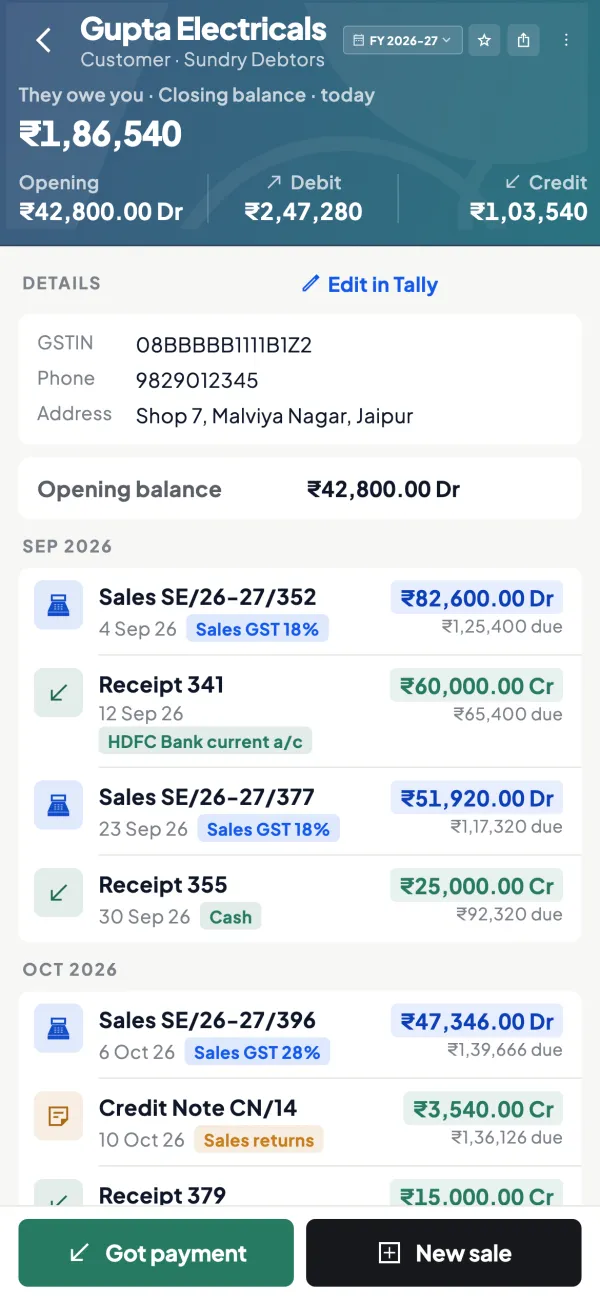
Questions people ask
Can a composition dealer issue a tax invoice?
Can a composition dealer buy from another state?
Is the 1% rate on total sales or only taxable sales?
Can I switch to regular GST in the middle of the year?
Can a composition dealer sell on credit?
Do composition dealers need to file GSTR-1?
Is the composition tax shown on the bill?
How do I opt in to composition?
This page is general information for Indian businesses, not tax, legal or financial advice. Rules and rates change — check the official portals or your CA before acting.