GST GST basics
Reverse charge mechanism under GST
Under reverse charge, the buyer, not the seller, pays GST to the government on certain notified goods and services. The buyer pays it in cash, reports it in GSTR-3B, and can usually claim it back as input tax credit.
- GST-registered businesses
- Manufacturers paying freight
- Traders hiring transporters
- Companies paying director fees
- Tenants of unregistered landlords
- Accountants filing GSTR-3B

On this page 11
How it differs from normal GST
Normally the supplier charges GST on the invoice, collects it and pays it. Under reverse charge (RCM), the supplier bills without GST and the recipient pays the tax directly. The government uses it where suppliers are numerous, small, or hard to track, such as transporters and advocates, or where the supplier is outside India.
There are two kinds:
- Notified supplies under section 9(3): listed goods and services where RCM applies whoever the supplier is.
- Purchases from unregistered suppliers under section 9(4): applies only to notified classes of recipients, currently mainly real estate promoters for certain shortfalls. An ordinary trader buying from an unregistered supplier does not pay RCM on that just for the supplier being unregistered.
Common cases for MSMEs
| Supply | Who pays under RCM |
|---|---|
| Goods transport agency (GTA) services, where the GTA has not opted to charge GST itself | Specified recipients such as registered businesses, factories and companies |
| Legal services by an advocate or firm of advocates | Business entity receiving them |
| Services of a director to the company | The company |
| Security services by a supplier that is not a company | Registered recipient (with exceptions) |
| Sponsorship services | Company or firm receiving them |
| Renting of commercial property by an unregistered landlord | Registered tenant (added in 2024, with later exceptions) |
| Import of services | The importer in India |
Goods under RCM include items such as raw cashew nuts, tendu leaves and raw cotton supplied by agriculturists. The lists change by notification; check cbic-gst.gov.in for the current schedule and conditions.
Worked example: freight
A Rajkot manufacturer hires a transport company (a GTA) that has not opted to charge GST itself. The freight bill is ₹50,000 without GST, and RCM applies at 5%.
- The GTA issues a consignment note and an invoice for ₹50,000, marked "tax payable on reverse charge".
- The manufacturer books ₹50,000 freight and an RCM liability of ₹2,500 (IGST if the GTA is in another state, else CGST ₹1,250 + SGST ₹1,250).
- In GSTR-3B, ₹2,500 goes into Table 3.1(d) and is paid in cash. It cannot be paid using credit.
- In the same GSTR-3B, ₹2,500 is claimed as ITC in Table 4A(3), since the freight is for business.
Net cost of the tax: zero, but cash is paid first and credited back, so a business short of cash still has to fund it. Confirm current GTA rates and options before relying on the 5% figure.
Time of supply and paperwork
When the tax becomes payable, in general terms:
- Goods: earliest of the date of receipt, the date of payment, or 31 days after the supplier's invoice.
- Services: earlier of the date of payment or 61 days after the supplier's invoice.
Documents: if the supplier is unregistered, the recipient issues a self-invoice, within the time limit set in the rules (currently 30 days from receipt), and a payment voucher when paying. If the supplier is registered, their invoice marked RCM is the document, and it should appear in your GSTR-2B.
Claiming the credit
RCM tax paid is generally available as input tax credit if the supply is used for business and is not blocked. For example, RCM paid on rent-a-cab services may be blocked under the same rules that block such credit for normal invoices; see blocked input tax credit. The 180-day payment rule for ITC does not apply to RCM supplies. Composition dealers pay RCM but cannot claim credit.
This is general information, not tax advice.
Common mistakes
- Paying RCM tax from the credit ledger. It must be paid in cash.
- Claiming the credit without paying the tax first.
- Paying the transporter's GST when the GTA has already charged GST on forward charge, or not paying RCM when it has not.
- Missing self-invoices for RCM purchases from unregistered suppliers.
- Forgetting RCM on director sitting fees and legal fees, which come up only a few times a year.
Tracking RCM in Tally and Cashflow OS
RCM entries are made in TallyPrime like any purchase, with the reverse charge setting on the ledger or voucher. Cashflow OS shows the freight, legal and rent ledgers and the Day Book on the phone, so the owner can see each month's RCM-type expenses at a glance. The GSTR-3B view prepared from Tally data shows the totals as booked; payment and filing happen on the GST portal.
Avoid these
Common mistakes
- MistakePaying RCM liability from the credit ledgerDo this instead
Pay RCM tax in cash through the electronic cash ledger, then claim it as credit in the same return if it is eligible.
- MistakeClaiming RCM credit before paying the taxDo this instead
Claim credit only for RCM tax actually paid; pay and claim in the same GSTR-3B where the rules allow.
- MistakePaying RCM when the GTA has already charged GSTDo this instead
Read the GTA's consignment note or invoice: if GST is charged on forward charge, do not pay it again under RCM.
- MistakeNo self-invoice for RCM buys from unregistered suppliersDo this instead
Issue a self-invoice within the time limit in the rules and a payment voucher when you pay, and keep both on file.
Keep handy
Checklist
Reverse charge mechanism under GST — 7 checks. Tick them as you go.
In Cashflow OS
How Cashflow OS helps
Cashflow OS puts your TallyPrime books on every phone in the team. Where it fits this topic:
See RCM-type expenses each month
Freight, legal and rent ledgers and the Day Book from your Tally data open on the phone, so the owner can see which RCM-type bills were booked this month.
See Financial reports from Tally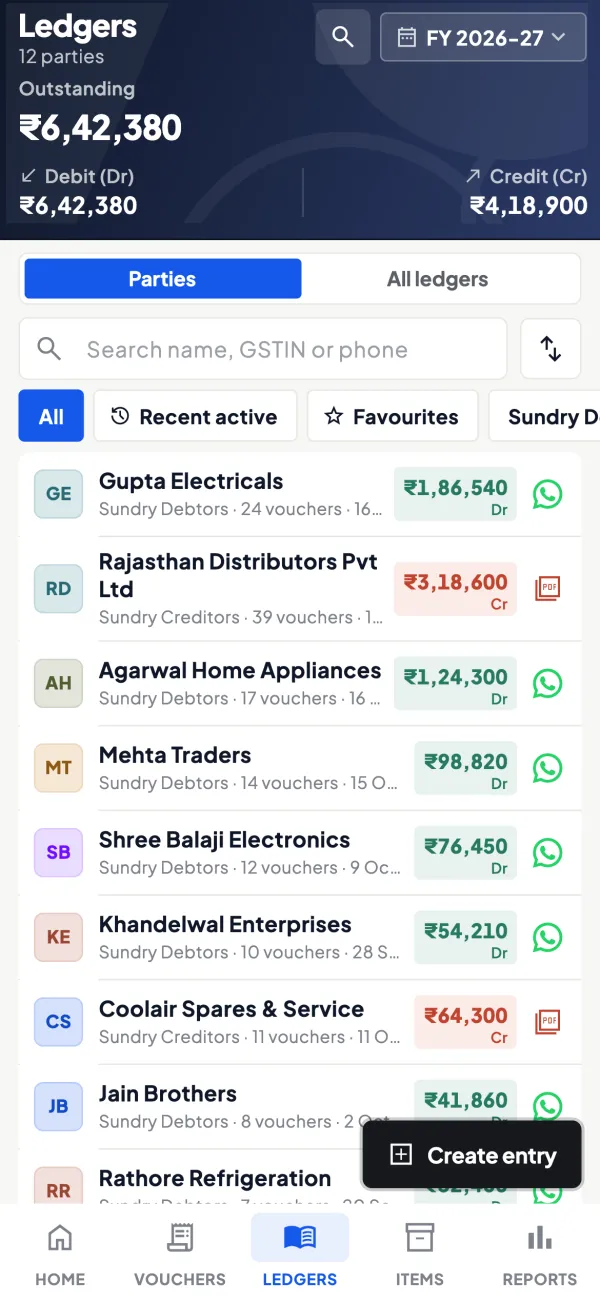
Check GSTR-3B totals before filing
The GSTR-3B view prepared from Tally data shows the totals as booked, for a review before the tax is paid and the return is filed on the GST portal.
See GST reports from your Tally data
Questions people ask
Is RCM payable on every purchase from an unregistered supplier?
Can RCM tax be paid using ITC?
Can I claim ITC on RCM tax in the same month?
Does a composition dealer pay RCM?
Does RCM apply to rent paid for a shop or office?
What happens if I miss paying RCM in a month?
Does RCM apply to imports of services?
Should RCM liability have its own ledgers?
This page is general information for Indian businesses, not tax, legal or financial advice. Rules and rates change — check the official portals or your CA before acting.