Glossary GST
Composition dealer
Definition
A composition dealer is a small GST-registered business that pays tax at a fixed rate on turnover, cannot charge GST on bills and cannot claim input tax credit.

Example
Ramesh Kirana in Jodhpur is under composition and sells ₹12,00,000 of goods in a quarter. It pays composition tax on that turnover from its own pocket, issues bills of supply, and cannot claim the GST on its purchases. A registered shop buying from Ramesh Kirana gets no input tax credit on those purchases.
Composition dealer in TallyPrime and in Cashflow OS
Where to find itIn TallyPrime
A composition business sets its GST registration type to composition in TallyPrime's company GST details. When you buy from one, set that supplier's ledger registration type to composition so no input credit is expected.
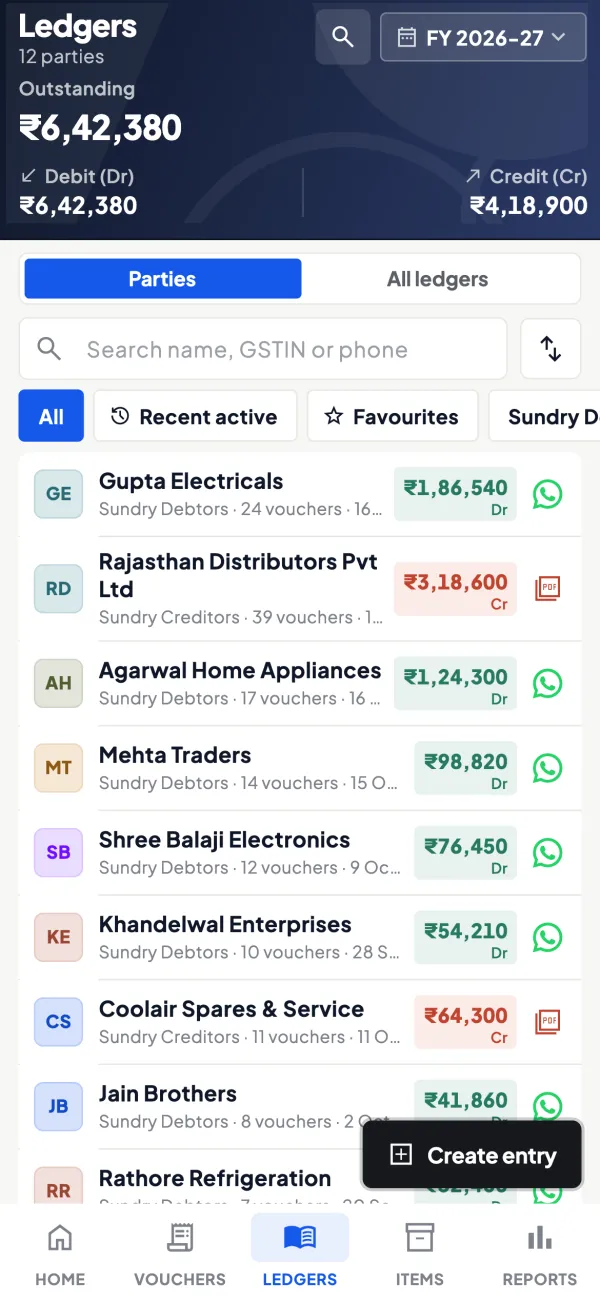
 On your phoneIn Cashflow OS
Cashflow OS reads party ledgers and purchases from Tally, so purchases from composition suppliers appear in the ledgers and reports as Tally records them.
Common misunderstandings
- Watch outShowing GST on the bill. A composition dealer issues a bill of supply and must not collect tax.
- Watch outAssuming the scheme suits everyone. Registered buyers lose ITC, which can cost you B2B customers.
Main rules
- Turnover limit: ₹1.5 crore in the previous year for most goods businesses (₹75 lakh in some special category states); a separate scheme for service providers has a ₹50 lakh limit.
- Rates on turnover: 1% for manufacturers and traders, 5% for restaurants not serving alcohol, 6% under the services scheme.
- Cannot collect GST from customers, so issues a bill of supply, not a tax invoice.
- Cannot claim input tax credit.
- Cannot make inter-state outward supplies of goods, and certain businesses (for example some manufacturers of notified goods) cannot opt in at all.
- Pays tax quarterly through CMP-08 and files an annual return in GSTR-4.
Limits, rates and the list of excluded businesses are set by notification, so check gst.gov.in before opting in. More in our guide on the GST composition scheme.
Example
A small kirana trader with ₹60 lakh annual turnover opts for composition. In a quarter it sells ₹15,00,000 of goods. Tax payable is 1% (0.5% CGST + 0.5% SGST), so ₹15,000, paid from its own pocket. The GST it paid on purchases stays part of the cost. A regular dealer with the same sales and an 18% rate charging customers ₹2,70,000 and claiming ₹2,20,000 ITC would pay ₹50,000, but would also have more billing and filing work. Whether the scheme suits a business depends on its buyers: registered buyers cannot claim ITC on purchases from a composition dealer.
Where it shows up in TallyPrime
A business on composition sets its GST registration type to composition in the company's GST details, and TallyPrime then prints a bill of supply and computes composition tax on turnover. When you buy from a composition dealer, mark the party ledger's registration type as composition so that TallyPrime does not expect ITC on those purchases and reports them correctly in your returns. See bill of supply under GST.
This is general information, not tax advice.
Related terms
Input tax credit (ITC)GSTINReverse charge (RCM)GSTR-3BAll terms A–Z
Questions about Composition dealer
Can a composition dealer show GST on the bill?
Can I claim ITC on purchases from a composition dealer?
Can a business leave the composition scheme mid-year?
Can a composition dealer sell goods to another state?
How do I know if a supplier is a composition dealer?
This page is general information for Indian businesses, not tax, legal or financial advice. Rules and rates change — check the official portals or your CA before acting.