Invoices & documents Invoices
Bill of supply format
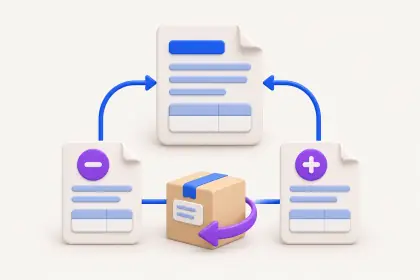
A bill of supply is the GST document you issue instead of a tax invoice when you cannot charge GST: as a composition dealer, or when the goods or services are exempt. It looks like an invoice but shows no tax.
- Composition dealers
- Kirana and grocery shops
- Sellers of exempt goods
- Suppliers of exempt services
- Accountants setting up bill formats

On this page 12
Who issues a bill of supply
- Composition dealers, who pay tax on turnover at a fixed rate and cannot collect GST from buyers. See the GST composition scheme.
- Registered persons selling exempt goods or services, such as fresh vegetables, unbranded grains or certain educational services.
- Mixed sellers who sell both taxable and exempt items to an unregistered buyer may issue one invoice-cum-bill of supply covering both.
The rules are in section 31(3)(c) of the CGST Act and Rule 49 of the CGST Rules. This is general information, not tax advice.
Fields a bill of supply must show
| Field | Example |
|---|---|
| Supplier name, address, GSTIN | Laxmi Kirana Bhandar, Bikaner, 08ABCDE1234F1Z3 |
| Serial number and date | BOS/25-26/1342, 08-11-2025 |
| Recipient name, address, GSTIN if registered | Hotel Marudhar, Bikaner, 08PQRSX5678K1Z0 |
| HSN or SAC | Per item, as applicable to your turnover |
| Description | Toor dal, sugar, cooking oil |
| Value after discount | ₹18,750 |
| Signature | Authorised signatory |
The serial number follows the usual GST rule: up to 16 characters, letters, digits, hyphen and slash, unique for the financial year. Use a BOS/ prefix if you also issue tax invoices.
Small sales below ₹200
For individual sales below ₹200 to unregistered buyers who do not ask for a bill, the rules allow one consolidated bill of supply at the end of the day instead of one per sale. Many counters still give a printed slip for every sale, which customers prefer anyway.
The composition dealer declaration
A composition dealer must print the words composition taxable person, not eligible to collect tax on supplies at the top of the bill of supply. The same declaration should be displayed at the shop and on the signboard. Missing it is one of the most common errors found during inspections of small shops.
A composition dealer cannot issue a tax invoice and cannot show GST separately, even if a customer asks for it. The tax the dealer pays is a cost built into the price.
Bill of supply vs tax invoice
| Point | Bill of supply | Tax invoice |
|---|---|---|
| Who issues | Composition dealers, exempt suppliers | Regular registered taxpayers |
| GST shown | No | Yes, with rate and amount |
| Buyer's input tax credit | Not available | Available if conditions met |
| Place of supply line | Not required | Required for inter-state supplies |
| Numbering rule | Same 16-character rule | Same 16-character rule |
See tax invoice format under GST for the full list on the other side.
Worked example: a mixed bill
A regular-scheme grocer sells to an unregistered customer: rice sold loose (exempt) and packaged biscuits (taxable). The grocer can issue one document showing both.
| Item | Value | GST |
|---|---|---|
| Loose rice 25 kg | ₹1,250 | Exempt |
| Biscuits, 2 cartons | ₹1,800 | At applicable rate |
| Total | ₹3,050 + tax on biscuits |
Whether an item is exempt can depend on packaging, labelling and branding, and the rules on pre-packaged food have changed in recent years. Check the current position for each HSN before treating it as exempt. See nil-rated, exempt and non-GST supplies.
Moving out of composition mid-year
When a composition dealer crosses the turnover limit or opts out, the switch to tax invoices happens from the date of withdrawal. Bills raised up to that date stay as bills of supply; from that date, tax invoices with GST are issued in a new series. Plan the switch carefully: update your billing software, print the new series, remove the composition declaration from the signboard and bills, and tell regular buyers that from now on they will receive tax invoices on which they can claim credit. Many buyers who avoided you because of the missing credit come back once you issue tax invoices.
Checklist
- Declaration at the top if you are under composition.
- No GST rate or amount anywhere on the bill.
- Separate series from any tax invoices you issue.
- HSN for each item where required.
- Bills of supply counted in the documents-issued table of GSTR-1, where you file GSTR-1.
Doing this with Tally and Cashflow OS
TallyPrime prints a bill of supply for composition companies and for exempt items based on your GST settings. With Cashflow OS, sales entered from the phone are written into Tally through the connector, so the document follows the company's Tally setup. The owner sees daily sales, receipts and cash from the home screen without opening Tally.
Avoid these
Common mistakes
- MistakeLeaving out the composition declarationDo this instead
Print 'composition taxable person, not eligible to collect tax on supplies' at the top and display it at the shop.
- MistakeShowing GST separately on a composition billDo this instead
A composition dealer cannot collect or show GST, even if a customer asks; the tax is a cost built into the price.
- MistakeTreating an item as exempt from memoryDo this instead
Check the current position for each HSN, as exemption can depend on packaging and labelling and rules have changed.
- MistakeUsing the same number series as tax invoicesDo this instead
Use a separate series, for example with a BOS/ prefix, unique for the financial year.
Keep handy
Checklist
Bill of supply format — 8 checks. Tick them as you go.
In Cashflow OS
How Cashflow OS helps
Cashflow OS puts your TallyPrime books on every phone in the team. Where it fits this topic:
Sales from the phone, written into Tally
Sales entered from the phone are written into Tally through the connector, so the document follows the company's Tally GST setup.
See Create Tally vouchers from your phone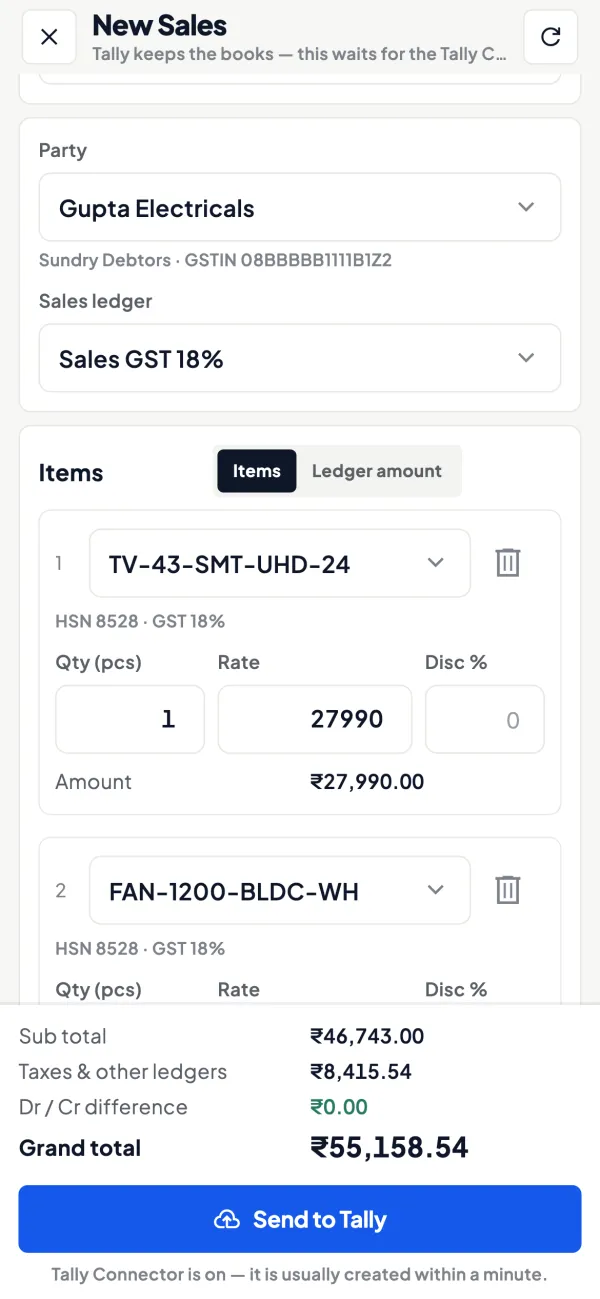
Daily sales without opening Tally
The owner sees daily sales, receipts and cash on the home screen, synced from Tally.
See Tally on mobile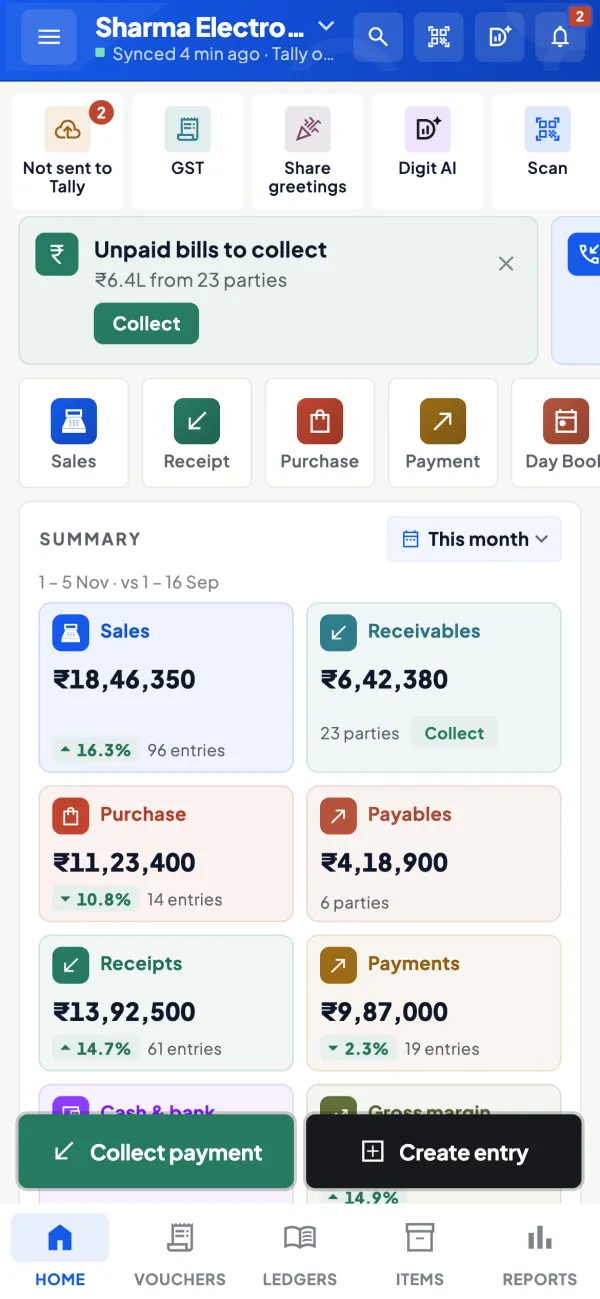
Questions people ask
Can a composition dealer charge GST on a bill?
Can the buyer claim credit on a bill of supply?
Is a bill of supply needed for exempt services?
Do unregistered businesses issue bills of supply?
What declaration does a composition dealer print on the bill?
Do I need a separate bill for every sale under ₹200?
Can I issue one bill for exempt and taxable items?
What changes when I leave the composition scheme?
This page is general information for Indian businesses, not tax, legal or financial advice. Rules and rates change — check the official portals or your CA before acting.