Invoices & documents Retail billing
Cash memo vs tax invoice
A cash memo is a simple bill for an on-the-spot cash sale. If your business is registered under regular GST, a cash memo for a taxable sale must still carry the details of a tax invoice; only very small sales to consumers can be grouped into one bill at day end.
- Retail shops and counters
- Showrooms
- Composition dealers
- Kirana and general stores
- Shop billing staff
On this page 12
What people mean by cash memo
A cash memo is the slip a counter gives when a customer pays immediately: item, quantity, rate, total, and often a stamp saying paid. It doubles as invoice and receipt. The term comes from pre-GST days and is still printed on many bill books.
What the document must contain depends on who you are, not what it is called:
| Your status | Document for a taxable sale |
|---|---|
| Not registered under GST | Ordinary cash memo or bill, no GST shown |
| Composition dealer | Bill of supply with composition declaration |
| Regular GST registration | Tax invoice, even if titled cash memo |
| Regular registration, exempt item | Bill of supply |
The ₹200 rule
For a regular taxpayer, the rules allow one relief for small consumer sales. If the value of a supply is less than ₹200, the buyer is unregistered, and the buyer does not ask for an invoice, you need not issue a tax invoice for that sale. Instead, you issue one consolidated tax invoice at the close of each day covering all such sales.
Example: a paan and cold-drink counter in Varanasi makes 140 sales under ₹200 on a Saturday, totalling ₹11,860 including tax. At closing, one consolidated tax invoice for ₹11,860, split into taxable value and GST by rate, is entered. Any customer who asks for a bill still gets one.
This is general information, not tax advice. Confirm the current rule on cbic-gst.gov.in.
What a GST-compliant counter bill shows
| Field | Example |
|---|---|
| Shop name, address, GSTIN | Gupta Kitchen World, Lucknow, 09ABCDE1234F1Z8 |
| Bill number and date | CS/25-26/08812, 09-11-2025 |
| Customer | Name and address needed if the bill is ₹50,000 or more |
| Item, HSN, qty, rate | Pressure cooker 5 L, HSN 7615, 1, ₹2,360 |
| Taxable value and GST | ₹2,000 + CGST ₹180 + SGST ₹180 (illustrative) |
| Total | ₹2,360 |
| Payment mode | UPI |
Price tags in retail are usually GST-inclusive, so the bill works backwards: ₹2,360 ÷ 1.18 = ₹2,000 taxable value. Make sure your billing system back-calculates correctly and rounds only the final total.
Why customers ask for a pakka bill
- Warranty: manufacturers ask for a proper invoice with the serial number.
- Business buyers: a registered buyer needs your tax invoice with their GSTIN to claim credit. See GST on sales to unregistered buyers for the other side.
- Reimbursement: employees claiming expenses need a full bill.
A kachcha slip without tax details helps nobody: the customer cannot use it and your sales figure becomes questionable.
Cash sales and your returns
Counter sales to consumers are B2C supplies in GSTR-1, reported in summary by rate and state rather than invoice by invoice, except for larger inter-state B2C bills. Your day's cash memos, consolidated bills and UPI receipts should add up to the B2C figure. See B2B vs B2C invoices in GSTR-1.
Daily closing checklist for a counter
- Print or note the last bill number of the day.
- Prepare the consolidated invoice for sub-₹200 sales, if you use the relief.
- Match cash in drawer plus UPI and card settlements with the day's bills.
- Note cancelled bills with reason; keep all copies.
- Enter or sync the day's sales into your books the same day.
Common mistakes
- Two bill books, one with GST and one without, for the same registered shop.
- Charging GST on a bill as a composition dealer.
- Writing cash memo when the buyer gave their GSTIN; issue a proper tax invoice with their details.
- Not issuing a bill for UPI sales because the bank has the record. The bank does not replace your invoice.
Doing this with Tally and Cashflow OS
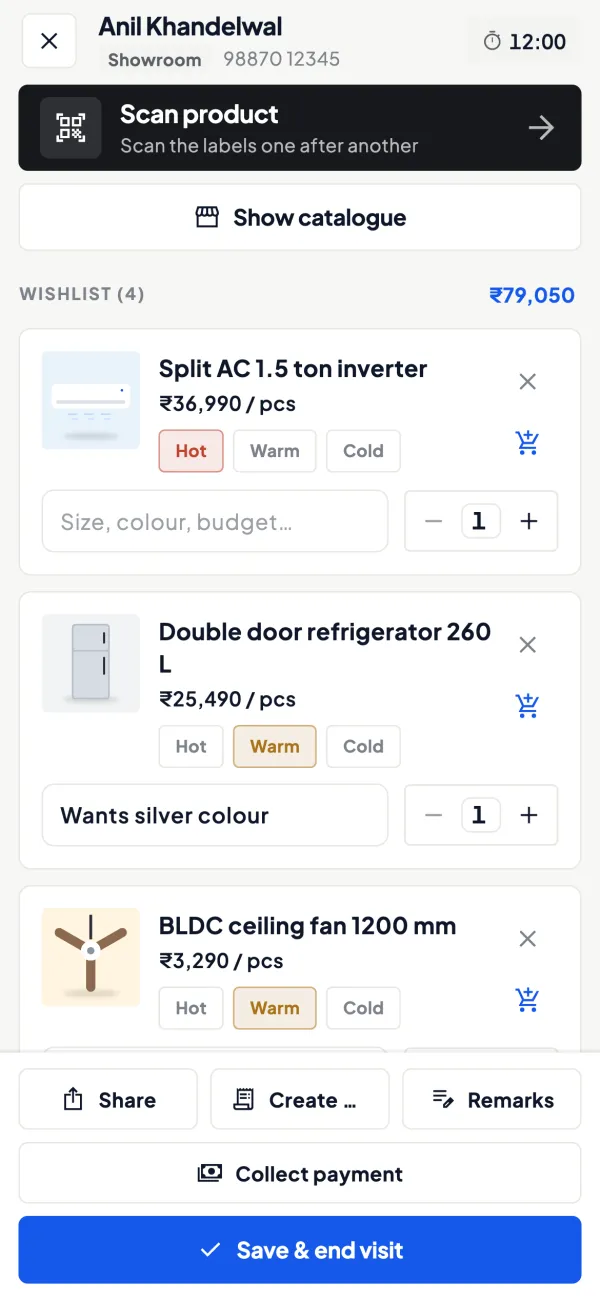
Counter sales booked in TallyPrime sync to Cashflow OS, so the owner sees today's sales, cash and bank on the home screen and can compare them with the same day last month. For showrooms, the walk-in module looks up a customer by mobile number and shows past visits and wishlists, and a sales order or sales voucher can be posted to Tally from the phone. See showroom walk-ins.
Avoid these
Common mistakes
- MistakeKeeping two bill books, with and without GSTDo this instead
A registered shop should bill every taxable sale through one numbered series with the correct GST details.
- MistakeCharging GST as a composition dealerDo this instead
Composition dealers issue a bill of supply with the composition declaration and cannot collect GST from customers.
- MistakeGiving a cash memo when the buyer gives a GSTINDo this instead
Issue a full tax invoice with the buyer's name, address and GSTIN so they can claim credit.
- MistakeSkipping bills for UPI salesDo this instead
The bank record does not replace an invoice. Bill every sale, or include small ones in the day's consolidated invoice.
Keep handy
Checklist
Cash memo vs tax invoice — 8 checks. Tick them as you go.
In Cashflow OS
How Cashflow OS helps
Cashflow OS puts your TallyPrime books on every phone in the team. Where it fits this topic:
Today's sales and cash on the phone
Counter sales booked in TallyPrime sync to the home screen, so the owner sees today's sales, cash and bank against the same period before.
See Tally on mobile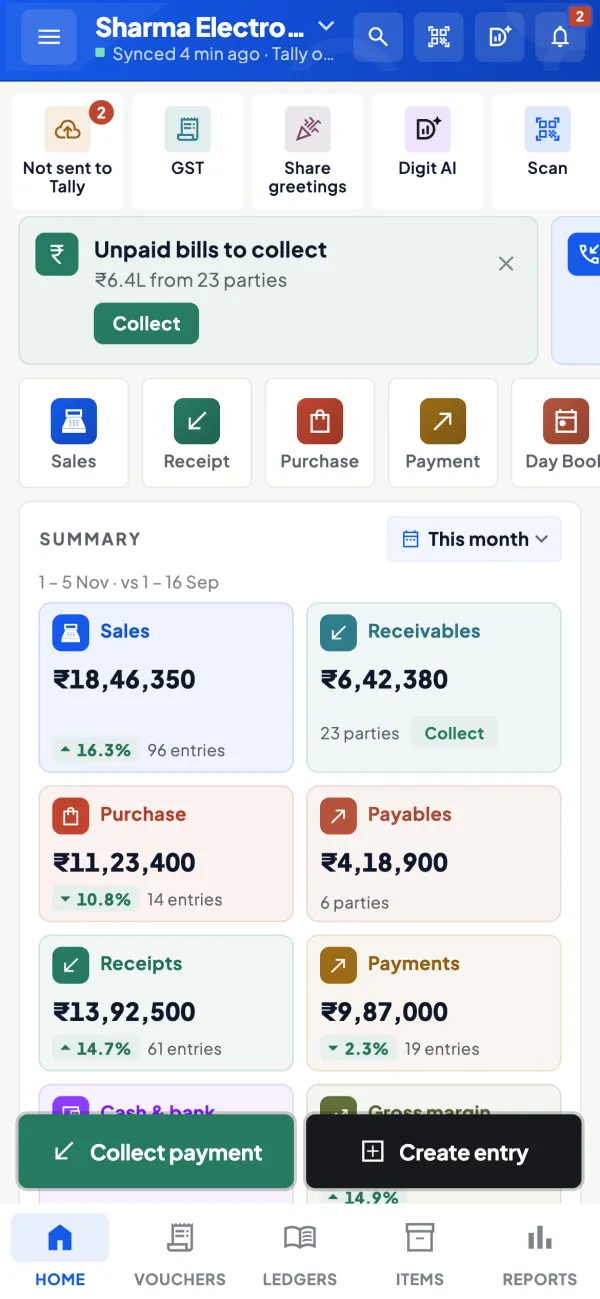
Walk-ins and sales from the phone
The walk-in module finds a customer by mobile number with past visits and wishlists, and a sales voucher can be posted to Tally from the phone.
See Showroom walk-ins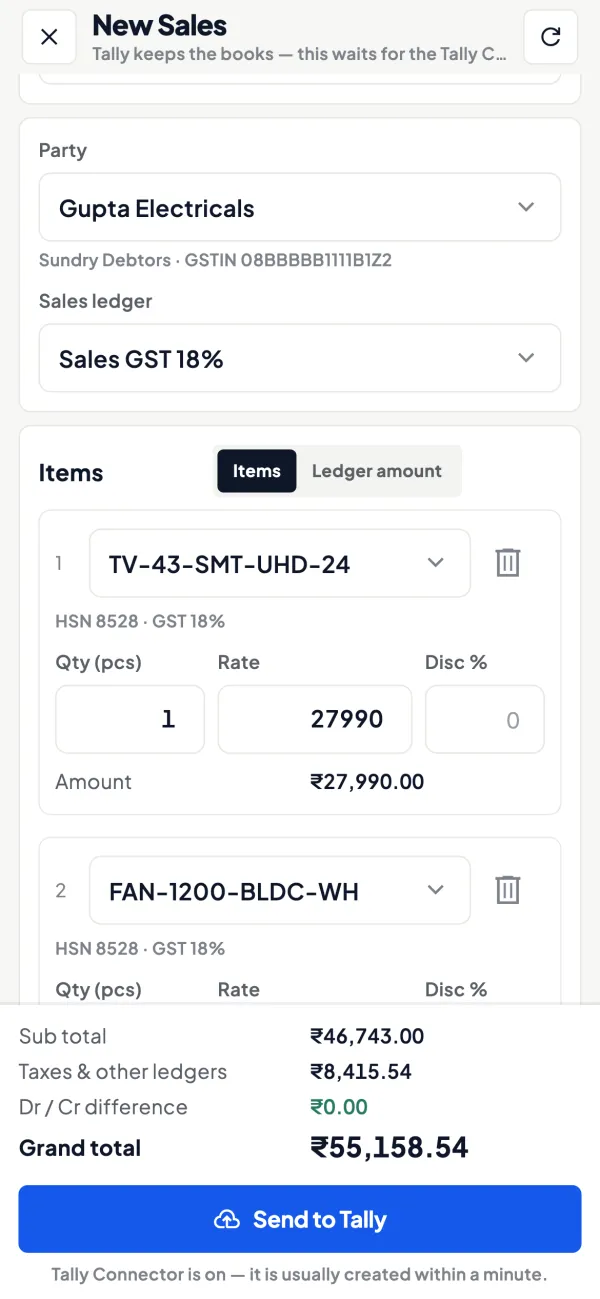
Questions people ask
Is a cash memo valid for GST input tax credit?
Do I need to give a bill for a ₹150 sale?
Can an unregistered shop show GST on its bill?
Is a bill of supply the same as a cash memo?
Must a counter bill show HSN codes?
Can I write the bill in Hindi?
How do I bill a GST-inclusive price?
Do I report each cash memo separately in GSTR-1?
This page is general information for Indian businesses, not tax, legal or financial advice. Rules and rates change — check the official portals or your CA before acting.