Invoices & documents Retail billing
Retail invoice vs tax invoice
Under the old VAT system, a retail invoice went to consumers and a tax invoice to dealers who wanted credit. Under GST that split has gone: a regular registered business issues a tax invoice to everyone, and only the buyer details change between a business and a consumer.
- Retail shops and showrooms
- Counter billing staff
- Sellers to dealers and consumers
- Shopkeepers moving from VAT habits
- Accountants
On this page 12
Where the two names came from
In most states before 2017, a VAT dealer printed two kinds of bills. A tax invoice showed VAT separately and let the buying dealer claim input credit. A retail invoice, given to end consumers, often showed only an inclusive price with no tax split. Many shopkeepers still say retail bill for counter sales and tax bill for dealers.
GST replaced this. Section 31 of the CGST Act requires a registered person making a taxable supply to issue a tax invoice, whoever the buyer is. A separate retail invoice is not a GST document type. This is general information, not tax advice.
The habit of keeping two kinds of bill books has outlived the law that created it. Some shops still keep a retail bill book without tax details for consumers and a tax bill book for dealers. For a regular GST registration this is a problem: every taxable sale must be on a tax invoice from a numbered series, so the second book creates sales that do not match your returns.
B2B vs B2C tax invoice
| Point | B2B (registered buyer) | B2C (consumer or unregistered) |
|---|---|---|
| Document | Tax invoice | Tax invoice |
| Buyer GSTIN | Mandatory | Not applicable |
| Buyer name and address | Mandatory | Needed if value is ₹50,000 or more |
| Tax shown separately | Yes | Yes, rate and amount |
| Buyer can claim credit | Yes, if conditions met | No |
| In GSTR-1 | Invoice by invoice | Summary by rate and state, except B2C large |
| E-invoice (if you are above the limit) | Yes | No; large businesses print a dynamic QR instead |
B2C large invoices
A B2C invoice for an inter-state supply above a value threshold is reported individually in GSTR-1 as B2C large, with the place of supply. The threshold was lowered to ₹1 lakh in 2024. Confirm the current figure on gst.gov.in and read B2C large invoices in GSTR-1.
Example: a Jaipur furniture shop sells a ₹1,40,000 dining set to a consumer in Ahmedabad, delivered there. Place of supply is Gujarat, so IGST applies, and the invoice is reported as B2C large with the customer's name and delivery address on it.
When a consumer turns out to be a business
A walk-in customer pays, takes the bill and then calls the next day: please put my GSTIN on the bill. If the invoice has not been reported yet, many businesses cancel and reissue it with the buyer's details in the same period, keeping the cancelled copy. If it has already been reported in GSTR-1 as B2C, it can be amended in a later GSTR-1, within the time limit for amendments. See GSTR-1 amendments. Asking have you a GSTIN? at billing time avoids the whole exercise.
Inclusive pricing on counter bills
Consumers see GST-inclusive prices, so counter bills often back-calculate tax.
| Item | MRP-style price | Taxable value | GST (illustrative) |
|---|---|---|---|
| Ceiling fan | ₹2,950 | ₹2,500.00 | ₹450.00 at 18% |
| LED bulb pack | ₹472 | ₹400.00 | ₹72.00 at 18% |
| Total | ₹3,422 | ₹2,900.00 | ₹522.00 |
Rates change by notification; use the current rate for each HSN.
Who issues something other than a tax invoice
- Composition dealers: bill of supply, no tax shown. See bill of supply format.
- Exempt goods or services: bill of supply.
- Unregistered businesses: an ordinary bill or cash memo, no GST.
- Small sales under ₹200: a regular taxpayer may issue one consolidated invoice at day end, if buyers do not ask for one.
Counter billing checklist
- One bill format for all customers, with an optional GSTIN field.
- Ask for GSTIN before printing, not after.
- Collect name and address for bills of ₹50,000 and above, and for deliveries out of state.
- Show taxable value and GST even on inclusive-price bills.
- Keep a single series per counter so numbering stays clean.
Doing this with Tally and Cashflow OS
TallyPrime uses the same sales voucher for B2B and B2C bills; the party's GST registration type decides how it is treated in GST reports. Cashflow OS prepares GSTR-1 views from that Tally data, with tiles that open bill-wise and HSN-wise detail, so you can check that B2C, B2C large and B2B rows look right before downloading the JSON for the portal. See GST reports.
Avoid these
Common mistakes
- MistakeKeeping a separate retail bill book without tax detailsDo this instead
Issue tax invoices from a numbered series for every taxable sale, so all sales appear in your returns.
- MistakeAsking for the buyer's GSTIN after printing the billDo this instead
Ask 'do you have a GSTIN?' at billing time to avoid cancelling and reissuing invoices later.
- MistakeInclusive-price bills with no tax splitDo this instead
Back-calculate and show taxable value, GST rate and amount even when the customer sees an inclusive price.
- MistakeMissing customer details on large out-of-state B2C salesDo this instead
Record name, delivery address and place of supply; check the current B2C large limit on gst.gov.in.
Keep handy
Checklist
Retail invoice vs tax invoice — 7 checks. Tick them as you go.
In Cashflow OS
How Cashflow OS helps
Cashflow OS puts your TallyPrime books on every phone in the team. Where it fits this topic:
Check B2B and B2C rows before filing
Cashflow OS prepares GSTR-1 views from your Tally sales vouchers, with tiles that open bill-wise detail, so you can see that B2C, B2C large and B2B rows look right.
See GST reports from your Tally data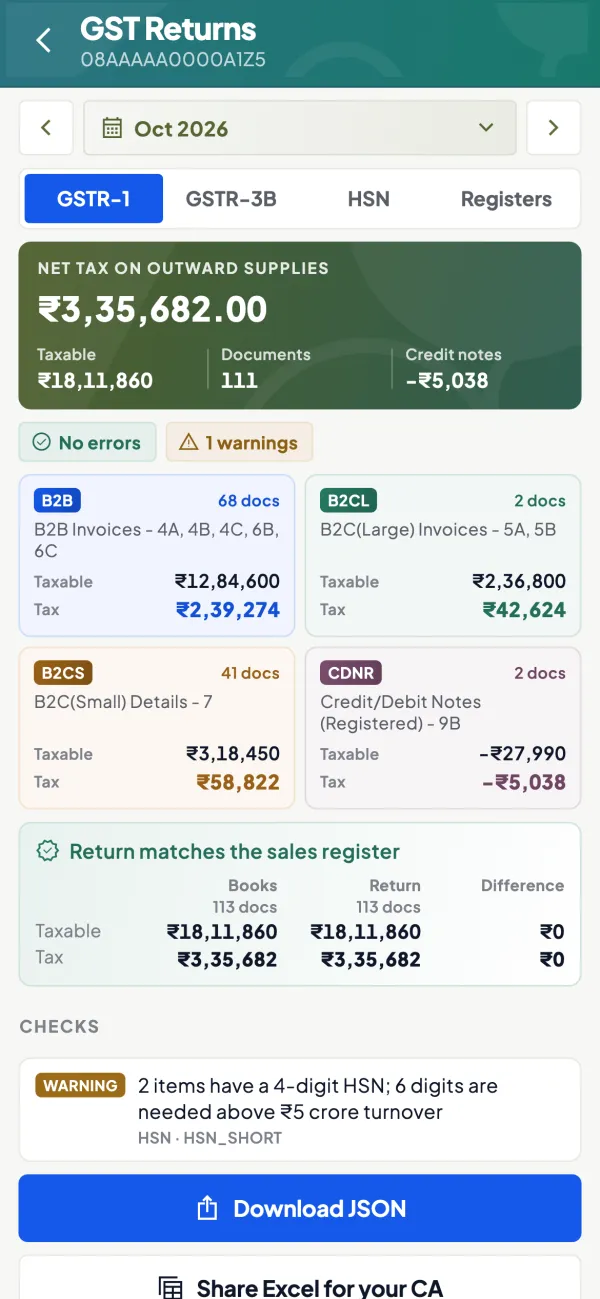
HSN-wise detail and JSON download
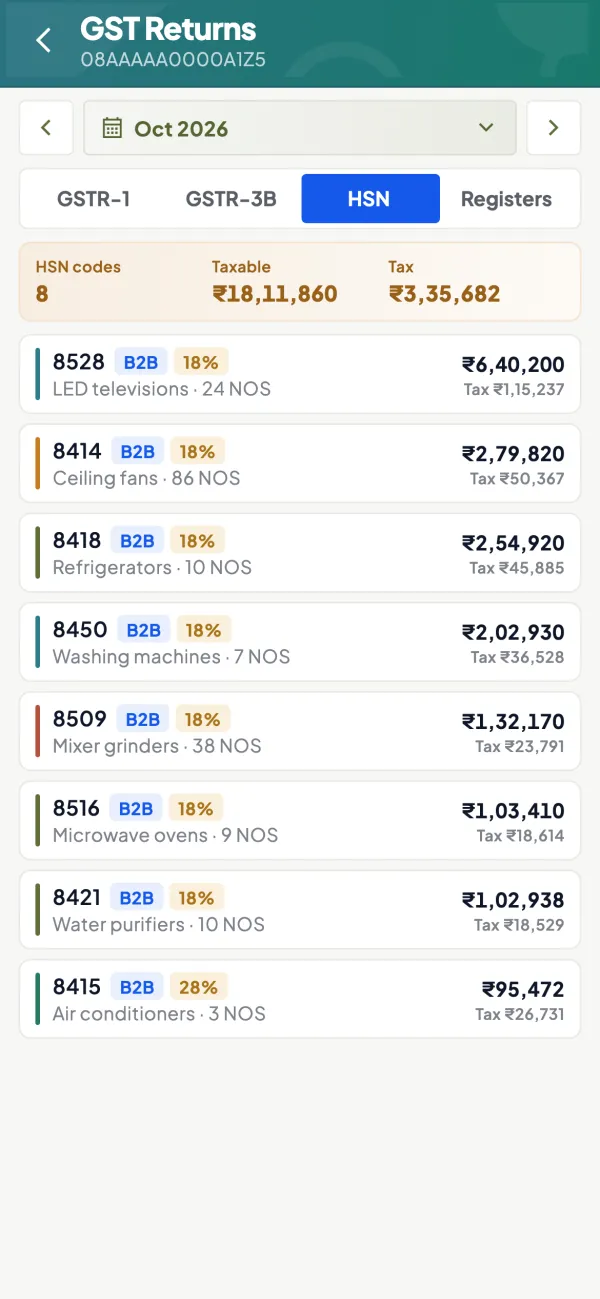
The HSN-wise view helps spot wrong rates, and the JSON for the portal can be downloaded. Filing is done on the GST portal.
Questions people ask
Is a retail invoice valid under GST?
Must I show GST separately on consumer bills?
Can a consumer claim GST credit?
Can I keep separate series for consumer and dealer bills?
Can I issue one invoice for many small sales?
What if a walk-in customer later asks for their GSTIN on the bill?
Do B2C sales need an e-invoice?
What does a composition dealer issue?
This page is general information for Indian businesses, not tax, legal or financial advice. Rules and rates change — check the official portals or your CA before acting.