GST GST B2C
GST on sales to unregistered buyers
Sales to customers without a GSTIN are B2C sales. You still charge GST at the item's rate, but the invoice details, the way you report it in GSTR-1 and the place of supply rules differ from B2B sales.
- Retail shops and showrooms
- Furniture and electronics stores
- Online sellers to consumers
- Jewellers
- Billing counters and accountants
On this page 12
What changes when the buyer is unregistered
| B2B (registered buyer) | B2C (unregistered buyer) | |
|---|---|---|
| Buyer's GSTIN on invoice | Mandatory | Not applicable |
| Buyer's name and address | Mandatory | Mandatory if taxable value is ₹50,000 or more |
| Buyer's ITC | Available | None |
| GSTR-1 reporting | Invoice-wise | Consolidated by state and rate, except B2C large |
| E-invoice (IRN) | If your turnover is above the limit | Not required; dynamic QR for very large businesses |
Tax is charged the same way: same rate, same CGST/SGST or IGST split.
The ₹200 and ₹50,000 points
- Below ₹200: where the buyer is unregistered and does not ask for an invoice, you need not issue one for each sale. Issue a consolidated tax invoice at the end of the day for all such sales.
- ₹50,000 and above: the invoice must carry the buyer's name and address and the delivery address, with state name and code.
Between these, a regular tax invoice without the buyer's details is acceptable, though recording the state is good practice. The full list of invoice fields is in GST invoice mandatory fields.
Place of supply for B2C
For goods, the place of supply is where the movement of goods ends for delivery to the buyer. Over-the-counter sales, where the customer collects at your shop, are generally intra-state: CGST + SGST. If you ship to a customer in another state, it is inter-state: IGST, and the state of delivery decides where the tax goes. See place of supply for goods.
Example. A Jaipur furniture showroom sells a sofa set for ₹80,000 + 18%.
- Customer from Jaipur, delivered in Jaipur: CGST ₹7,200 + SGST ₹7,200.
- Customer orders for delivery to Ahmedabad: IGST ₹14,400. Value is under ₹1,00,000, so it goes into B2C small for Gujarat.
- Same customer orders goods worth ₹1,20,000 for Ahmedabad: IGST, and the invoice is reported individually in B2C large.
Reporting in returns
- B2C small (B2CS): intra-state B2C sales of any value, and inter-state B2C sales up to the B2C large limit, consolidated by place of supply and rate.
- B2C large (B2CL): inter-state invoices to unregistered buyers above the limit (₹1,00,000 at present), invoice-wise; see B2C large invoices.
- GSTR-3B table 3.2: inter-state supplies to unregistered persons, by state.
- Credit notes to unregistered buyers have their own table in GSTR-1.
Cash receipts
B2C sales often mean cash. Income-tax law (Section 269ST) bars receiving ₹2,00,000 or more in cash from one person in a day, for a single transaction, or for transactions relating to one event. A ₹2,40,000 jewellery or electronics sale cannot be taken fully in cash, even if split across two bills on the same day. Take the excess through UPI, card or bank transfer. This is an income-tax rule, separate from GST. This is general information, not tax advice.
When a registered buyer is billed as B2C
Sometimes a customer reveals a GSTIN after the bill is made. If the GSTR-1 for that period is not yet filed, cancel and re-issue the invoice, or edit it in the books, so it goes into B2B. If it is filed, the change has to be made through an amendment, moving the invoice from B2C to B2B. Ask 'GST bill chahiye?' at the counter before billing; it saves this work.
Common mistakes
- Charging CGST + SGST on goods shipped to another state.
- Leaving out name and address on high-value B2C invoices.
- All B2C sales reported under your own state in B2CS, even when shipped elsewhere.
- Splitting one large cash sale into several bills.
Walk-in sales with Tally and Cashflow OS
Walk-in sales are billed in TallyPrime, with a cash or walk-in customer ledger and the state set on the voucher. In Cashflow OS, showroom staff can look up a walk-in customer by mobile number to see past visits and wishlists, and a sales order or invoice can be posted to Tally with writing back on; GST is worked out from the item and the party's state. The GSTR-1 view shows B2C small and B2C large totals for the period.
Avoid these
Common mistakes
- MistakeCharging CGST + SGST on goods shipped to another stateDo this instead
Use the delivery state as the place of supply; an out-of-state delivery takes IGST.
- MistakeNo name or address on high-value B2C invoicesDo this instead
Capture name, address and delivery address with state for every B2C invoice of ₹50,000 or more.
- MistakeAll B2C sales reported under your own stateDo this instead
Record the delivery state on each B2C invoice so B2C small is summarised by the right place of supply.
- MistakeSplitting one large cash sale into several billsDo this instead
Take amounts of ₹2,00,000 or more from one person by UPI, card or bank transfer; splitting bills does not avoid the income-tax limit.
Keep handy
Checklist
GST on sales to unregistered buyers — 7 checks. Tick them as you go.
In Cashflow OS
How Cashflow OS helps
Cashflow OS puts your TallyPrime books on every phone in the team. Where it fits this topic:
Walk-in customers by mobile number
Showroom staff can look up a walk-in customer by mobile number to see past visits and wishlists, and with writing back on, post the sale to Tally with GST worked out from the item and state.
See Showroom walk-ins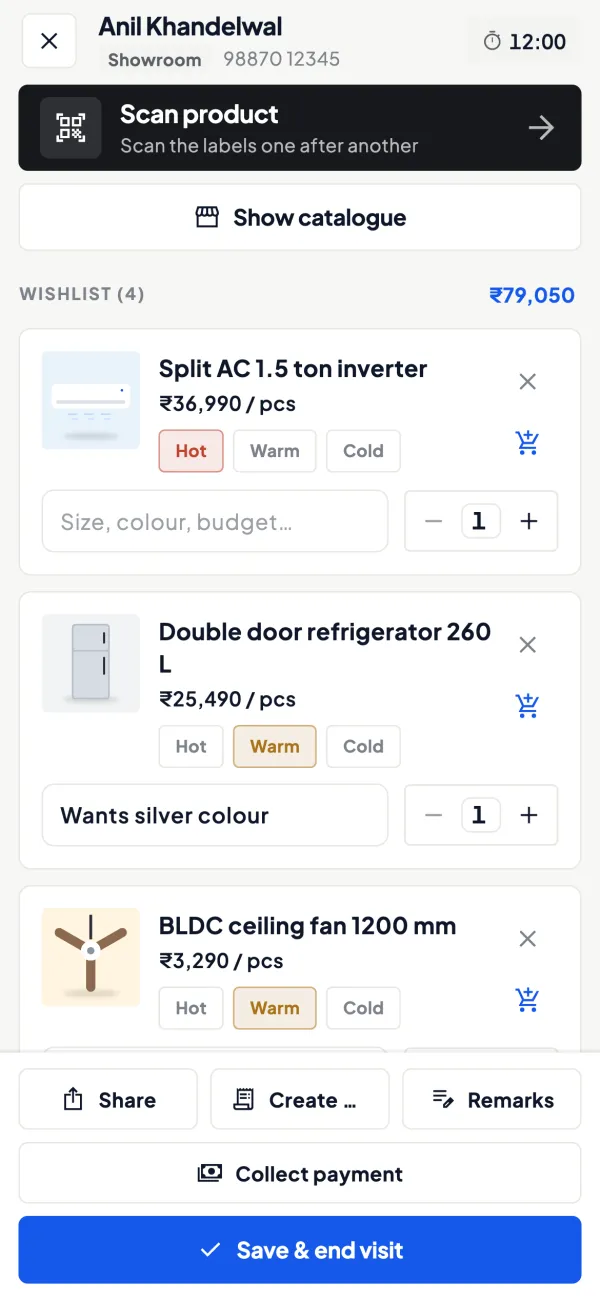
B2C totals before filing
The GSTR-1 view prepared from your Tally data shows B2C small and B2C large totals for the period, so a sale under the wrong state shows up early.
See GST reports from your Tally data
Questions people ask
Is GST charged on sales to unregistered buyers?
Is the customer's name mandatory on a B2C invoice?
How are B2C sales reported in GSTR-1?
Can I issue one bill for many small sales?
What is the B2C large limit in GSTR-1?
Are intra-state B2C sales ever reported invoice-wise?
What if a customer gives a GSTIN after the bill is made?
Do B2C invoices need an e-invoice IRN?
This page is general information for Indian businesses, not tax, legal or financial advice. Rules and rates change — check the official portals or your CA before acting.