GST GST invoices
Bill of supply under GST
A bill of supply is the document you issue instead of a tax invoice when no GST can be charged: by a composition dealer, or by anyone supplying exempt goods or services. It looks like an invoice but shows no tax.
- Composition taxpayers
- Grocers selling fresh produce
- Clinics and exempt service providers
- Regular dealers with exempt items
- Accountants and tax practitioners

On this page 12
Who issues it
- Composition taxpayers: they pay tax on turnover at a fixed rate and cannot collect GST from buyers. Every sale goes on a bill of supply. See GST composition scheme.
- Registered persons supplying exempt goods or services: for example, a grocer selling fresh vegetables, or a clinic supplying exempt healthcare services.
Exports under LUT are not on a bill of supply. They are zero-rated and go on a tax invoice with the LUT declaration.
What it must contain
Rule 49 of the CGST Rules sets the contents:
- Name, address and GSTIN of the supplier.
- A consecutive serial number, up to 16 characters, unique for the financial year.
- Date of issue.
- Name, address and GSTIN (or UIN) of the recipient, if registered.
- HSN code of goods or SAC of services.
- Description of goods or services.
- Value of supply, after any discount.
- Signature or digital signature of the supplier or an authorised person.
A composition dealer must also print 'composition taxable person, not eligible to collect tax on supplies' at the top. A layout is in bill of supply format.
Example
A composition-registered stationery shop in Kota sells to a school:
| Item | HSN | Qty | Rate | Amount |
|---|---|---|---|---|
| Notebooks, 200 pages | 4820 | 200 | ₹45 | ₹9,000 |
| Ball pens (box of 10) | 9608 | 30 | ₹80 | ₹2,400 |
| Total | ₹11,400 |
No GST line. The school pays ₹11,400 and claims no ITC. The shop pays composition tax on its turnover each quarter from its own pocket.
Small sales and mixed bills
- Below ₹200: a bill of supply need not be issued for a supply below ₹200, subject to the conditions set in the rules (broadly, where the recipient is unregistered and does not ask for one). A consolidated document can cover such sales at the end of the day. Check the current conditions.
- Taxable and exempt items to an unregistered buyer: a regular dealer can issue a single invoice-cum-bill of supply covering both.
- Taxable and exempt items to a registered buyer: a tax invoice for the taxable items and a bill of supply for the exempt ones, or the combined document as the rules allow.
Bill of supply vs tax invoice
| Tax invoice | Bill of supply | |
|---|---|---|
| Issued by | Regular taxpayers for taxable supplies | Composition dealers; suppliers of exempt goods/services |
| GST shown | Yes, CGST/SGST or IGST | No |
| Buyer's ITC | Available | Not available |
| Place of supply | Shown for inter-state | Not required in the same way |
Where bills of supply are reported
- Composition dealers do not file GSTR-1. They report turnover in the quarterly CMP-08 statement and the annual GSTR-4, and pay tax at the composition rate on it.
- Regular dealers with exempt sales report them in GSTR-1 in the nil-rated, exempted and non-GST table, split into inter-state and intra-state and into registered and unregistered buyers, and in the nil/exempt row of GSTR-3B.
- Document summary: regular dealers list their bill of supply series separately from tax invoices in the document summary table of GSTR-1, with the count issued and cancelled.
Exempt sales also count when you split common input tax credit between taxable and exempt turnover, so the totals must be accurate even though no tax is charged on them.
Common mistakes
- A composition dealer printing 'GST included' on bills. It cannot collect GST, even inside the price.
- Issuing a bill of supply for zero-rated exports.
- Using the same number series as tax invoices without distinction, which confuses the document summary in GSTR-1.
- Leaving HSN off because 'no tax is charged'. HSN is still required.
This is general information, not tax advice. Exempt status of an item can change; check the current notifications, or see nil-rated, exempt and non-GST supplies.
Bills of supply in Tally and Cashflow OS
In TallyPrime, a sales voucher type can be set up for bills of supply, and items marked exempt or nil-rated are reported in the right table of GSTR-1 automatically. Cashflow OS syncs those vouchers; the GSTR-1 view shows exempt and nil-rated totals for the period, and the HSN-wise detail confirms items are classified correctly. If writing back is switched on, sales vouchers created from the phone use the item's GST details from Tally.
Avoid these
Common mistakes
- MistakePrinting 'GST included' on a composition billDo this instead
A composition dealer cannot collect GST, even inside the price; show only the value of supply.
- MistakeIssuing a bill of supply for zero-rated exportsDo this instead
Exports are zero-rated and go on a tax invoice with the LUT or IGST-payment declaration.
- MistakeLeaving HSN off because no tax is chargedDo this instead
Show HSN or SAC as required; it is part of the bill's contents regardless of tax.
- MistakeIgnoring exempt sales when splitting input tax creditDo this instead
Keep exempt turnover accurate, because it decides how common credit is split between taxable and exempt supplies.
Keep handy
Checklist
Bill of supply under GST — 8 checks. Tick them as you go.
In Cashflow OS
How Cashflow OS helps
Cashflow OS puts your TallyPrime books on every phone in the team. Where it fits this topic:
Exempt and nil-rated totals in the GSTR-1 view
Vouchers synced from Tally feed a GSTR-1 view that shows exempt and nil-rated totals, and HSN-wise detail confirms items are classified correctly.
See GST reports from your Tally data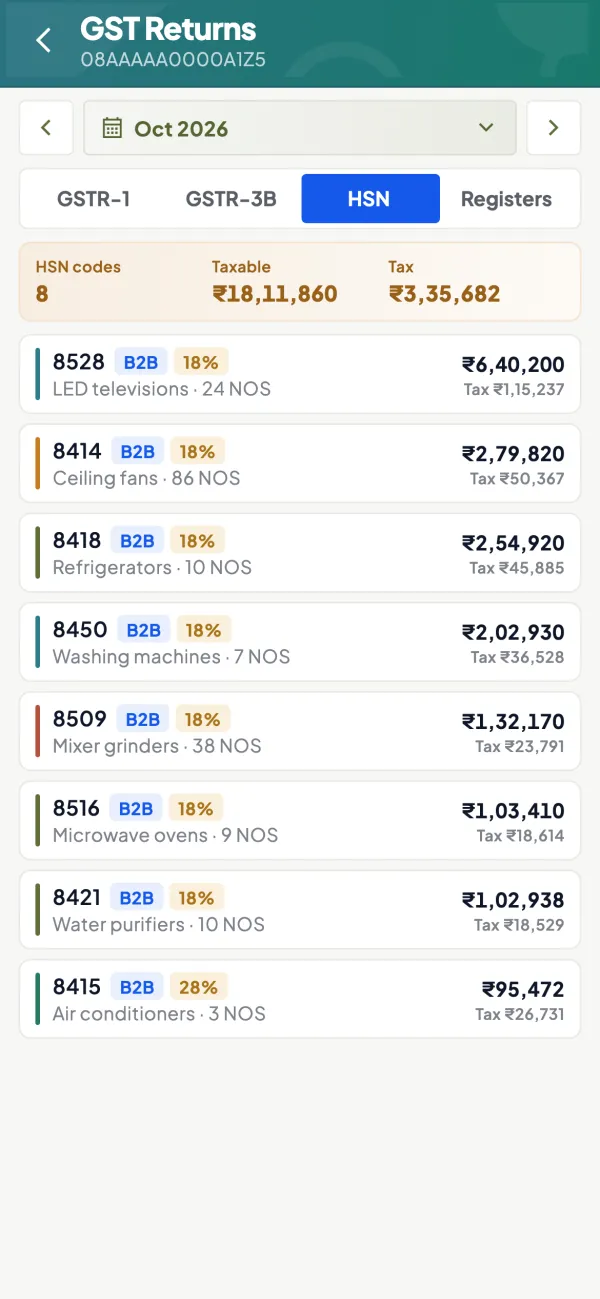
Phone bills use the item's GST details
With writing back switched on, sales vouchers created from the phone use the item's GST details from Tally, and Tally validates each one.
See Create Tally vouchers from your phone
Questions people ask
Can a composition dealer issue a tax invoice?
Is HSN required on a bill of supply?
Can the buyer claim ITC on a bill of supply?
Is a bill of supply used for exports?
Which returns do composition dealers file?
Where do regular dealers report exempt sales?
What if I sell exempt and taxable items to a registered buyer?
Can a clinic issue a bill of supply?
This page is general information for Indian businesses, not tax, legal or financial advice. Rules and rates change — check the official portals or your CA before acting.