Glossary Tax
TDS (tax deducted at source)
Definition
TDS (tax deducted at source) is income tax the payer deducts from certain payments, such as contractor bills, fees, rent or commission, and deposits for the payee.

Example
A Jaipur distributor pays a building contractor a ₹1,00,000 bill on which TDS applies. If the rate for that payment is 2%, it pays ₹98,000, deposits ₹2,000 as TDS and files it in the quarterly TDS return. The contractor later adjusts the ₹2,000 against its own income tax.
TDS in TallyPrime and in Cashflow OS
Where to find itIn TallyPrime
With TDS enabled in TallyPrime, party and expense ledgers are marked with the nature of payment. TDS is then calculated on vouchers, booked to the TDS ledger and shown in reports for deposit and returns.
 On your phoneIn Cashflow OS
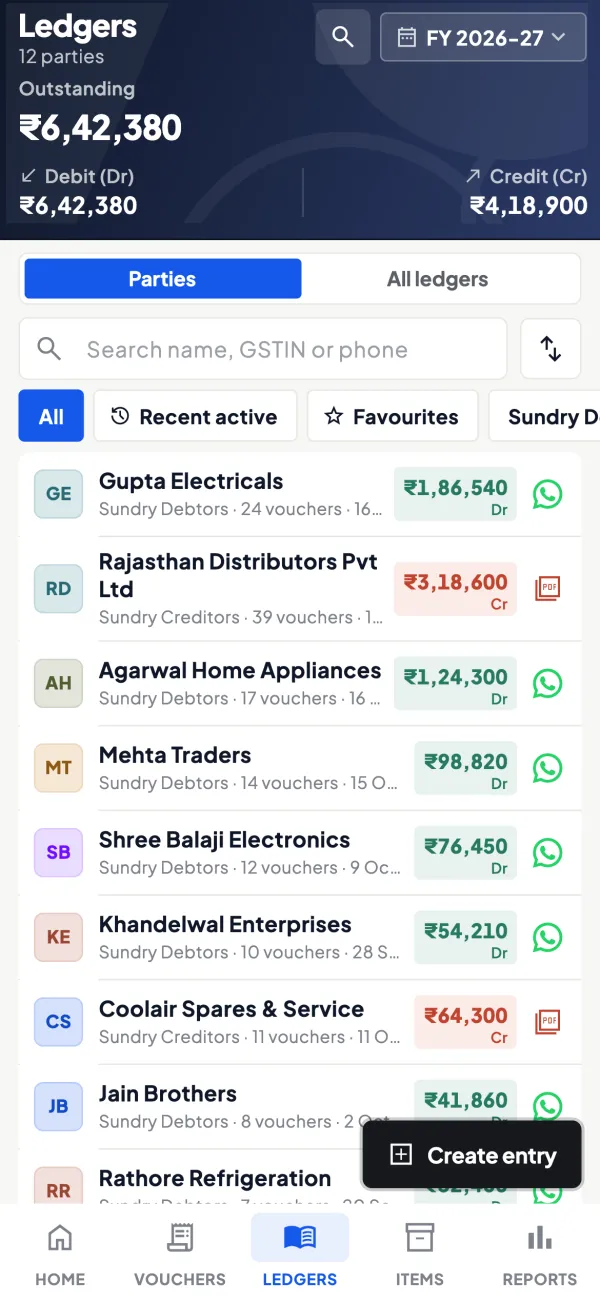
Cashflow OS shows the TDS payable ledger and party ledgers from Tally with live balances on phone and web, so pending TDS is visible before the due date.
Common misunderstandings
- Watch outDeducting TDS but depositing it late, which brings interest and possible penalties.
- Watch outNot checking the payee's PAN; a missing or invalid PAN can mean a higher rate.
How TDS works
The payer deducts a set percentage when paying or crediting the amount, pays the deducted tax to the government by the due date, files a quarterly TDS return, and gives the payee a certificate. The payee sees the credit in their tax records and adjusts it against their own income tax. A business that has to deduct needs a TAN.
The Income-tax Act, 2025 replaced the 1961 Act from 1 April 2026 and renumbered the TDS provisions. Many people still use the old section names, such as 194C for contractors and 194J for professional fees. Rates, thresholds and who must deduct are set in the law and change from time to time, so check incometax.gov.in for the current position. Our guide on TDS basics for business owners goes further.
Example
A distributor pays a chartered accountant a fee of ₹60,000. If TDS on professional fees applies at 10%, the distributor pays the CA ₹54,000 and deposits ₹6,000 as TDS. In the books, the CA's ledger is credited ₹60,000 for the bill, debited ₹54,000 for the payment and debited ₹6,000 for the TDS, leaving nil. The ₹6,000 sits in a TDS payable ledger until it is deposited.
TDS under GST
GST has its own TDS, separate from income tax. Notified deductors, mainly government departments and bodies, deduct 2% (1% CGST plus 1% SGST, or 2% IGST) from payments to suppliers above a contract value limit. The supplier can use it from the electronic cash ledger. See TDS and TCS under GST.
Where it shows up in TallyPrime
With TDS turned on for the company, TallyPrime lets you mark party and expense ledgers with their nature of payment. It then calculates TDS on purchase, journal or payment vouchers, books it to the TDS ledger and gives reports of deductions and dues for filing. Check the deductee's PAN on the ledger, because a missing PAN can mean a higher rate.
This is general information, not tax advice.
Related terms
TCS (tax collected at source)LedgerVoucherTrial balanceAll terms A–Z
Questions about TDS
What happens if I do not deduct TDS?
Is TDS a cost to the business?
How does the payee get credit for TDS?
Do I need a TAN to deduct TDS?
Are the old section numbers like 194C still used?
This page is general information for Indian businesses, not tax, legal or financial advice. Rules and rates change — check the official portals or your CA before acting.