Running the business Year-end
Year-end closing checklist for small businesses
Closing the financial year on 31 March means making the books match reality: stock, cash, bank, parties and taxes. Work through the list below in April and your CA can finalise accounts without weeks of back-and-forth.
- Small business owners
- Accountants closing books
- Businesses facing a tax audit
- Partners and proprietors
- Traders with stock

On this page 11
Why the year-end close matters more than the month-end
A month-end close keeps the books tidy. The year-end close fixes the numbers that go into your income-tax return, your GST annual return, your bank's renewal file and, for many businesses, the tax audit. Once those numbers are filed, changing them is slow and sometimes costly.
The goal is simple: every balance in the books on 31 March should be something you can prove — with a count sheet, a bank statement, a party confirmation or a working.
Before 31 March: what to do while the year is still open
- Chase old receivables. Bills that are 180+ days old need a decision: collect, settle with a credit note, or ask your CA about writing them off.
- Clear suspense and unadjusted entries. Any receipt booked as on-account or to a suspense ledger should be matched to bills.
- Plan stock count day. Pick a date (usually 31 March after closing, or 1 April before opening), assign godowns and staff, and freeze movement during the count.
- Check the last advance tax instalment. The final instalment falls in mid-March. See advance tax for businesses.
- Collect pending purchase bills. Suppliers often send March bills late. Ask for them now so expenses land in the right year.
The closing checklist
| Area | What to check | Proof to keep |
|---|---|---|
| Cash | Cash in hand matches the cash ledger on 31 March | Cash count sheet signed by two people |
| Bank | Every bank account reconciled to the statement | Bank reconciliation statement, statement PDF |
| Stock | Physical count matches Tally stock; slow and damaged items valued correctly | Count sheets, valuation working |
| Debtors | Balances confirmed with major customers | Signed or emailed confirmations |
| Creditors | Balances agreed with suppliers; missing bills booked | Supplier statements |
| GST | Sales in books match GSTR-1; ITC in books matches what suppliers uploaded | Reconciliation sheet |
| TDS | TDS deducted, deposited and shown in quarterly statements | Challans, certificates received and issued |
| Loans | Loan balances match lender statements; interest booked | Loan statements, interest certificates |
Year-end adjusting entries
These are the journal entries that make profit for the year correct. Your accountant passes them; you should know what they are.
- Outstanding expenses: March electricity, rent or salary not yet paid. Example: March salary of ₹3,40,000 paid on 5 April is still a March expense.
- Prepaid expenses: insurance of ₹24,000 paid in January for 12 months — ₹18,000 belongs to next year.
- Depreciation: on vehicles, computers, furniture and machinery, at the rates your CA applies.
- Closing stock: valued at cost or realisable value, whichever is lower. Dead stock should not sit in the books at full cost.
- Interest accrued: on loans and fixed deposits up to 31 March.
- Bad debts: only after a clear decision and documentation.
Tax points to flag to your CA
From 1 April 2026 the Income-tax Act, 2025 replaced the 1961 Act. Most concepts carried over, but section and form numbers changed, so confirm the current references with your CA and on incometax.gov.in.
- Whether turnover crosses the limit for a tax audit.
- Cash payments above the allowed limit to a single party in a day, which can be disallowed.
- Payments to MSME suppliers beyond 45 days, which can affect the deduction for that expense.
- TDS that was deducted but not deposited, or not deducted where it should have been.
- GST corrections for the year that must be made in returns before the cut-off, and the GSTR-9 annual return later.
This is general information, not tax advice. Thresholds and dates change; confirm them each year.
After closing: lock the year and start clean
- Get final figures signed off by your CA.
- Take a full backup of the Tally company data and store a copy off-site.
- Restrict back-dated entries into the closed year so nobody changes it by mistake.
- Check that opening balances in the new year match closing balances of the old year — especially stock, debtors and creditors.
- Note what went wrong this year (late bills, missed counts) and fix the process for next year.
Doing this with Tally and Cashflow OS
Tally remains where the books are closed. Cashflow OS syncs the Tally data so you can check the year from your phone or the web app: Profit & Loss, Balance Sheet and Trial Balance for any financial year, bill-wise outstanding with ageing, and cash and bank books. Party statements can be shared on WhatsApp as a PDF, which makes balance confirmations quicker. Reports export to Excel or PDF for your CA. If you run several Tally companies, you can switch between them in one account. See financial reports.
Avoid these
Common mistakes
- MistakeCounting stock while goods are still movingDo this instead
Freeze movement during the count, after closing on 31 March or before opening on 1 April.
- MistakeMarch supplier bills booked in AprilDo this instead
Ask suppliers for March bills early so expenses land in the right year.
- MistakeDead stock left in the books at full costDo this instead
Value closing stock at cost or realisable value, whichever is lower, with a written working.
- MistakeBack-dated entries after the CA signs offDo this instead
Restrict entries into the closed year and correct only with your CA's advice.
Keep handy
Checklist
Year-end closing checklist for small businesses — 8 checks. Tick them as you go.
In Cashflow OS
How Cashflow OS helps
Cashflow OS puts your TallyPrime books on every phone in the team. Where it fits this topic:
Year figures on the phone
P&L, Balance Sheet and Trial Balance for any year, bill-wise outstanding with ageing and cash and bank books come from synced Tally data, with Excel and PDF export.
See Financial reports from Tally
Faster balance confirmations
Share party statements on WhatsApp as a PDF, so customers and suppliers can confirm 31 March balances quickly.
See Party ledger statements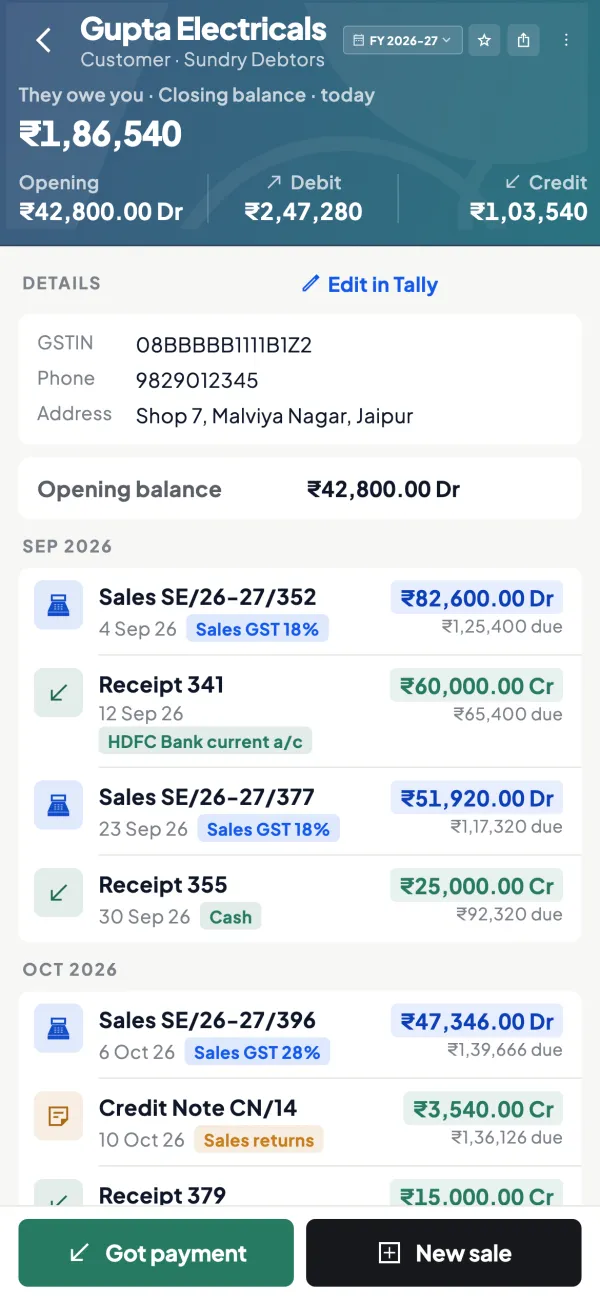
Questions people ask
When does the financial year end for Indian businesses?
Should stock be counted on 31 March or 1 April?
Do I need balance confirmations from every party?
Can I change entries after the year is closed?
What are outstanding expenses at year-end?
Should old receivables be written off at year-end?
Which tax points should I raise with my CA?
Why check opening balances in the new year?
This page is general information for Indian businesses, not tax, legal or financial advice. Rules and rates change — check the official portals or your CA before acting.