Running the business Income tax
Tax audit basics for business owners
A tax audit is an audit of your books by a chartered accountant, required under income-tax law once your business crosses certain turnover limits. The CA examines your accounts and reports specific details in a prescribed form, which is filed before your income-tax return.
- Traders near the audit limit
- Distributors and wholesalers
- Manufacturers
- Proprietors and partnership firms
- Accountants preparing for the CA

On this page 11
Who needs a tax audit
The broad rules for businesses (as they have stood in recent years):
| Situation | Audit required if |
|---|---|
| Business, general case | Turnover exceeds ₹1 crore in the year |
| Business where cash receipts and cash payments are each within 5% of the total | Turnover exceeds ₹10 crore |
| Business on presumptive taxation that declares lower profit than the presumptive rate | In certain cases, depending on income and the scheme |
| Professionals | Separate, lower limits on gross receipts |
These limits and conditions can change with each Finance Act, and the Income-tax Act, 2025 applies from 1 April 2026 with renumbered provisions. Confirm what applies to your year with your CA and on incometax.gov.in.
The 5% cash condition, explained
The higher ₹10 crore limit applies only if both cash receipts and cash payments are within 5% of total receipts and payments respectively. Cheques that are not account-payee, and similar non-electronic modes, are treated like cash for this purpose.
Example: a distributor with ₹6 crore turnover receives ₹22 lakh in cash from counter sales (about 3.7%) and pays ₹14 lakh in cash for freight and labour (well under 5% of payments). If all other receipts and payments are through banking channels, the ₹10 crore limit may apply and a tax audit may not be needed. If counter cash were ₹40 lakh (over 6%), the ₹1 crore limit would apply and an audit would be required. Your CA will verify the calculation.
What the auditor checks and reports
The audit report includes a long list of particulars. Owners should expect questions on:
- Whether books are properly maintained and the method of accounting and stock valuation.
- Turnover, gross profit and net profit ratios, compared with the previous year.
- Payments to related parties (partners, relatives, group concerns).
- Cash payments above the allowed limits and cash loans taken or repaid.
- TDS: whether deducted and deposited on time on all applicable payments. See TDS basics.
- Payments to MSME suppliers beyond the allowed credit period. See the 45-day payment rule.
- GST details: turnover and other particulars as per GST records.
- Loans and deposits taken or repaid, with modes of payment.
- Depreciation on fixed assets.
- Quantitative details of stock for traders and manufacturers, where applicable.
Timeline
For businesses requiring a tax audit, the audit report has to be filed by a due date that has typically been 30 September following the financial year, with the income-tax return due later. Due dates are sometimes extended by the department. Plan to close books by June or July so the CA has time; a rushed September audit is where mistakes and qualifications happen.
Not getting a required audit, or filing the report late, can attract a penalty linked to turnover, subject to a cap. Ask your CA about current consequences.
A preparation checklist
- Close the books using the year-end closing checklist.
- Reconcile every bank account and loan account.
- Get balance confirmations from major debtors, creditors and lenders.
- Prepare stock records: opening, purchases, sales, closing quantities by main items.
- List fixed assets bought and sold with bills and dates of use.
- Reconcile turnover in books with GST returns; explain differences.
- Reconcile TDS deducted, deposited and filed; and TDS deducted by customers with your tax credit statement.
- List payments to related parties and any cash transactions above limits.
- List MSME suppliers with dates of bills and payments.
- Keep vouchers and bills organised by month for sample checks.
Tax audit vs other audits
A company also has a statutory audit under company law, regardless of turnover; the tax audit is in addition and often done by the same CA. A GST audit by the department is different again — it is the tax authority examining your GST records. See GST audit preparation. This page is general information, not tax advice.
Preparing with Tally and Cashflow OS
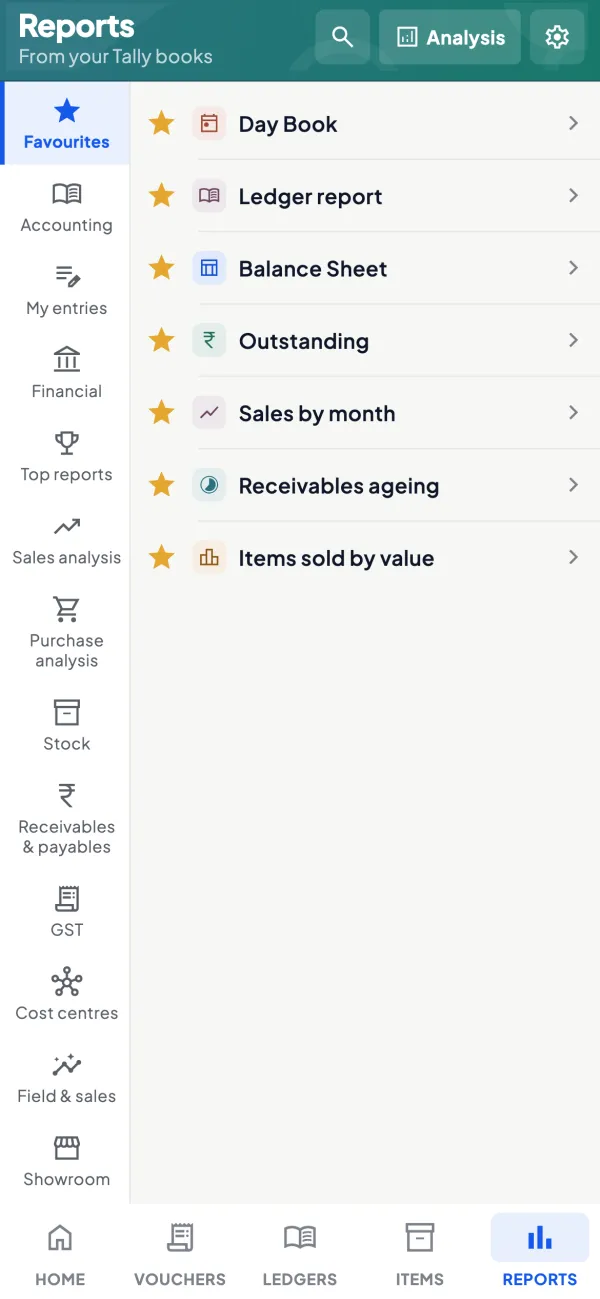
Cashflow OS does not perform audits. It helps you prepare by giving quick access to Tally data: Trial Balance, P&L and Balance Sheet for the year, Day Book, ledgers, bill-wise outstanding with ageing, stock summaries, and GSTR-1 and GSTR-3B views from the books to compare with your returns. Reports export to Excel and PDF for the auditor. See reports in Excel and PDF.
Avoid these
Common mistakes
- MistakeAssuming the higher limit applies without checking cash shareDo this instead
Work out cash receipts and cash payments as a share of totals for the year, and let your CA confirm which limit applies.
- MistakeHanding books to the CA in SeptemberDo this instead
Close and reconcile books by June or July so there is time for questions, confirmations and corrections.
- MistakeTurnover in books not matched with GST returnsDo this instead
Reconcile books with GSTR-1 and GSTR-3B before the audit and write down the reason for each difference.
- MistakeNo list of late payments to MSME suppliersDo this instead
Keep supplier Udyam status, bill dates and payment dates so the CA can report them without a search.
Keep handy
Checklist
Tax audit basics for business owners — 8 checks. Tick them as you go.
In Cashflow OS
How Cashflow OS helps
Cashflow OS puts your TallyPrime books on every phone in the team. Where it fits this topic:
Year figures ready for the auditor
Trial Balance, P&L, Balance Sheet, Day Book and ledgers for the year come from the synced Tally data and export to Excel and PDF.
See Reports in Excel and PDF
GST views to compare with returns
GSTR-1 and GSTR-3B views prepared from your Tally books help you spot gaps between books and filed returns before the CA asks.
See GST reports from your Tally data
Questions people ask
What is the turnover limit for a tax audit?
Is tax audit required for a small business on presumptive taxation?
Who can do a tax audit?
What is the due date for the tax audit report?
Is a tax audit the same as a statutory audit?
Do non-account-payee cheques count as cash for the 5% test?
What happens if a required tax audit is not done?
Did the Income-tax Act, 2025 change the tax audit?
This page is general information for Indian businesses, not tax, legal or financial advice. Rules and rates change — check the official portals or your CA before acting.