Running the business Selling
WhatsApp for business selling
WhatsApp is where most Indian customers and dealers already talk to their suppliers. Used well, it shortens the sales cycle: catalogues, quotes, orders and statements in one thread. Used carelessly, orders get lost in chats and nothing reaches the books.
- Distributors and wholesalers
- Showrooms and retailers
- Salespeople
- Owners handling dealer chats
- Businesses selling by catalogue

On this page 12
Set up the basics
- Use a separate business number, not the owner's personal phone, so staff can handle it and the history stays with the business.
- Use the WhatsApp Business app at minimum: business profile with address and hours, labels for chats (new order, payment pending, delivered), quick replies for common answers, and an away message.
- Decide who answers which chats, and by when. A dealer waiting three hours for a rate will call someone else.
What to send on WhatsApp
| Stage | What to send |
|---|---|
| Before the sale | Catalogue link or photos with codes and rates |
| Enquiry | Quotation as a PDF with GST and validity |
| Order | Order confirmation with items, quantities and expected dispatch |
| Dispatch | Invoice PDF, transport details |
| Payment | Statement and polite reminders; thank-you on receipt |
For B2B buyers, a browsable link is better than 40 forwarded photos. See catalogue sharing for B2B sales.
Taking orders without losing them
The biggest risk is orders that sit in a chat and never reach billing. A few rules help:
- Every order in a chat is confirmed back in a standard format: "Confirming order: 20 × FAN-1200-WH, 10 × SW-6A. Dispatch Thursday."
- The order is entered into your system the same hour, with the chat's date.
- Label the chat "order entered" so nobody enters it twice.
- Voice notes are confirmed back in text before entry.
See moving from paper to digital orders for a fuller order process.
Message etiquette
- Message customers who have given you their number and agreed to hear from you. Respect "please stop".
- Broadcast lists only reach people who have saved your number; do not spam groups.
- Send in working hours, except for replies the customer is waiting for.
- Keep messages short, specific and signed with a name.
- For payment reminders, use a polite, fixed sequence; see payment reminder templates.
Sample message: new stock
English: Namaste Gupta ji, the new range of 6A modular switches has arrived. Photos and dealer rates attached. Stock is limited in white; let me know quantities by Friday to reserve. – Neha, Arora Electricals
Hinglish: Namaste Gupta ji, 6A modular switches ki nayi range aa gayi hai. Photos aur dealer rate bhej rahi hoon. White mein stock kam hai, Friday tak quantity bata dein to reserve kar dete hain. – Neha
Keeping records straight
- WhatsApp is a channel, not a record. The order, invoice and receipt must be in your books.
- Save important confirmations (rates agreed, schemes promised) where they can be found later.
- Back up business chats, and remove former staff's access to the business number.
Agree internally that a rate, scheme or delivery date promised on WhatsApp is binding only once it is confirmed by the person authorised to give it. This protects both you and the customer from misunderstandings in quick chat messages.
Setting up groups and broadcasts sensibly
Dealer groups are popular, but they have drawbacks: every dealer sees every other dealer's questions and sometimes their rates, and important messages get lost in forwards. A tidier set-up:
- Use a broadcast list for announcements (new stock, price changes, holidays); replies come back privately.
- Keep groups for small, specific purposes, such as your own sales team or one project with a contractor.
- Never discuss a dealer's rate, scheme or outstanding in a group.
- Assign one person to post announcements so the tone and timing stay consistent.
Segment your broadcast lists by dealer type or area, so a price change for A dealers does not reach C dealers, and a festival offer in one city does not confuse another.
WhatsApp and Cashflow OS
Cashflow OS shares on WhatsApp what you already keep in TallyPrime: party statements (Tally-style PDF or a Hindi हिसाब page), quotations, proforma invoices, purchase orders and delivery challans with your logo and UPI details, wishlists, and an online catalogue link where customer enquiries arrive on WhatsApp. Orders taken by staff can be posted to Tally as sales orders. See online catalogue.
Avoid these
Common mistakes
- MistakeOrders left sitting in chatsDo this instead
Confirm each order back in text, enter it into your system the same hour and label the chat "order entered".
- MistakeSalespeople using personal numbersDo this instead
Use business numbers, or record every order and promise in your own system the same day.
- MistakeRates and schemes discussed in dealer groupsDo this instead
Keep rates, schemes and outstanding to one-to-one chats; use broadcast lists for announcements.
- MistakeSending 40 photos instead of a catalogueDo this instead
Share a browsable catalogue link with codes and rates, which is easier for B2B buyers.
Keep handy
Checklist
WhatsApp for business selling — 7 checks. Tick them as you go.
In Cashflow OS
How Cashflow OS helps
Cashflow OS puts your TallyPrime books on every phone in the team. Where it fits this topic:
Statements and documents to share
Share party statements as a Tally-style PDF or a Hindi हिसाब page, plus quotations, proforma invoices and challans with your logo, on WhatsApp.
See Party ledger statements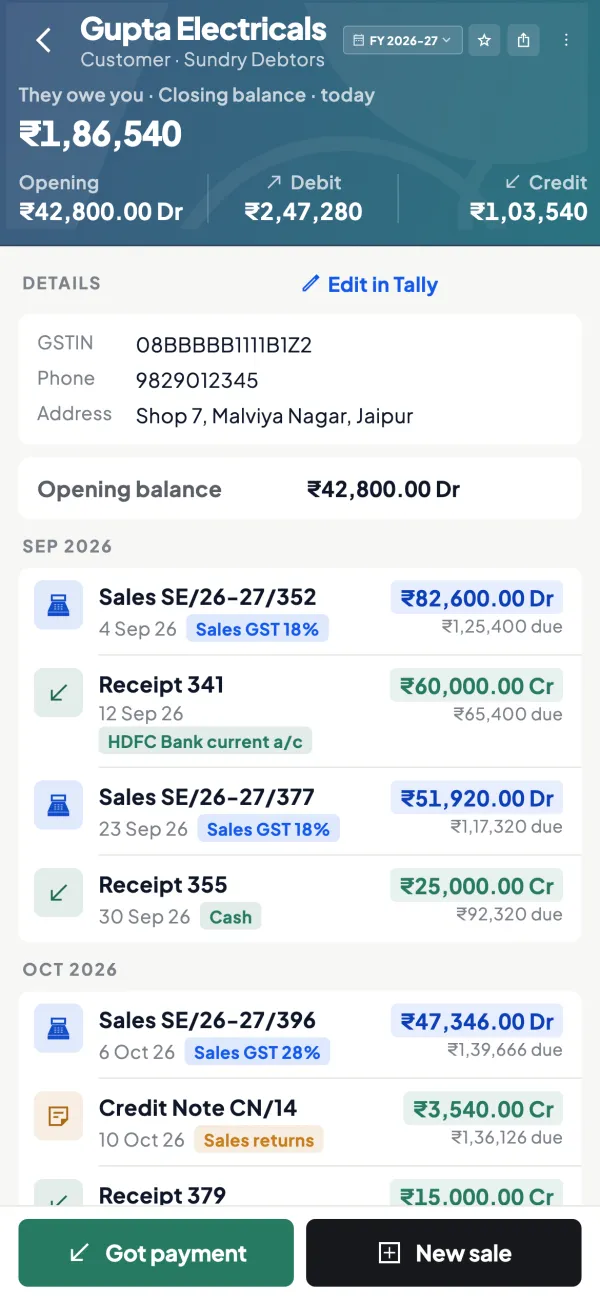
A catalogue link for enquiries
An online catalogue built from your Tally items lets customers browse without the app, and enquiries come to you on WhatsApp.
See Online catalogue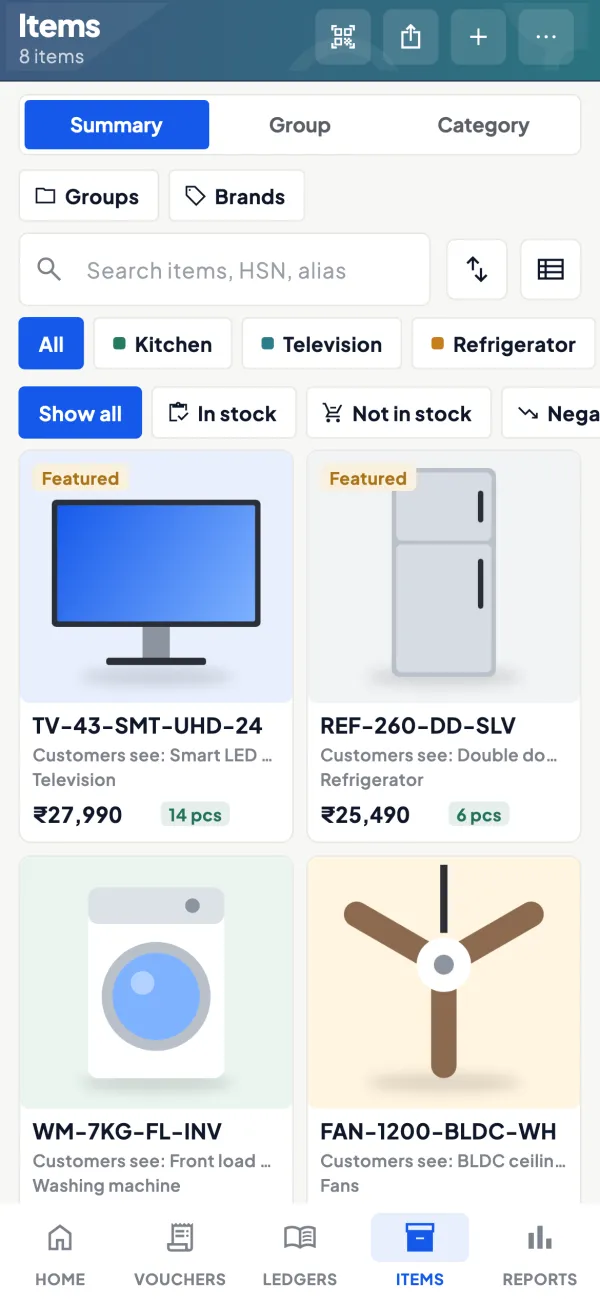
Questions people ask
Is the WhatsApp Business app enough for a small distributor?
Can I send invoices on WhatsApp?
How do I avoid annoying customers with messages?
Should salespeople use their personal WhatsApp for customers?
Should voice-note orders be accepted?
Are dealer groups a good idea?
Is a rate promised on WhatsApp binding?
Can I send payment reminders on WhatsApp?
This page is general information for Indian businesses, not tax, legal or financial advice. Rules and rates change — check the official portals or your CA before acting.