GST GST for branches
GST on stock transfer between branches
Moving stock between godowns under the same GSTIN is not a supply; a delivery challan is enough. Sending stock to your own branch in another state is a taxable supply between distinct persons, even though no money changes hands.
- Multi-state distributors
- Manufacturers with depots
- Businesses with several GSTINs
- Retail chains
- Accountants handling branch accounts
On this page 12
Same GSTIN or different GSTIN?
GST registration is state-wise. A business with a shop in Jaipur and a godown in Jodhpur has one GSTIN for Rajasthan. A business with a godown in Jaipur and a branch in Ahmedabad has two GSTINs, and the law treats the two as distinct persons.
| Movement | Supply? | Document |
|---|---|---|
| Shop to godown, same state, same GSTIN | No | Delivery challan |
| Branch to branch, different states | Yes (Schedule I), IGST | Tax invoice |
| Two registrations in the same state (separate business verticals) | Yes, CGST + SGST | Tax invoice |
An e-way bill is needed for the movement in all three cases when the value crosses the limit; see e-way bill basics.
What value to charge on an inter-state transfer
Rule 28 of the CGST Rules sets the value for supplies between distinct persons:
- the open market value of the goods; or
- if that is not available, the value of like goods; or
- at the supplier's option, 90% of the price charged to an unrelated customer for like goods.
There is an important relief: where the receiving branch is eligible for full input tax credit, the value declared on the invoice is deemed to be the open market value. Most trading branches fall in this case, so transferring at cost is commonly accepted. Confirm with your CA where the receiving branch makes exempt supplies.
Worked example
A tiles distributor's Morbi (Gujarat) unit sends 1,000 boxes to its own Jaipur branch. Cost is ₹300 a box; the GST rate on the tiles is 18%.
| Line | Amount |
|---|---|
| Taxable value (1,000 × ₹300) | ₹3,00,000 |
| IGST @ 18% | ₹54,000 |
| Invoice value | ₹3,54,000 |
The Gujarat GSTIN reports the invoice in GSTR-1 as a B2B supply to the Rajasthan GSTIN and pays ₹54,000 IGST, usually by using ITC. The Jaipur branch sees the invoice in its GSTR-2B and claims ₹54,000 as ITC. Overall, tax neutral, but only if both sides report correctly and in time.
Steps for each transfer
- Raise a tax invoice from the sending GSTIN to the receiving GSTIN, with IGST for inter-state movement.
- Generate the e-way bill (and e-invoice, if the sending GSTIN's turnover requires it; see e-invoicing and IRN).
- Book the purchase at the receiving branch on arrival.
- Report in both GSTINs' returns for the same period.
- Reconcile inter-branch accounts monthly: what one branch shows as sold must equal what the other shows as bought.
Services between branches
Branches in different states also provide services to each other: a head office's accounts team or management. Where the receiving branch is eligible for full ITC, the invoice value is accepted as the value, and many businesses choose to invoice a reasonable amount. This area has seen clarifications over time and depends on facts; take advice before deciding not to invoice. This is general information, not tax advice.
Common mistakes
- Moving goods to another state's branch on a delivery challan, as if it were the same GSTIN.
- Sending branch reporting the invoice, receiving branch forgetting to book it, so ITC is lost or delayed.
- Using CGST + SGST on an inter-state branch transfer.
- Different stock values on each side because one branch added freight and the other did not.
Monthly inter-branch reconciliation
At month end, put both branches' figures side by side. A short table is enough:
| Check | Morbi (sender) | Jaipur (receiver) | Difference |
|---|---|---|---|
| Transfer invoices (taxable value) | ₹12,40,000 | ₹11,80,000 | ₹60,000 |
| IGST | ₹2,23,200 | ₹2,12,400 | ₹10,800 |
| Branch account balance | ₹14,63,200 Dr | ₹13,92,400 Cr | ₹70,800 |
Here one invoice of ₹60,000 + ₹10,800 IGST is in transit or not yet booked at Jaipur. Book it in the month the goods arrive, and check it appears in Jaipur's GSTR-2B before the credit is claimed.
Branches in Tally and Cashflow OS
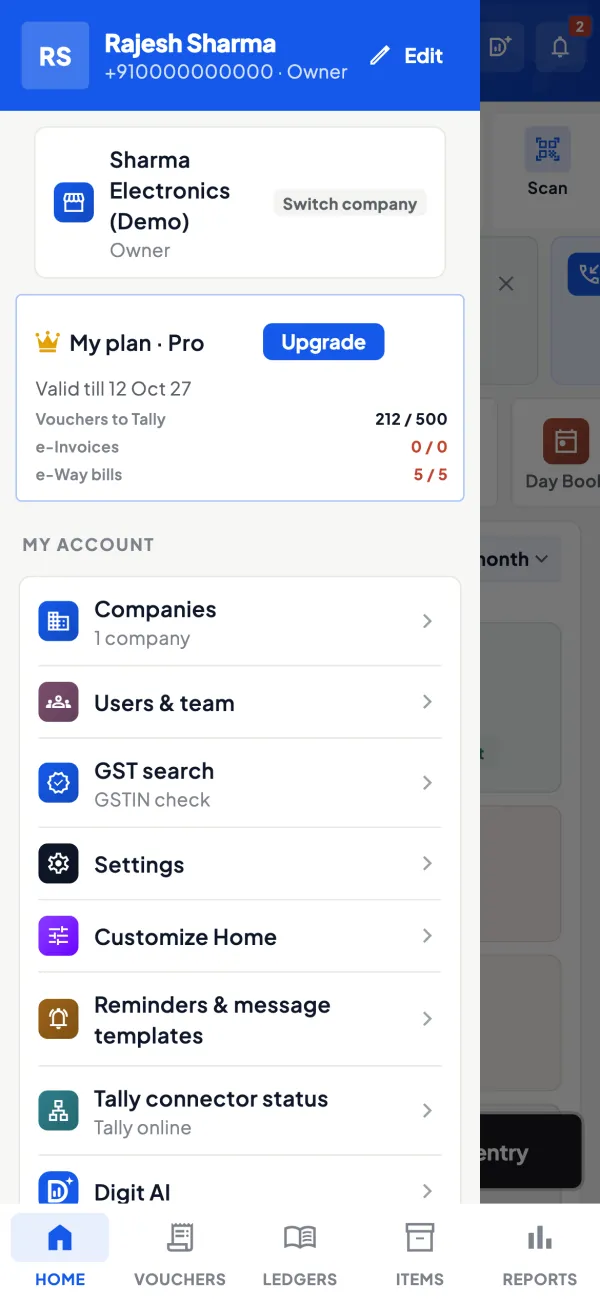
Within one GSTIN, TallyPrime handles transfers through godowns and stock journals. Branches with separate GSTINs are often separate Tally companies. Cashflow OS can hold several Tally companies in one account, so you can switch between branches on the phone, compare stock summaries and check that the transfer invoice appears in the sending branch's GSTR-1 view. If writing back is on, a stock journal or delivery note can be posted from the phone.
Avoid these
Common mistakes
- MistakeMoving goods to another state's branch on a challanDo this instead
A branch with another GSTIN is a distinct person; raise a tax invoice with IGST for inter-state movement.
- MistakeReceiving branch forgetting to book the transferDo this instead
Book the purchase on arrival and check it appears in the receiving branch's GSTR-2B before claiming the credit.
- MistakeCharging CGST + SGST on an inter-state transferDo this instead
Inter-state branch transfers take IGST. CGST + SGST applies only between two registrations in the same state.
- MistakeDifferent values on each side of the transferDo this instead
Agree whether freight is included and use the same value in both branches' books.
Keep handy
Checklist
GST on stock transfer between branches — 7 checks. Tick them as you go.
In Cashflow OS
How Cashflow OS helps
Cashflow OS puts your TallyPrime books on every phone in the team. Where it fits this topic:
All branches in one account
Branches with separate GSTINs are often separate Tally companies. Cashflow OS holds several companies in one account, so you can switch between them and compare stock and balances.
See Multiple Tally companies in one account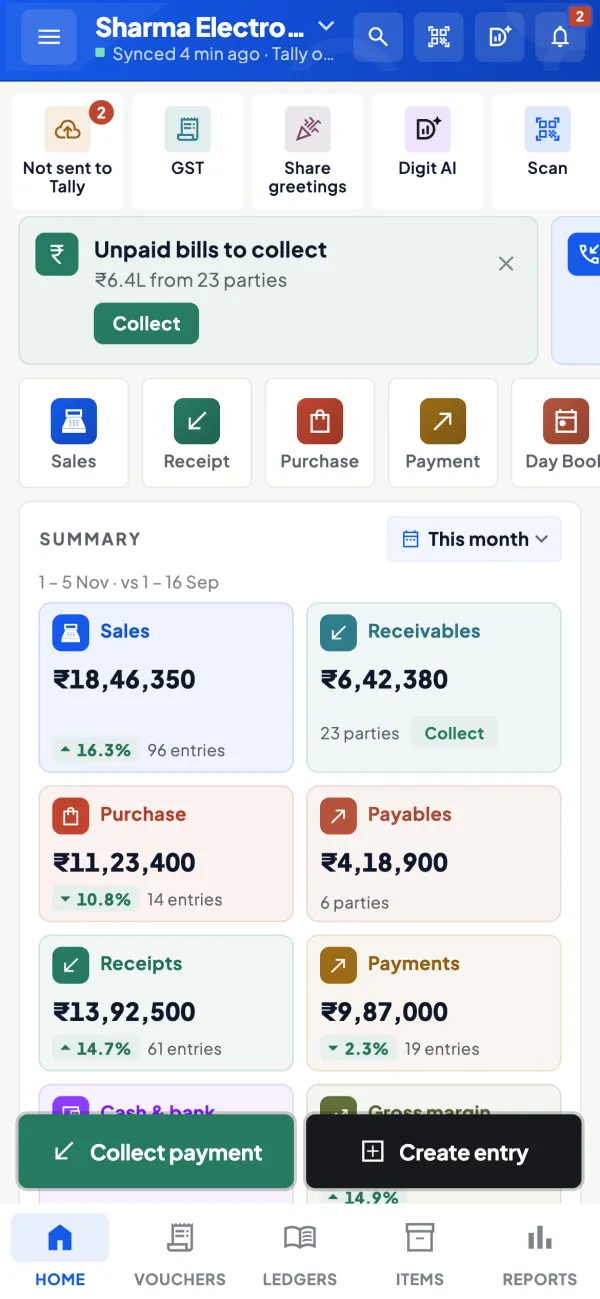
Check the transfer in GSTR-1
The sending branch's GSTR-1 view, prepared from Tally data, opens bill-wise detail so you can confirm the transfer invoice is there. With writing back on, a stock journal can be posted from the phone.
See GST reports from your Tally data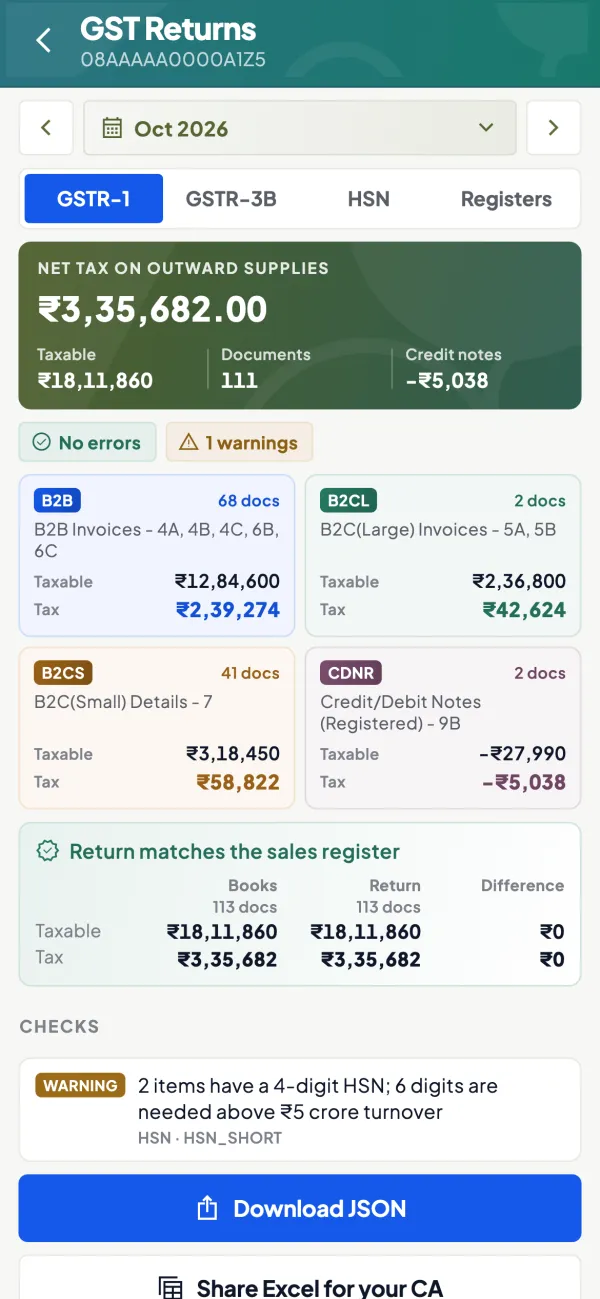
Questions people ask
Is GST payable on stock transfer within the same state?
At what value should inter-state branch transfers be invoiced?
Can the receiving branch claim ITC on a branch transfer?
Is an e-way bill needed for branch transfers?
Do two registrations in the same state pay GST on transfers?
Are branch transfers counted in aggregate turnover?
Can head office services to branches be left uninvoiced?
What if goods are still in transit at month end?
This page is general information for Indian businesses, not tax, legal or financial advice. Rules and rates change — check the official portals or your CA before acting.