
Running the business Running costs
Expense control for small businesses
Expense control is not about cutting everything; it is about knowing what each rupee buys. Group your costs, compare them with sales every month, set approval limits, and look closely at the few heads that grow fastest.
- Owners of trading businesses
- Distributors with delivery fleets
- Accountants preparing MIS
- Branch and office managers
- Family businesses

On this page 12
Start by grouping expenses the way you think about them
Tally lets you create expense ledgers under Direct Expenses and Indirect Expenses. Many small businesses end up with fifty ledgers that nobody reads. Group them into five or six heads that match decisions you actually make:
| Head | Typical ledgers |
|---|---|
| People | Salaries, wages, incentives, staff welfare, PF/ESI |
| Premises | Rent, electricity, maintenance, security |
| Delivery | Freight outward, vehicle fuel, vehicle repairs, loading |
| Selling | Travel, sales promotion, dealer meets, samples |
| Office and admin | Telephone, internet, software, stationery, professional fees |
| Finance | Bank interest, bank charges, card and payment charges |
You can use Tally groups under Indirect Expenses for these heads, so the P&L rolls up neatly.
Measure each head as a percentage of sales
Absolute numbers grow as the business grows. Percentages tell you whether costs are under control.
Example: a tiles and sanitaryware trader with monthly sales of ₹40,00,000.
| Head | Last year (% of sales) | This year (₹ / month) | This year (%) |
|---|---|---|---|
| People | 5.0% | 2,10,000 | 5.3% |
| Premises | 2.2% | 88,000 | 2.2% |
| Delivery | 1.8% | 1,04,000 | 2.6% |
| Selling | 0.8% | 36,000 | 0.9% |
| Finance | 1.2% | 60,000 | 1.5% |
Delivery jumped from 1.8% to 2.6% — ₹32,000 a month more than last year's ratio, or nearly ₹3,84,000 a year. That is where to look first, not at stationery.
Set approval limits and stick to them
- Up to ₹2,000: branch manager or counter in-charge from petty cash, with a bill.
- ₹2,000 to ₹25,000: accounts head or manager approves before payment.
- Above ₹25,000, or any new recurring cost: owner approves.
- Any new vendor: owner or accounts head adds them; staff cannot.
The exact limits depend on your size. What matters is that everyone knows them and the person paying is not the same person approving. See internal controls for small business.
Where small businesses usually leak money
- Delivery: half-empty vehicles, multiple trips to the same area, no route planning.
- Subscriptions: software, SIM cards and internet plans for staff who have left.
- Bank charges and interest: CC limit used for long periods because collections are slow; charges on cheque returns.
- Freight inward not checked: transporter bills paid without matching to goods received.
- Incentives without targets: fixed payouts that no longer depend on performance.
- Wastage and breakage: written off quietly instead of being tracked by reason.
Make every expense carry a reason
Expenses are easiest to control when each entry says what it was for. Ask your accountant to write a short narration on every expense voucher — vehicle number for fuel, month and meter reading for electricity, branch name for rent. For delivery and travel, a cost centre per branch, vehicle or salesperson lets you see cost by person or route rather than one big total.
With that detail, the monthly review stops being a debate. You can see that one vehicle's fuel cost is ₹9,000 more than the other's on similar routes, or that one branch's electricity doubled after a new display was installed.
A monthly expense review in five steps
- Make sure all expense bills for the month are entered; missing bills hide the problem.
- Pull the expenses for the month and the same month last year.
- Calculate each head as a percentage of sales.
- Pick the one or two heads that moved most, open the ledgers and read the actual entries.
- Decide one action, write it down, and check it next month.
Repeat this through the year and expense control becomes routine rather than a crisis exercise in March.
Cutting costs without hurting the business
Some costs earn money. Cutting a salesperson's travel may save ₹15,000 a month and lose ₹3,00,000 of orders. Before cutting, ask what the cost produces. Good candidates for cuts are costs with no link to sales or service: idle subscriptions, duplicate trips, avoidable interest. Costs to protect are the ones customers notice: timely delivery, stock availability and after-sales service. A useful companion is cash vs profit, because cash savings and profit savings are not always the same thing.
Tracking expenses with Tally and Cashflow OS
Cashflow OS includes an expenses report built from your Tally ledgers, along with the Profit & Loss for any period or custom date range, so you can compare this month with the same month last year. Open any expense ledger to see its entries. Reports export to Excel or PDF. Team roles let an accountant see the accounts while a salesperson sees only items and their own customers. See financial reports.
Avoid these
Common mistakes
- MistakeFifty expense ledgers that nobody readsDo this instead
Group them under a few Tally groups such as People, Premises, Delivery, Selling, Admin and Finance.
- MistakeWatching rupee totals instead of ratiosDo this instead
Compare each head as a percentage of sales, since totals grow naturally as the business grows.
- MistakeCutting sales travel to save a littleDo this instead
Ask what each cost produces before cutting; start with idle subscriptions, duplicate trips and avoidable interest.
- MistakeExpense entries without narrationsDo this instead
Ask for a short reason on every voucher and use cost centres for vehicles, branches or salespeople.
Keep handy
Checklist
Expense control for small businesses — 8 checks. Tick them as you go.
In Cashflow OS
How Cashflow OS helps
Cashflow OS puts your TallyPrime books on every phone in the team. Where it fits this topic:
Expenses and P&L for any period
An expenses report built from your Tally ledgers and a P&L for any period or custom date range let you compare this month with the same month last year.
See Financial reports from Tally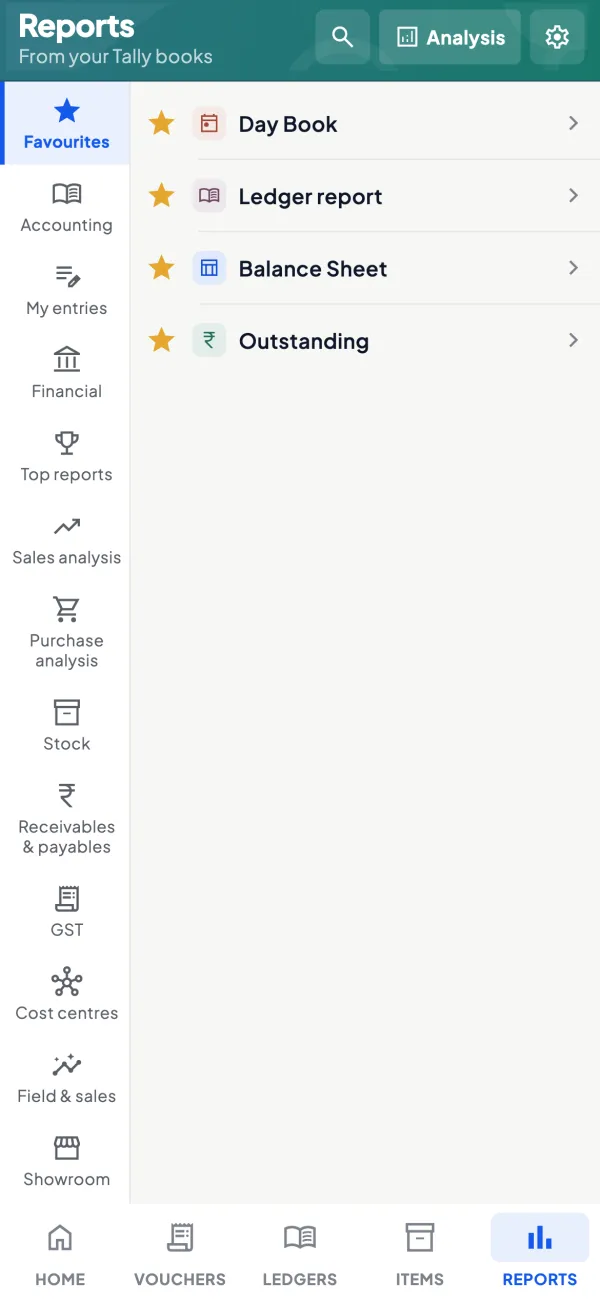
Export for the monthly review
Reports export to Excel or PDF, so the accountant can add percentage-of-sales columns and share the review with the owner.
See Reports in Excel and PDF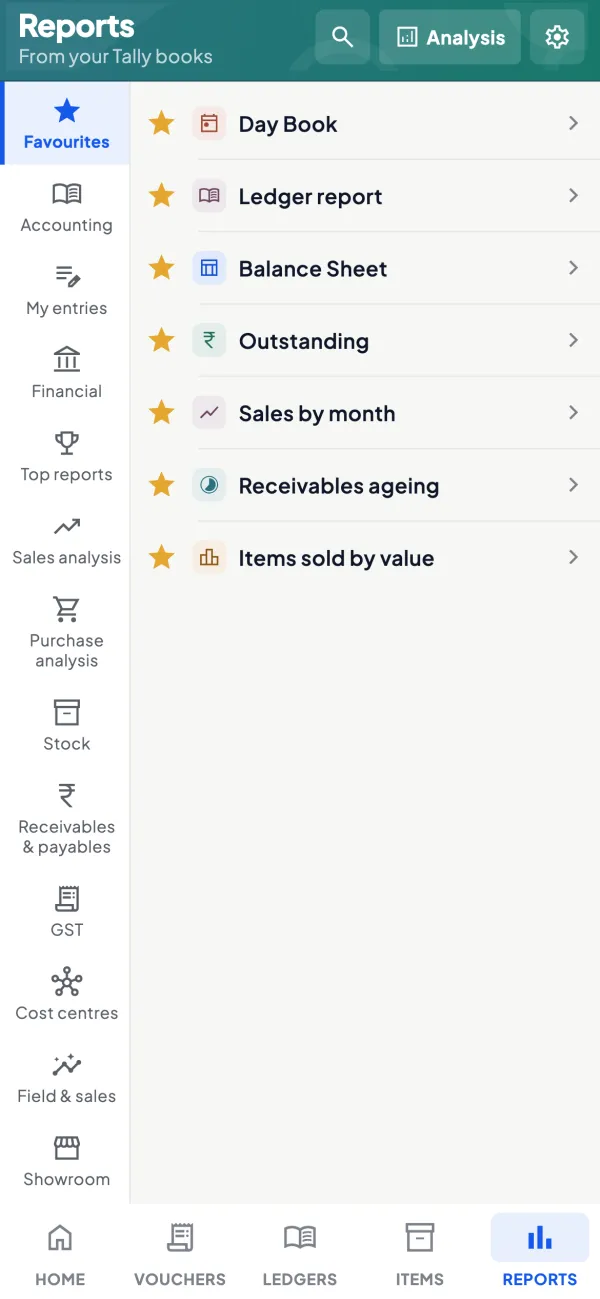
Questions people ask
What is a good expense ratio for a trading business?
Should I cut staff costs first?
How many expense ledgers should I keep in Tally?
How do I stop staff spending without approval?
What is a cost centre?
How often should I review expenses?
Are bank charges worth checking?
Should petty cash have a fixed float?
This page is general information for Indian businesses, not tax, legal or financial advice. Rules and rates change — check the official portals or your CA before acting.