Glossary GST
HSN code
Definition
An HSN code is the number that classifies goods for GST and customs in India; it decides an item's GST rate and groups sales in the HSN summary.

Example
A Rajkot hardware dealer sells ₹60,000 of ceiling fans and ₹25,000 of switches in a month. Each item carries its HSN in the item master, so the invoices print it and GSTR-1's HSN summary shows two lines with quantity, taxable value and tax. If half the fans were coded under a different HSN, the summary would show three lines and would not match the purchase side.
HSN code in TallyPrime and in Cashflow OS
Where to find itIn TallyPrime
HSN is set in a stock item's GST details or at stock group level so items inherit it. TallyPrime prints it on invoices and uses it in the HSN summary of its GST reports.
 On your phoneIn Cashflow OS
Cashflow OS's GSTR-1 view, prepared from the Tally data, has HSN-wise detail so you can review the summary before filing on the portal.
See how it works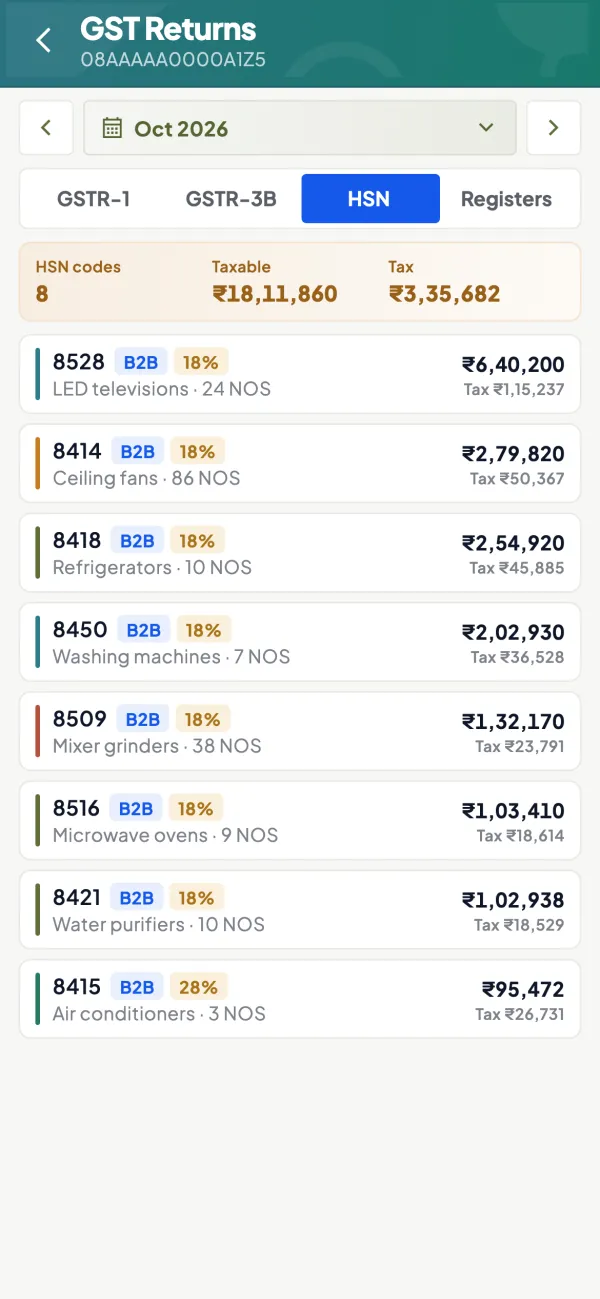
Common misunderstandings
- Watch outCoding the same product under two HSN codes in different item masters.
- Watch outCopying the HSN from a supplier's bill without checking it fits your product and rate.
What HSN means
HSN is an international classification of goods run by the World Customs Organization. India uses it for both customs and GST. The first two digits are the chapter (for example 85 for electrical machinery), the next two narrow it to a heading, and further digits narrow it more. India's tariff goes to eight digits.
Services are classified separately under SAC codes; see the SAC code entry.
How many digits you need
The number of HSN digits required on tax invoices and in the HSN summary of GSTR-1 depends on your aggregate turnover in the previous year. As a broad rule, smaller businesses show at least four digits and businesses above ₹5 crore show six. The exact requirement, and whether it applies to B2C invoices, has been changed by notification over the years, so confirm the current position on cbic-gst.gov.in or gst.gov.in.
Example
A hardware shop sells LED bulbs worth ₹40,000. The bulbs fall under chapter 85. On the invoice the line shows the HSN code at the required number of digits, the taxable value ₹40,000 and GST at the rate the rate schedule gives for that code. In GSTR-1, every sale of that code during the month adds up in the HSN summary: quantity, unit, taxable value and tax. If the same bulbs are coded under two different HSN numbers in your item masters, they show as two lines and the summary will not match your purchase side or your supplier's data.
Where it shows up in TallyPrime
HSN is set in the GST details of a stock item, or at the stock group level so that every item in the group inherits it. TallyPrime then prints it on the invoice and uses it to build the HSN summary in its GST reports. Setting HSN at group level saves work, but check exceptions item by item. Our guide on the HSN summary in GSTR-1 shows how to review it before filing.
This is general information, not tax advice.
Related terms
Questions about HSN code
Does HSN decide the GST rate?
Is HSN needed on a bill of supply?
What if I use the wrong HSN code?
How do I find the right HSN code?
Is HSN required on an e-way bill?
This page is general information for Indian businesses, not tax, legal or financial advice. Rules and rates change — check the official portals or your CA before acting.