Running the business Reading reports
Trial balance explained
A trial balance lists every ledger with its closing debit or credit balance on a date. If the debit and credit totals match, the double entry is complete — but that does not mean every entry is correct.
- Business owners
- Accountants and bookkeepers
- Commerce students
- Partners reviewing books
- Businesses preparing for the CA

On this page 12
What a trial balance is
Every voucher in Tally has a debit side and a credit side of equal amount. A trial balance adds up the closing balance of every ledger and places it in a debit or credit column. Because each voucher is balanced, the two column totals are equal.
Accountants use it as the working sheet from which the P&L and balance sheet are built. Income and expense ledgers go to the P&L; assets, liabilities and capital go to the balance sheet.
A worked example
A small kitchenware wholesaler's trial balance as on 30 September, grouped the way Tally groups it:
| Group / ledger | Debit (₹) | Credit (₹) |
|---|---|---|
| Capital account | 18,00,000 | |
| Sundry creditors | 9,40,000 | |
| Sales accounts | 62,00,000 | |
| Purchase accounts | 51,30,000 | |
| Indirect expenses | 5,80,000 | |
| Sundry debtors | 14,60,000 | |
| Opening stock | 12,10,000 | |
| Cash and bank | 4,60,000 | |
| Total | 88,40,000 | 89,40,000 |
The totals differ by ₹1,00,000. In Tally you would not normally see this, because Tally will not save an unbalanced voucher. A difference like this usually comes from opening balances entered when the company was created, which Tally shows as a difference in opening balances.
How to read it, group by group
- Debit balances are normally assets (cash, bank, debtors, stock, fixed assets) and expenses (purchases, salaries, rent).
- Credit balances are normally liabilities (creditors, loans, taxes payable), capital and income (sales, discount received).
- A balance on the wrong side is a clue. Cash in hand with a credit balance is impossible — something was booked wrongly. A customer with a credit balance means an advance or an excess receipt; check it.
- Look at sizes, not just sides. If indirect expenses are ₹5,80,000 for six months last year and ₹9,00,000 now, open the group and see which ledger grew.
Why a trial balance can tally and still be wrong
Matching totals only prove that debits equal credits. These mistakes leave the totals matched:
| Error | Example | How to catch it |
|---|---|---|
| Wrong ledger | ₹45,000 repair booked to purchases | Scan expense and purchase ledgers for odd entries |
| Wrong party | Receipt from Sharma Traders posted to Sharma Electricals | Party balance confirmations |
| Missed entry | Supplier bill never entered | Match supplier statements |
| Duplicate entry | Same sales bill entered twice | Check invoice numbering for repeats |
| Wrong amount both sides | ₹18,500 entered as ₹15,800 | Bank reconciliation, party statements |
A monthly trial balance review in 20 minutes
- Open the trial balance as on the last day of the month, at group level.
- Check cash in hand is a debit and roughly matches the cash in the drawer.
- Check each bank ledger against the bank statement closing balance (after reconciliation).
- Look for a suspense ledger or difference in opening balances. Either should be zero or explained.
- Drill into GST and TDS ledgers: balances should match what is due for the month.
- Look for customers with credit balances and suppliers with debit balances; most are advances to be adjusted.
- Compare expense groups with the same month last year.
This is the core of a good month-end close and makes the year-end close far lighter.
Tracing a wrong balance back to its entry
When a balance looks wrong, work from the top down rather than scrolling through the whole year:
- Narrow the period. Compare the trial balance at the end of each month. If the ledger was fine on 31 July and odd on 31 August, the problem is in August.
- Open the ledger. Sort entries by amount and look for the largest or the unusual ones: a round figure, an entry on a Sunday, a narration that does not fit.
- Check the other side. Every wrong entry has a partner ledger. If ₹45,000 went to purchases instead of repairs, the repairs ledger is short by the same amount.
- Correct with a journal or by altering the voucher, and write a clear narration so the auditor can follow it later.
Keep a short list of corrections made each month. Repeated mistakes usually point to a ledger that is badly named or a staff member who needs a few minutes of guidance.
Trial balance vs balance sheet vs P&L
The trial balance is the raw list. The P&L takes the income and expense lines and arrives at profit. The balance sheet takes the remaining lines, adds the profit to capital and adds closing stock. That is why the trial balance shows opening stock but not closing stock: closing stock is a valuation, not a ledger balance, unless your Tally company is set to maintain stock in the books.
Checking the trial balance with Cashflow OS
Cashflow OS shows the Trial Balance synced from Tally on your phone or the web app, for any financial year or a custom date range. Tap a ledger to see its vouchers, or open the Day Book to find a recent entry that changed a balance. Export the report to Excel when your accountant wants to work on it. With several Tally companies in one account, you can review each one in turn. See financial reports.
Avoid these
Common mistakes
- MistakeTaking a tallied trial balance as proof the books are rightDo this instead
Check for wrong ledgers, wrong parties, missed bills and duplicates through statements and reconciliations.
- MistakeIgnoring a difference in opening balancesDo this instead
Find the ledger whose opening balance was entered wrongly and correct it; the difference should be zero.
- MistakeScrolling the whole year to find one wrong balanceDo this instead
Compare month-end trial balances to find the month, then sort the ledger by amount and check the other side.
- MistakeCorrecting entries without a narrationDo this instead
Write a clear narration for every correction so the auditor can follow it later.
Keep handy
Checklist
Trial balance explained — 7 checks. Tick them as you go.
In Cashflow OS
How Cashflow OS helps
Cashflow OS puts your TallyPrime books on every phone in the team. Where it fits this topic:
Trial Balance for any period
Cashflow OS shows the Trial Balance synced from Tally for any financial year or custom range; tap a ledger to see its vouchers.
See Financial reports from Tally
Excel for the accountant
Export the Trial Balance to Excel when the accountant wants to work on it, and review each Tally company in one account.
See Reports in Excel and PDF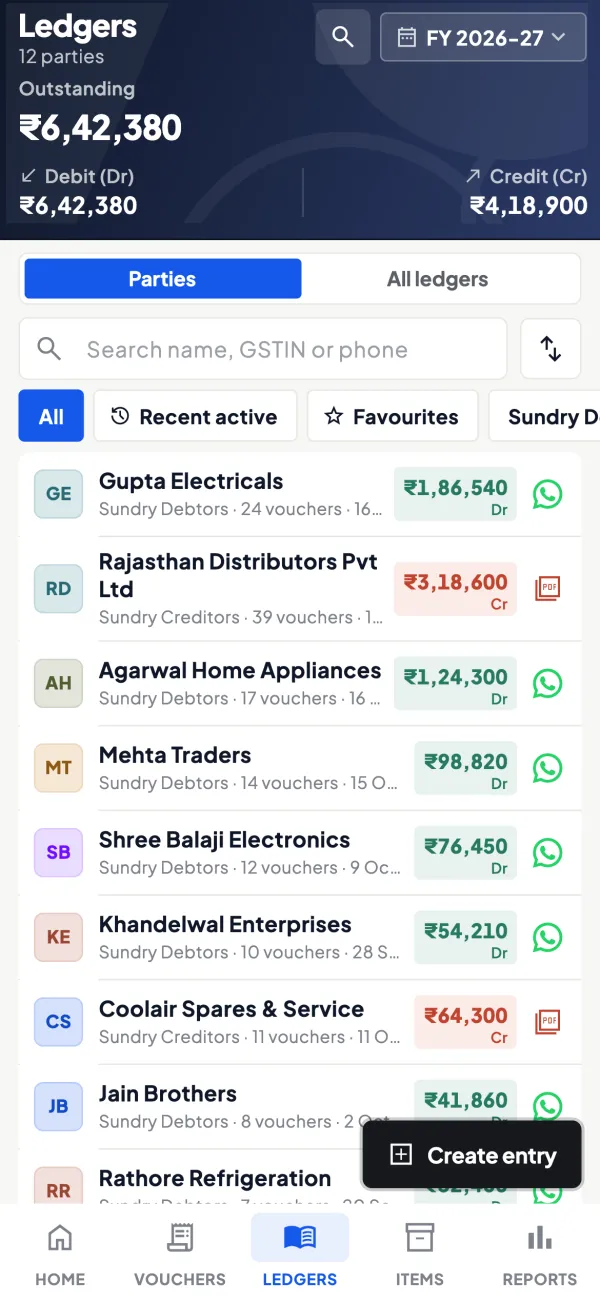
Questions people ask
Why does Tally show difference in opening balances?
Does a tallied trial balance mean my books are correct?
How often should I look at the trial balance?
Why does closing stock not appear in my trial balance?
Which balances are normally debits?
What does a customer with a credit balance mean?
Is the trial balance the same as the balance sheet?
Can a trial balance be prepared for a date mid-month?
This page is general information for Indian businesses, not tax, legal or financial advice. Rules and rates change — check the official portals or your CA before acting.