GST GST valuation
GST on cash discounts given after the sale
A cash discount for early payment is usually given after the invoice. You can reduce GST on it only if the discount was agreed before the sale and you issue a GST credit note that the buyer accounts for; otherwise give it through a financial credit note and leave the GST unchanged.
- Distributors and wholesalers
- Manufacturers with dealer terms
- Accountants posting credit notes
- Businesses selling on credit
- FMCG and pharma stockists

On this page 12
Why cash discounts are tricky
A trade discount is known when you bill, so it goes on the invoice. A cash discount depends on when the buyer pays, which you do not know when you bill. By the time the buyer pays early, the invoice has been issued and reported in GSTR-1, and the buyer has claimed ITC on the full tax.
Section 15(3)(b) of the CGST Act lets a post-sale discount reduce the taxable value only where it was established by an agreement made at or before the time of supply, is linked to the relevant invoices, and the related ITC is reversed by the buyer, with the discount passed through a credit note. The broader picture on schemes is in GST on discounts and schemes.
Two ways to give it
| GST credit note | Financial credit note | |
|---|---|---|
| Pre-condition | Discount terms agreed before or at the sale (e.g. printed payment terms) | None |
| Your output GST | Reduced | Unchanged |
| Buyer's ITC | Must be reduced to match | Unchanged |
| Reported in GSTR-1 | Yes, as a credit note | No |
| Time limit | Yes (see below) | No GST time limit |
| Best for | Large, regular discounts to registered dealers | Small or ad hoc discounts; unregistered buyers |
Worked example
Invoice: goods ₹1,00,000 + 18% GST ₹18,000 = ₹1,18,000. Payment terms printed on the invoice and in the dealer agreement: '2% cash discount on taxable value if paid within 7 days'. The dealer pays on day 5.
Option A, GST credit note. Discount ₹2,000 on taxable value, GST on it ₹360. Credit note total ₹2,360. Dealer pays ₹1,15,640. Your output tax falls by ₹360; the dealer's ITC falls by ₹360.
Option B, financial credit note. You allow ₹2,360 (or ₹2,000, as agreed) as a discount in the books only, without GST. Your output tax stays ₹18,000; the dealer keeps ₹18,000 ITC. Same cash outcome for both if you allow ₹2,360, but tax stays higher on both sides, which nets off.
When the buyer is a registered dealer who can claim full ITC, Option B is often simpler and loses nobody money. When the buyer is unregistered, Option A only works if the discount was agreed upfront, which is rare for retail.
Time limit for GST credit notes
A GST credit note for a supply must be declared in a return no later than 30 November following the end of the financial year of the supply, or the date of filing the annual return, whichever is earlier. A cash discount on a February invoice given in May is fine; one given in December of the next year is too late for a GST credit note and must go through a financial credit note. See credit notes and debit notes in GST.
Entries in the books
| Option | Debit | Credit |
|---|---|---|
| A: GST credit note | Discount allowed ₹2,000; Output CGST ₹180; Output SGST ₹180 | Dealer ₹2,360 |
| B: Financial credit note | Discount allowed ₹2,360 | Dealer ₹2,360 |
Option A is a credit note voucher with GST; option B is a journal or a credit note marked as not relevant for GST. Do not post option B through a GST credit note voucher by habit; it will reduce your output tax by mistake.
The buyer's side
If you choose option A, tell the buyer. Their GSTR-2B will show the credit note, and they must reduce their ITC. Many disputes come from buyers who claimed full credit and then see a credit note months later. A line on your statement of account, such as 'CN 45 dated 12 June, GST ₹360, ITC to be reversed', avoids that. This is general information, not tax advice.
Common mistakes
- Reducing GST on a cash discount that was never mentioned before the sale.
- Giving the discount on the tax-inclusive total and then also reducing GST, which double-counts.
- Issuing one lump credit note for a quarter without linking it to invoices.
- Missing the 30 November cut-off.
Recording it with Tally and Cashflow OS
Both kinds of entry are made in TallyPrime. With writing back switched on, an accountant can post a credit note or a journal from Cashflow OS on the phone or web, against the dealer's bill; Tally validates it. The party ledger then shows the discount, and the statement shared on WhatsApp makes it visible to the dealer. GST credit notes appear in the GSTR-1 view for the period.
Avoid these
Common mistakes
- MistakeCutting GST on a discount never agreed before the saleDo this instead
Use a financial credit note without GST unless the payment terms were in the agreement or printed on the invoice.
- MistakeDiscount on the tax-inclusive total plus a GST cutDo this instead
Decide whether the discount is on taxable value or invoice total, and reduce GST only on the taxable part.
- MistakeOne lump credit note for the quarter, no invoice linkDo this instead
Link each GST credit note to the invoices it relates to, as the law requires.
- MistakePosting a financial discount through a GST credit noteDo this instead
Use a journal, or a credit note marked not relevant for GST, so output tax is not reduced by mistake.
Keep handy
Checklist
GST on cash discounts given after the sale — 7 checks. Tick them as you go.
In Cashflow OS
How Cashflow OS helps
Cashflow OS puts your TallyPrime books on every phone in the team. Where it fits this topic:
Post the credit note from the phone
With writing back switched on, an accountant can create a credit note or journal in Cashflow OS against the dealer's bill; Tally validates it before saving.
See Create Tally vouchers from your phone
Show the discount on the statement
The party ledger reflects the credit note from Tally, and the statement can be shared on WhatsApp as a PDF so the dealer sees it.
See Party ledger statements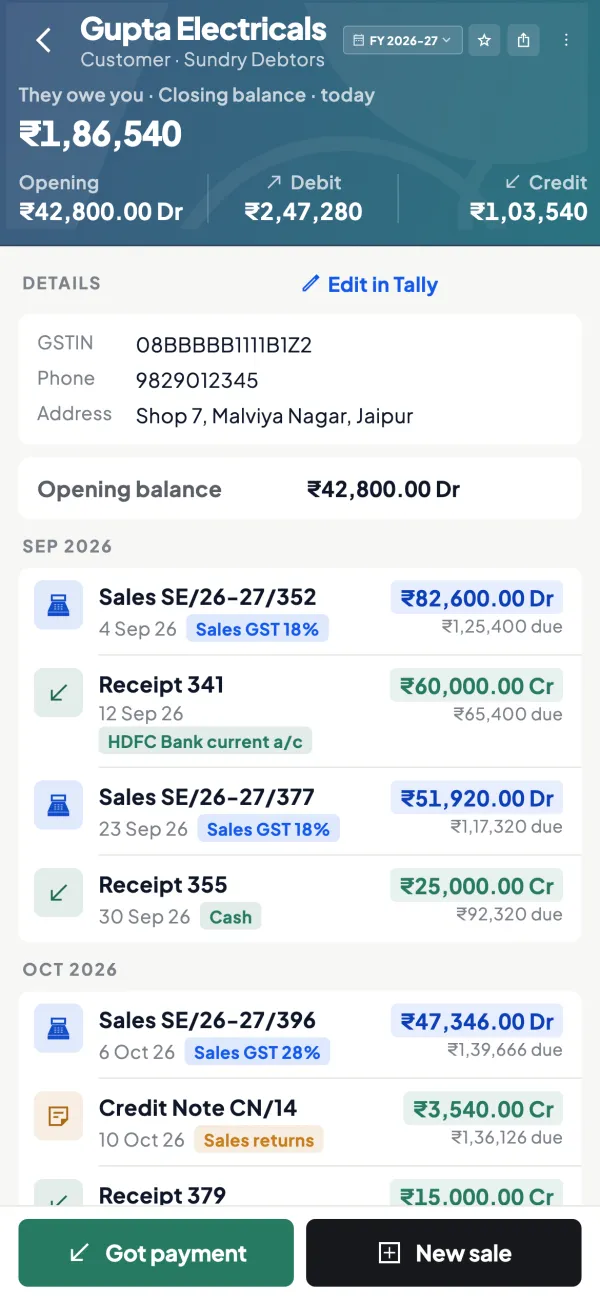
Questions people ask
Can I reduce GST for a cash discount given after the invoice?
What is a financial credit note?
Is a cash discount on retail sales to unregistered buyers adjustable in GST?
Is cash discount calculated on taxable value or invoice total?
Does the buyer have to reverse ITC on a GST credit note?
What is the deadline for a GST credit note?
Which option is simpler for a registered dealer?
Is a financial credit note recorded in Tally?
This page is general information for Indian businesses, not tax, legal or financial advice. Rules and rates change — check the official portals or your CA before acting.