Invoices & documents Payments
Invoice payment terms
Payment terms tell the buyer when and how to pay, and what happens if they are late. Clear terms on every invoice, with a due date written as a date, are the cheapest collection tool a business has.
- Distributors and wholesalers
- Manufacturers selling on credit
- Micro and small enterprises
- Service businesses
- Accountants handling collections
On this page 12
Common terms and what they mean
| Term | Meaning | Typical use |
|---|---|---|
| Advance / 100% advance | Pay before dispatch | New parties, custom orders |
| Against delivery | Pay when goods arrive | Local deliveries, cash-and-carry |
| Due on receipt | Pay as soon as the invoice is received | Services, small orders |
| Net 15 / Net 30 / Net 45 | Pay within 15, 30 or 45 days of invoice date | Regular dealers |
| 2/10 net 30 | 2% off if paid in 10 days, otherwise full in 30 | Pushing early payment |
| PDC with order | Post-dated cheque given at order | Some distributor trades |
| Part advance | e.g. 30% advance, 70% before dispatch | Projects, large orders |
Ready-to-use wording
- Payment due on or before 14-12-2025 (30 days from invoice date).
- Please pay by bank transfer or UPI to the account shown and share the UTR on WhatsApp.
- Interest at 18% per annum will be charged on amounts outstanding beyond the due date.
- Cheques are subject to realisation. Bounced cheque charges will be debited to your account.
- Payments will be adjusted against the oldest outstanding invoices first unless you specify otherwise.
- Any discrepancy in this invoice must be reported within 7 days of receipt.
The 18% figure is an example; pick a rate you can justify and have agreed in writing with regular buyers. Writing the due date as a date stops the endless did-you-mean-30-days-from-delivery debate.
If you are a micro or small enterprise
The MSMED Act protects micro and small suppliers registered under Udyam. In short:
- The agreed credit period cannot exceed 45 days from the day the buyer accepts the goods or services.
- Where there is no written agreement, payment is due within 15 days.
- Late payment attracts compound interest with monthly rests at three times the bank rate notified by RBI.
- Buyers who pay micro and small suppliers late can also lose the income-tax deduction for that expense until they pay.
So print your Udyam registration number on every invoice and keep terms within 45 days. Details in the MSME 45-day payment rule. This is general information, not tax or legal advice.
The 180-day GST link
Under GST, a buyer who does not pay the supplier the value plus tax within 180 days of the invoice date has to reverse the input tax credit taken, and can reclaim it after paying. Mentioning this politely helps with slow payers: Kindly note that input tax credit on this invoice is linked to payment within 180 days. Read ITC reversal and the 180-day rule.
Is an early payment discount worth it?
Take 2/10 net 30 on an invoice of ₹1,00,000. The buyer pays ₹98,000 on day 10 instead of ₹1,00,000 on day 30.
| Item | Value |
|---|---|
| Discount given | ₹2,000 |
| Days money comes early | 20 |
| Cost of the discount, annualised | About 37% a year (2/98 × 365/20) |
That is expensive money. A cash discount makes sense only if your alternative is worse, such as a buyer who otherwise pays in 90 days, or if you need cash urgently and cannot borrow cheaper. Also note that a discount given after the invoice, not shown on it, has its own GST treatment; see GST on cash discounts after sale.
Matching terms to the party
- New party: advance or against delivery for the first few orders.
- Regular, prompt payer: Net 30 with a credit limit.
- Regular, slow payer: shorten terms, hold dispatch above limit, or ask for part advance.
- Large institutional buyer: accept their terms only after pricing in the wait.
Review terms party by party every quarter using an ageing report.
Making terms stick
- Agree terms in writing when opening the account, not after the first late payment.
- Print them on quotations, orders and invoices so they are never a surprise.
- Send a friendly reminder three days before the due date, not after.
- Stop dispatch to parties over the agreed limit, politely and consistently.
- Send a ledger statement every month so disputes surface early.
Doing this with Tally and Cashflow OS
Cashflow OS shows bill-wise outstanding and ageing from your Tally data on the phone, so you can see which invoices are past due before a salesperson visits. Documents such as quotations and proformas carry your terms, bank and UPI details, and party statements go out on WhatsApp in a tap. See outstanding receivables.
Avoid these
Common mistakes
- MistakeWriting 'Net 30' with no start dateDo this instead
Print the actual due date, and say whether the period runs from the invoice date or the delivery date.
- MistakeAgreeing terms only after the first late paymentDo this instead
Put terms in writing when opening the account, and print them on quotations, orders and invoices.
- MistakeOffering a cash discount without working out its costDo this instead
Annualise it first. A 2% discount for paying 20 days early costs far more than most bank borrowing.
- MistakeDispatching to parties over their limitDo this instead
Hold dispatch politely and consistently above the agreed limit, or ask for part advance.
Keep handy
Checklist
Invoice payment terms — 7 checks. Tick them as you go.
In Cashflow OS
How Cashflow OS helps
Cashflow OS puts your TallyPrime books on every phone in the team. Where it fits this topic:
See past-due bills before the visit
Bill-wise outstanding and ageing from your Tally data show which invoices are overdue, on the phone, before a salesperson walks in.
See Outstanding receivables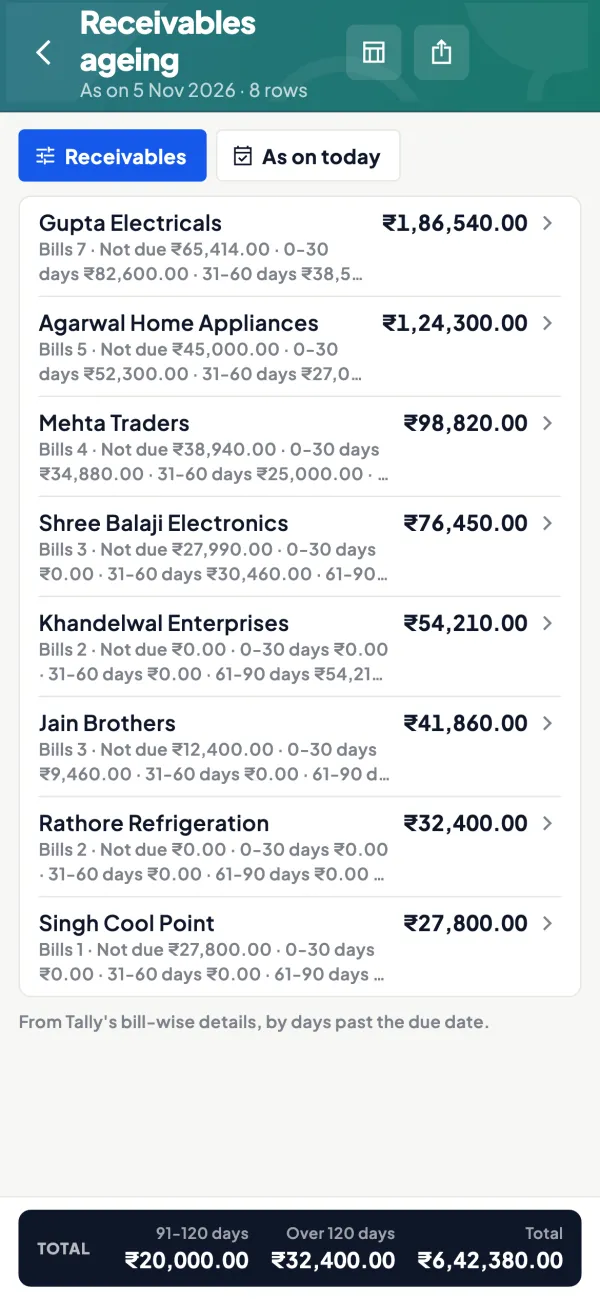
Statements and reminders on WhatsApp
Send party statements and payment reminders on WhatsApp, and let salespeople record what they collect with the collections module.
See Collections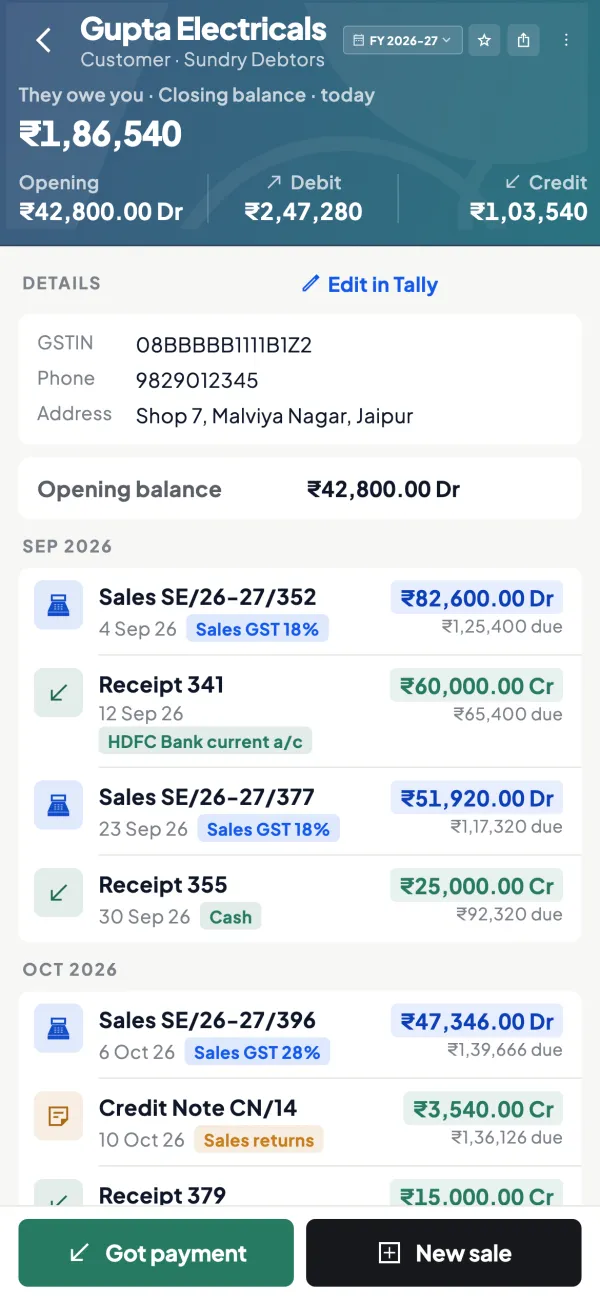
Questions people ask
Can I charge interest on late payment?
Should payment terms start from invoice date or delivery date?
What is the most common term in distribution?
What is the difference between payment terms and a credit limit?
Should I accept post-dated cheques?
Can I change payment terms for an existing customer?
Is payment against delivery risky?
Do long payment terms affect when I pay GST?
This page is general information for Indian businesses, not tax, legal or financial advice. Rules and rates change — check the official portals or your CA before acting.