
Invoices & documents Quotations
Estimate vs quotation
A quotation is a firm price for a defined job or set of goods, valid for a fixed period. An estimate is your best guess of the cost when the final figure depends on what you find while doing the work. Send the wrong one and you either lose money or lose trust.
- Contractors and electricians
- Repair and service businesses
- Fabricators and job shops
- Traders sending price offers
- Showrooms quoting projects

On this page 12
The difference in one table
| Point | Estimate | Quotation |
|---|---|---|
| Price | Approximate, may change | Fixed for the validity period |
| Best for | Repairs, projects, custom work | Goods from stock, standard services |
| Detail | Assumptions and ranges | Exact items, quantities, rates |
| Buyer's expectation | Final bill close to it | Final bill equal to it |
| Changes | Allowed, with notice | Only by agreement |
| GST status | Not a tax document | Not a tax document |
Neither creates a GST liability. The tax invoice follows the supply. This is general information, not tax advice.
When an estimate is the honest choice
- Repairs: you cannot know if the motor or only the capacitor is gone until you open it.
- Site work: electrical or plumbing jobs where wall conditions decide material.
- Custom manufacturing: fabrication where weight is known only after cutting.
- Commodity-linked items: copper wire or steel, where prices move daily.
In these cases a firm quote forces you either to pad the price heavily or to absorb losses. An estimate with clear assumptions is fairer to both sides.
An estimate is also useful when the customer is still deciding what they want. Sending a range early, such as ₹55,000 to ₹65,000 for a basic option and ₹80,000 to ₹90,000 with premium fittings, helps them set a budget before you spend time preparing a detailed, itemised quote that may be thrown away.
When a quotation is better
- Goods sold from stock at list prices.
- Standard services such as an AMC, a fixed installation or a fixed-scope design job.
- Tenders and institutional buyers, who need a firm price to compare and approve.
- Repeat orders where you know the cost precisely.
See quotation format and best practices for a full layout.
Worked example: wiring a shop
An electrical contractor in Nashik is asked to rewire a 600 sq ft shop.
As an estimate
| Line | Estimate |
|---|---|
| Wire, conduits, boxes (approx.) | ₹38,000 to ₹45,000 |
| Labour (fixed) | ₹18,000 |
| Total before GST | ₹56,000 to ₹63,000 |
Assumptions: existing conduits reusable on the rear wall; copper prices as on date; any wall breaking extra at actuals. Final bill within 10% of the upper figure, or we will ask before proceeding.
As a quotation
Fixed ₹62,000 plus GST, valid 15 days, covering the listed points. If the contractor discovers that the rear wall conduits are damaged, the extra is the contractor's loss unless the quote excluded it.
The estimate protects the contractor; the quote reassures the customer. Some businesses send both: a firm quote for the defined part and an estimate for the uncertain part.
Wording that prevents disputes
- This is an estimate based on the information available today. The final amount may vary.
- We will inform you and take your approval before exceeding the estimate by more than 10%.
- Material is billed at actual quantity used; labour as stated.
- GST extra at the applicable rate.
- Estimate valid for 7 days.
The 10% band is an example; choose what suits your trade, but always write a number.
Common mistakes
- Calling a firm quote an estimate to keep the option of raising the price later. Customers notice.
- Giving a single figure on an estimate with no range or assumptions.
- Not getting approval before going over the estimate.
- Leaving GST out of the figure without saying so.
- Not converting the approved estimate into the job record, so the final bill does not match.
Proforma, estimate, quotation: the order
A rough sequence for many businesses: an estimate to start the conversation, a quotation once scope is fixed, a proforma invoice to collect an advance, then the tax invoice at supply. For repair work, the estimate usually sits on the job card and leads straight to the service invoice; see job card and service invoice.
Doing this with Tally and Cashflow OS
Cashflow OS has quotations built from your Tally items, with your logo, letterhead and signature, shared as a PDF on WhatsApp or email and convertible into a sales order or a Tally sales invoice. For repair work, the service jobs module lets you add items and service charges as the job progresses and then invoice it when closed.
Avoid these
Common mistakes
- MistakeCalling a firm quote an estimate to raise it laterDo this instead
Be honest about which one you are sending; customers notice when an 'estimate' was really a padded quote.
- MistakeA single figure on an estimate with no rangeDo this instead
Give a range and list the assumptions behind it, such as material prices on date or reusable fittings.
- MistakeGoing over the estimate without askingDo this instead
Write a tolerance on the estimate and take the customer's approval before exceeding it.
- MistakeLeaving GST out without saying soDo this instead
Show GST, or write clearly that GST is extra at the applicable rate.
Keep handy
Checklist
Estimate vs quotation — 7 checks. Tick them as you go.
In Cashflow OS
How Cashflow OS helps
Cashflow OS puts your TallyPrime books on every phone in the team. Where it fits this topic:
Quotations from your Tally items
Quotations are built from your Tally items with your logo, letterhead and signature, shared as PDF on WhatsApp or email, and can be converted into a sales order or a Tally sales invoice.
See Quotations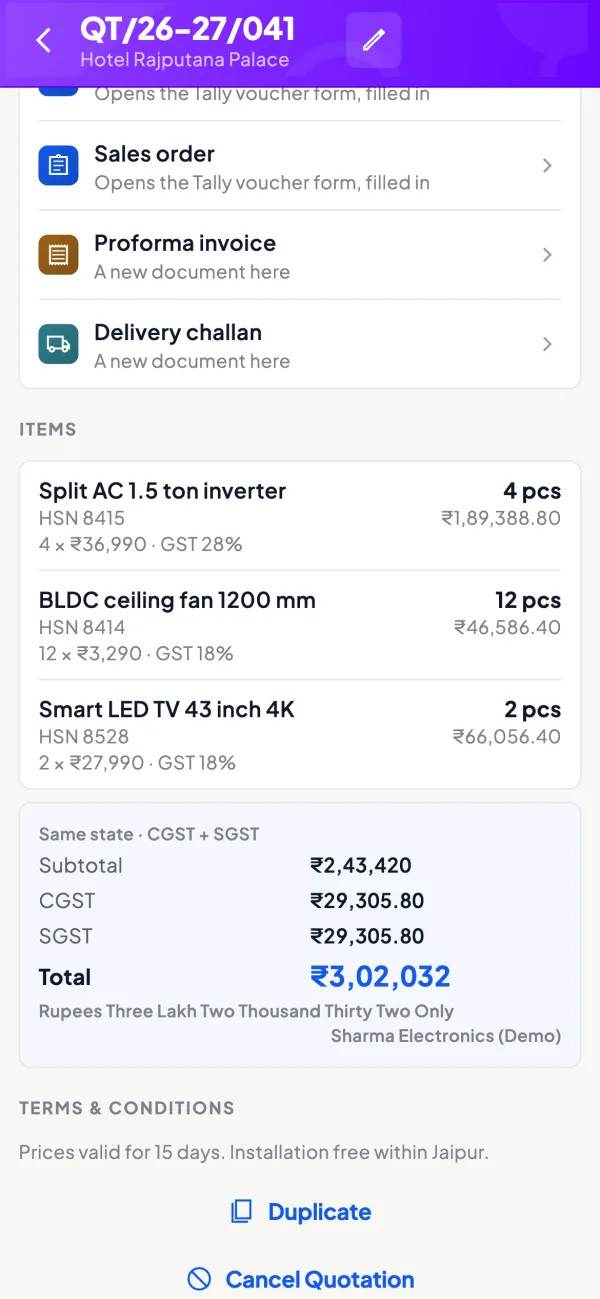
Repair jobs that grow as you work
For repair work, the service jobs module lets you add items and service charges as the job progresses and invoice it when closed.
See Service jobs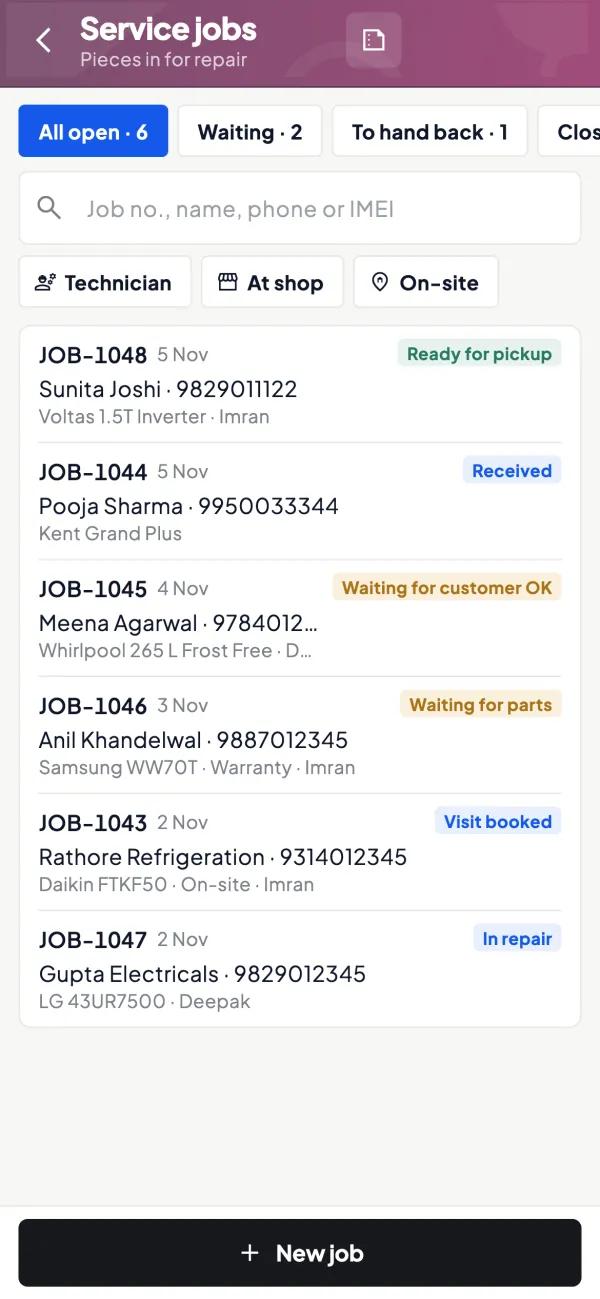
Questions people ask
Is an estimate legally binding?
Can I convert an estimate into a quotation?
Should an estimate include GST?
How long should an estimate be valid?
Can I send both an estimate and a quotation for one job?
Is a quotation a tax invoice?
Should a quotation have its own number?
What if material prices rise during a quote's validity?
This page is general information for Indian businesses, not tax, legal or financial advice. Rules and rates change — check the official portals or your CA before acting.