Invoices & documents Quotations
How to convert a quotation into an invoice
Converting a quotation means carrying the agreed items, rates and terms into a sales order or tax invoice, then adding what only the invoice can have: a GST serial number, the actual quantity supplied and the date of supply.
- Distributors and wholesalers
- Hardware and building material suppliers
- Sales teams sending quotes
- Billing staff
- B2B manufacturers

On this page 12
The usual path: quote, order, invoice
- Quotation sent and accepted by the buyer, ideally with a purchase order quoting your quote number.
- Sales order booked, so stock is reserved and the team knows what is pending.
- Delivery of all or part of the order, with a delivery note or challan where needed.
- Tax invoice for what was actually supplied.
- Receipt of payment against the invoice.
Small shops often skip the sales order and invoice straight from the quote. That is fine when everything goes in one dispatch. When deliveries are split, the sales order is what stops you from billing the same item twice or forgetting the balance. See sales order vs purchase order.
What carries over and what changes
| Item | From the quote | On the invoice |
|---|---|---|
| Number | QT/25-26/118 | New GST series, e.g. INV/25-26/0560; quote number as reference |
| Date | Quote date | Date of supply |
| Items and rates | As agreed | Same, unless the buyer agreed to a change |
| Quantity | As quoted | Actually dispatched |
| GST | Estimated | Final, based on place of supply on the invoice date |
| Buyer details | Contact name | Legal name, GSTIN, billing and delivery address |
| Validity, options | Shown | Removed |
Worked example: a partial dispatch
A Ludhiana hardware supplier quoted 50 door locks at ₹1,200 and 200 hinges at ₹85 to a builder in Chandigarh. The builder accepted, but only 30 locks are in stock today.
| Line | Ordered | Invoiced today | Pending |
|---|---|---|---|
| Door lock ₹1,200 | 50 | 30 = ₹36,000 | 20 |
| Hinge ₹85 | 200 | 200 = ₹17,000 | 0 |
| Taxable value | ₹77,000 | ₹53,000 | ₹24,000 |
Chandigarh is a Union Territory, so this sale from Punjab is inter-state and carries IGST. At an illustrative 18%, today's invoice is ₹53,000 + ₹9,540 = ₹62,540. The sales order keeps the 20 locks open, and the next invoice picks them up. If prices rise before the second dispatch, the agreed quote rate still applies unless the buyer agrees otherwise.
This is general information, not tax advice.
Checks before you press save
- Buyer's legal name and GSTIN, not just the shop name used in the quote.
- Place of supply: if the delivery state differs from the quote, the tax type changes.
- Quote validity: an expired quote may need fresh confirmation of rates.
- Discounts agreed during negotiation are on the invoice before tax, not as a later credit note.
- Advance already received is adjusted against the invoice.
- Freight and packing lines match what the quote promised.
Why retyping is the real risk
Most errors in this process are copy errors: a rate typed as ₹1,020 instead of ₹1,200, a line missed, or the wrong party picked from a long list of similar names. Each one leads to a credit or debit note later, a disputed bill and delayed payment. Whatever tool you use, convert from the saved quote rather than retyping from a printout or a WhatsApp image. If you must retype, have a second person compare the totals.
Handling advances and changes mid-way
Two situations come up again and again. First, the buyer pays an advance on accepting the quote. Record it as a receipt against the party, then adjust it against the invoice when goods go out, so the ledger shows only the balance as outstanding. Second, the buyer changes the order after acceptance: adds items, cancels a line or asks for a different brand. Update the sales order, not the original quote, and keep the quote as the record of what was first offered. If the change affects price, send a short written confirmation, for example: Revised order for QT/118: 40 locks instead of 50, hinges unchanged, rates as quoted. Please confirm. That one line prevents most billing disputes.
Track the conversion rate
Once quotes and invoices are linked, you can see how many quotes became orders, how long it took and which salesperson converts best. A simple monthly view, such as 42 quotes, 19 converted, average 6 days, tells you whether to chase faster or price differently. Read measuring salesperson performance for ideas.
Doing this with Tally and Cashflow OS
In Cashflow OS a quotation can be converted into a sales order or a Tally sales invoice in a few taps. The entry goes to TallyPrime through the connector once write-back is switched on; GST is worked out from the item and the party's state, and Tally validates it. Orders from frontline staff can be set to need approval first. Sales orders posted to Tally are covered in sales orders to Tally.
Avoid these
Common mistakes
- MistakeUsing the quotation number as the invoice numberDo this instead
Use the next number in your GST invoice series and print the quote number as a reference.
- MistakeRetyping the quote from a printout or WhatsApp imageDo this instead
Convert from the saved quote; if you must retype, have a second person compare totals.
- MistakeBilling the contact name instead of the legal nameDo this instead
Check the buyer's legal name, GSTIN and billing address before saving the invoice.
- MistakeGiving an agreed discount as a later credit noteDo this instead
Show negotiated discounts on the invoice before tax, so the tax is right from the start.
Keep handy
Checklist
How to convert a quotation into an invoice — 8 checks. Tick them as you go.
In Cashflow OS
How Cashflow OS helps
Cashflow OS puts your TallyPrime books on every phone in the team. Where it fits this topic:
Quotation to invoice in a few taps
Convert a Cashflow OS quotation into a sales order or a Tally sales invoice; GST is worked out from the item and the party's state, and Tally validates it.
See Quotations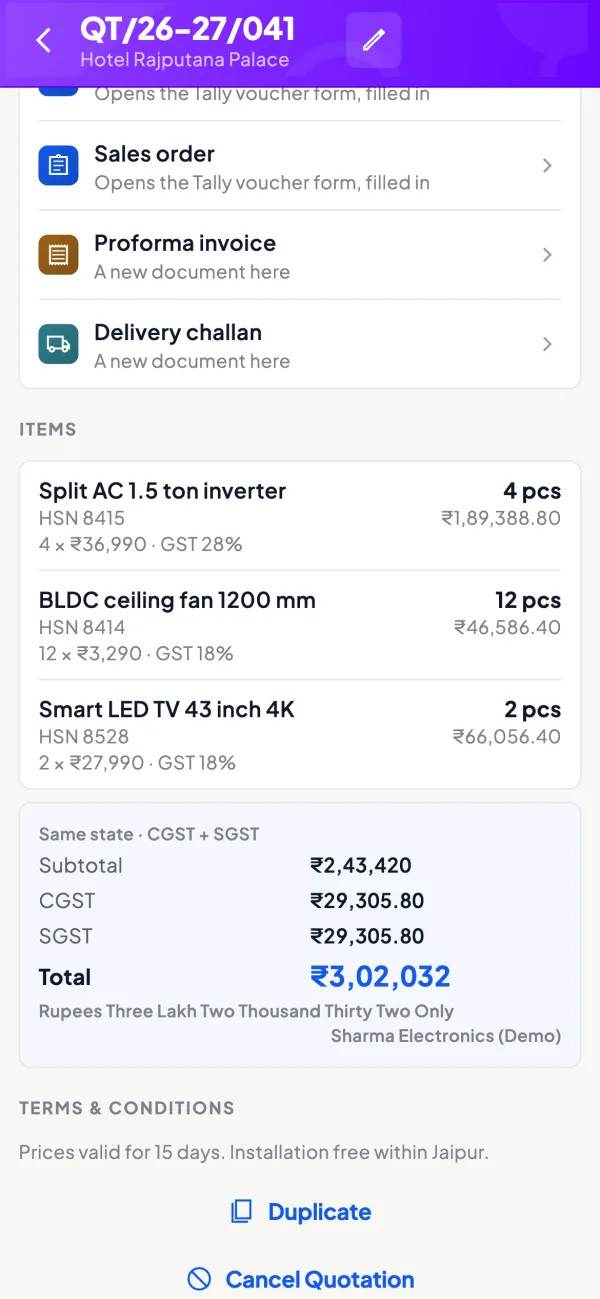
Sales orders into Tally
Sales orders go into TallyPrime through the connector once write-back is on, and frontline orders can be set to need approval first.
See Sales orders to Tally
Questions people ask
Can I use the quotation number as the invoice number?
What if the buyer wants a different price at billing?
Do I need a sales order for every quotation?
Should GST on the invoice match the quote?
How long is a quotation valid?
How do I bill a partial dispatch?
Where does an advance go when the invoice is made?
What if the buyer changes the order after accepting the quote?
This page is general information for Indian businesses, not tax, legal or financial advice. Rules and rates change — check the official portals or your CA before acting.