Invoices & documents Purchase orders
Purchase order format
A purchase order is your written instruction to a supplier: what to send, how much, at what rate, by when and on what terms. It is not a GST document, but it is the reference you check every supplier bill against.
- Traders and distributors
- Purchase managers
- Manufacturers buying materials
- Accountants booking bills
- Business owners controlling spend

On this page 12
Why bother with a PO
Many small businesses order on a phone call or a WhatsApp voice note. That works until the supplier bills a different rate, sends 120 pieces instead of 100, or a salesman swears he ordered the blue variant. A purchase order fixes the agreement in one document that both sides can point to.
It also controls spending inside your business. When only the owner or a purchase manager can issue POs, nobody else commits the company's money, and the accountant can refuse to book a bill that has no PO behind it.
Fields to include
| Field | Example |
|---|---|
| PO number and date | PO/25-26/0057, 03-11-2025 |
| Your name, address, GSTIN, delivery address | Agarwal Distributors, Kanpur, 09ABCDE1234F1Z1; deliver to godown, Fazalganj |
| Supplier name, address, GSTIN | Shakti Plastics, Delhi, 07PQRSX5678K1Z4 |
| Supplier's quotation reference | Their quote SP/Q/221 dated 30-10-2025 |
| Items, HSN, quantity, unit, rate | Plastic bucket 16 L, HSN 3924, 600 NOS, ₹118 |
| Discount and GST | 2% discount; IGST as applicable |
| Delivery date | On or before 15-11-2025 |
| Freight, packing, insurance | Freight paid by supplier up to our godown |
| Payment terms | 45 days from date of receipt of goods |
Sample totals
| Line | Amount |
|---|---|
| 600 buckets × ₹118 | ₹70,800 |
| Less 2% discount | ₹1,416 |
| Taxable value | ₹69,384 |
| IGST at 18% (illustrative) | ₹12,489 |
| PO value | ₹81,873 |
Delhi to Uttar Pradesh is inter-state, so the supplier's invoice will carry IGST. Your input tax credit depends on the supplier's tax invoice, not the PO, and on the other conditions in input tax credit conditions. Rates shown are only illustrations.
This is general information, not tax advice.
Terms worth printing on every PO
- Please quote our PO number on your invoice, challan and e-way bill.
- Goods not matching the specification or sample will be returned at your cost.
- Quantity received in excess of the PO will not be paid for unless agreed in writing.
- Rates are firm for this order and include packing.
- Your invoice must show our GSTIN correctly; an incorrect invoice will be returned for correction before payment.
- If you are registered under Udyam as a micro or small enterprise, please mention your Udyam number on the invoice.
The last line matters because payments to micro and small suppliers have a legal time limit; see the MSME 45-day payment rule.
Matching the PO, receipt and bill
Before the bill is booked or paid, compare three documents: the PO, what was actually received (your goods receipt note or the signed challan), and the supplier's invoice. This three-way match catches most purchase errors.
- Quantity billed is not more than quantity received.
- Rate billed equals the PO rate.
- GST type is correct for the supplier's state and yours.
- Freight is not billed if the PO said freight paid by supplier.
When something does not match, ask for a corrected invoice or a credit note before you pay, not after.
Amending or cancelling a PO
Plans change: a customer cancels, prices move or the supplier cannot deliver on time. Do not edit the original PO silently. Issue an amendment with the same number and a suffix, such as PO/25-26/0057-A1, listing only what changed: Qty of 16 L buckets reduced from 600 to 450; delivery date extended to 22-11-2025; all other terms unchanged. Send it the same way you sent the PO and ask for a reply confirming it.
To cancel, send a short written cancellation before dispatch and keep the supplier's acknowledgement. If goods have already left their godown, agree in writing who bears the freight both ways. These small records save long arguments when the ledger is reconciled at year end.
Good habits
- Use a separate PO series per financial year, such as PO/25-26/.
- Close or cancel old POs that will never be supplied, so pending orders stay honest.
- Review open POs weekly against expected stock.
- Share the PO as a PDF rather than a photo of a handwritten page.
Doing this with Tally and Cashflow OS
Cashflow OS includes purchase orders as a document, built from your Tally items and supplier ledgers, with your logo, letterhead and signature, shared as a PDF on WhatsApp or email. If you track pending orders in TallyPrime, a purchase order voucher can be created from the phone through the connector, and later a receipt note and purchase voucher as the goods and bill arrive.
Avoid these
Common mistakes
- MistakeOrdering only by phone call or voice noteDo this instead
Send a written PO as a PDF so both sides can point to the same quantity, rate and terms.
- MistakePaying bills without a three-way matchDo this instead
Compare the PO, what was received and the invoice for quantity, rate, GST type and freight before booking or paying.
- MistakeEditing a PO silently after sending itDo this instead
Issue an amendment with a suffix such as -A1 listing only what changed, and ask the supplier to confirm it.
- MistakeLeaving dead POs open for monthsDo this instead
Review open POs weekly and close or cancel those that will never be supplied, so pending orders stay honest.
Keep handy
Checklist
Purchase order format — 8 checks. Tick them as you go.
In Cashflow OS
How Cashflow OS helps
Cashflow OS puts your TallyPrime books on every phone in the team. Where it fits this topic:
Purchase orders as branded PDFs
Make purchase orders from your Tally items and supplier ledgers with your logo, letterhead and signature, and share them on WhatsApp or email.
See Purchase orders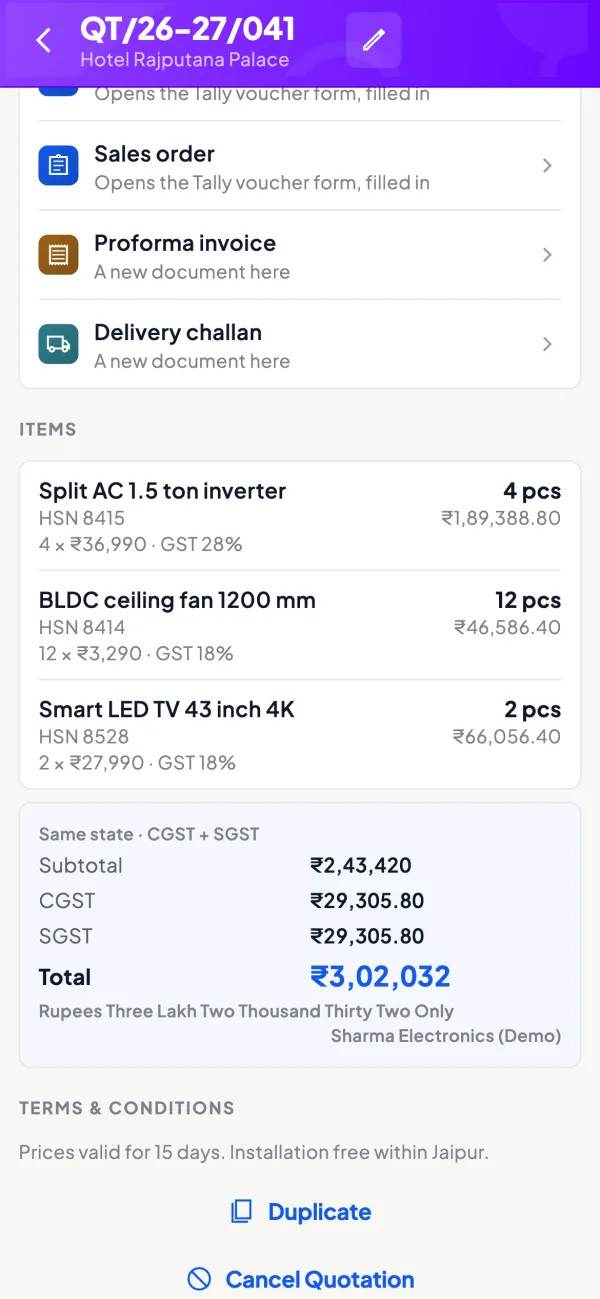
PO, receipt note and purchase in Tally
If you track pending orders in TallyPrime, create a purchase order voucher from the phone, then a receipt note and purchase voucher as goods and the bill arrive.
See Create Tally vouchers from your phone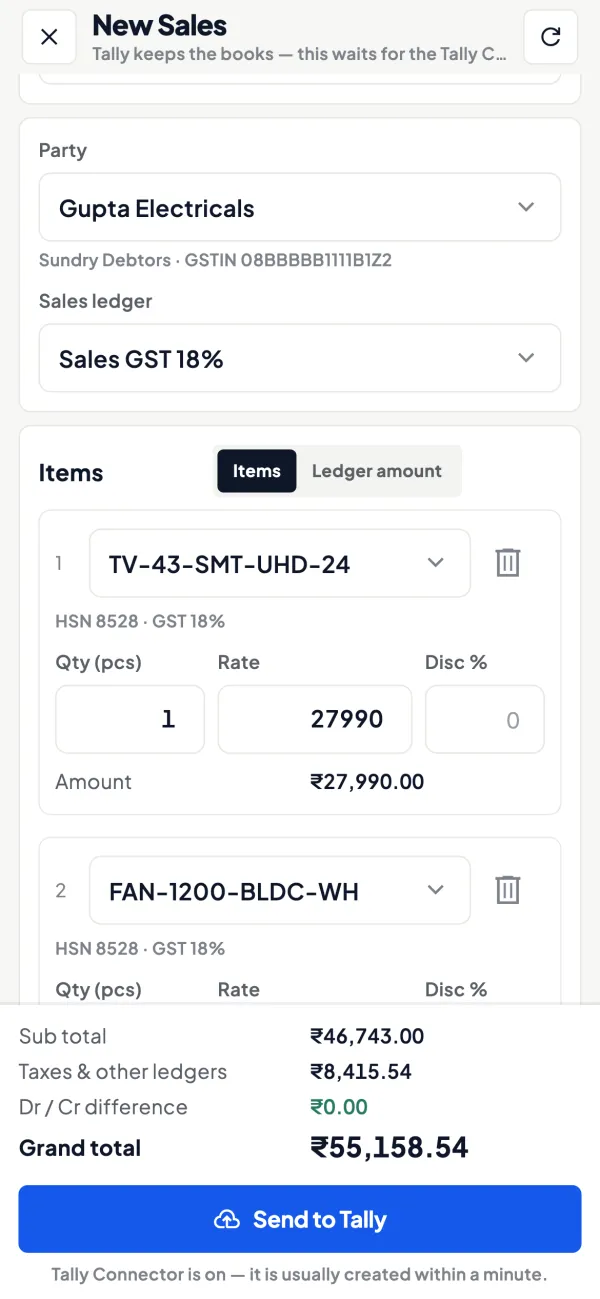
Questions people ask
Is a purchase order mandatory under GST?
Is a PO legally binding?
Should GST be shown on a PO?
Can one PO be supplied in parts?
What is a three-way match?
How do I cancel a PO already sent?
Why ask suppliers for their Udyam number?
Should the PO show payment terms?
This page is general information for Indian businesses, not tax, legal or financial advice. Rules and rates change — check the official portals or your CA before acting.