GST GST online selling
GST for e-commerce sellers
Selling through a marketplace adds three things to normal GST work: the operator collects TCS from your payouts, every sale needs the right place of supply, and your GSTR-1 must match what the operator reports.
- Marketplace sellers
- Online brands and D2C sellers
- Small intra-state online sellers
- Accountants for e-commerce
- Traders starting online sales

On this page 12
Do you need GST registration?
Section 24 of the CGST Act requires persons supplying through an e-commerce operator that collects TCS to register regardless of turnover. Over time this has been relaxed:
- Service providers selling through operators, with turnover below the threshold, are exempt from compulsory registration.
- Small sellers of goods can, subject to conditions (such as selling only within their own state and having a PAN), supply through operators without registering, below the threshold.
- Composition taxpayers can supply goods through operators within their state.
The exact conditions are set by notification and have changed several times; check the current position on cbic-gst.gov.in before you list. Thresholds are covered in GST registration threshold.
TCS on your payouts
The operator collects TCS under Section 52 on the net value of taxable supplies made through it (sales less returns), at a notified rate, and reports it in GSTR-8. You accept the entries on the portal and the amount reaches your electronic cash ledger. The mechanics are in TDS and TCS under GST.
Example. In a month, sales through a marketplace are ₹5,00,000 and returns ₹40,000, both excluding GST. Net value ₹4,60,000. At a TCS rate of 0.5% (confirm the current rate), TCS is ₹2,300. Your settlement shows ₹2,300 less, and ₹2,300 reaches your cash ledger once accepted.
Place of supply on online orders
For goods, the place of supply is where delivery ends, which is the customer's address. An order from a buyer in another state is an inter-state sale with IGST, even though you never met the buyer. Your invoice must carry the buyer's state. See place of supply for goods.
What goes into your returns
| Item | Where |
|---|---|
| B2C sales through operators | GSTR-1, B2C tables by state and rate, plus the table for supplies made through e-commerce operators (with the operator's GSTIN) |
| Inter-state B2C invoices above the B2C large limit | GSTR-1, B2C large table, invoice-wise |
| Customer returns | Credit notes in GSTR-1 |
| Commission and fees charged by the operator | Purchase; ITC through GSTR-2B |
| TCS credit | Accepted on the portal; flows to cash ledger |
The operator's GSTR-8 shows your supplies through it. Large gaps between that figure and your GSTR-1 are visible to the department.
Monthly reconciliation routine
- Download the operator's sales, returns and settlement reports for the month.
- Match order-wise sales to your sales register, and returns to credit notes.
- Check the TCS amount on the settlement against the TCS shown on the portal.
- Book commission, shipping fees and penalties as purchases with their GST.
- Match the commission invoices with GSTR-2B before claiming ITC.
- Clear the operator's party ledger to the actual payouts received.
Services where the operator pays the tax
For some services, such as passenger transport, accommodation and restaurant services supplied through operators, Section 9(5) makes the operator liable to pay the GST instead of the supplier. If you supply such services, do not charge GST yourself on those orders, and keep them out of your taxable sales in returns. This is general information, not tax advice.
Common mistakes
- Reporting marketplace sales net of commission. Your sale is the full price the customer paid; commission is a separate purchase.
- Charging CGST + SGST on every order because you are in one state, even when the customer is elsewhere.
- Ignoring returns that arrive in the next month, so GSTR-1 shows higher sales than the operator's net figure.
- Never accepting TCS entries, so the credit sits unused while you pay full GST in cash.
- Listing on a marketplace before checking whether registration is needed for your type of supply.
Keeping your Tally side clean
Record marketplace sales in TallyPrime with each operator as a party, so the operator's ledger shows sales, commissions, TCS and payouts together. Cashflow OS syncs that ledger to your phone, its GSTR-1 view prepared from your Tally data shows the month's B2C totals by state and rate, and reports export to Excel for matching against settlement files.
Avoid these
Common mistakes
- MistakeReporting marketplace sales net of commissionDo this instead
Report the full price the customer paid as your sale; book commission as a purchase with GST.
- MistakeCGST and SGST on every orderDo this instead
For goods, place of supply is the delivery address; orders to other states are inter-state sales with IGST.
- MistakeNever accepting TCS entries on the portalDo this instead
Accept them each month so the TCS reaches your electronic cash ledger and can be used.
- MistakeIgnoring returns that come next monthDo this instead
Issue credit notes for returns and reconcile with the operator's net figure each month.
Keep handy
Checklist
GST for e-commerce sellers — 8 checks. Tick them as you go.
In Cashflow OS
How Cashflow OS helps
Cashflow OS puts your TallyPrime books on every phone in the team. Where it fits this topic:
Operator ledger on the phone
With each operator as a party in TallyPrime, Cashflow OS syncs that ledger so sales, commissions, TCS and payouts can be seen together.
See Party ledger statements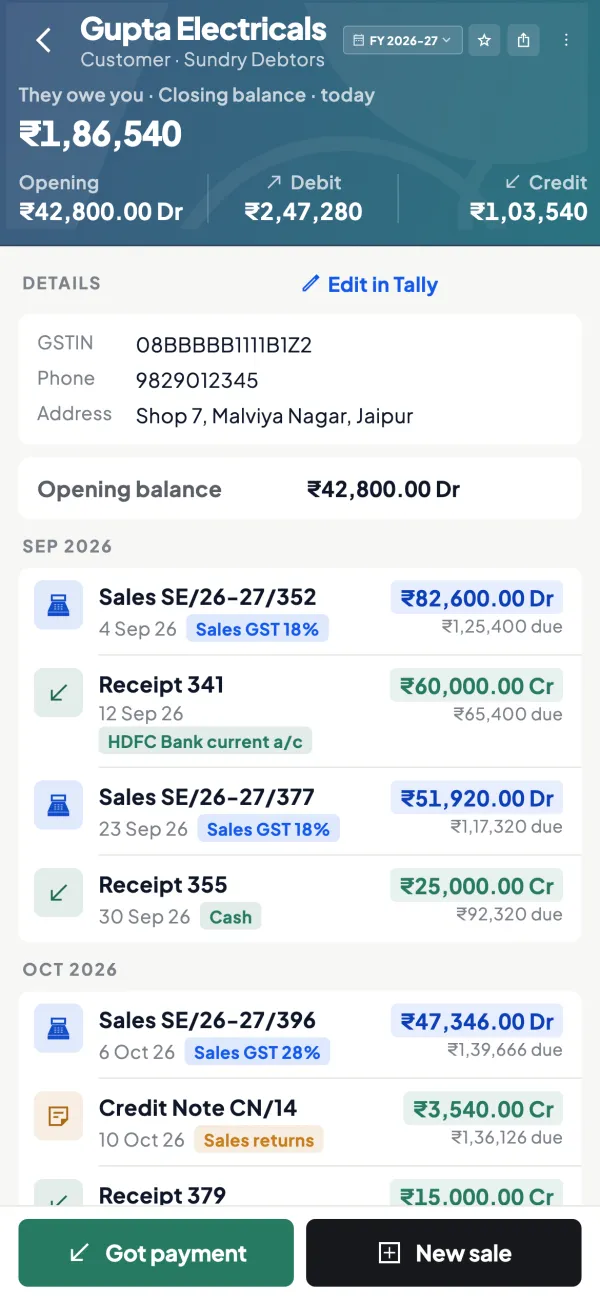
B2C totals by state and rate
The GSTR-1 view prepared from Tally shows the month's B2C totals by state and rate, and reports export to Excel for matching against settlement files.
See GST reports from your Tally data
Questions people ask
Is GST registration compulsory to sell on a marketplace?
What is TCS for e-commerce sellers?
Can I claim ITC on marketplace commission?
Who pays GST on online restaurant orders?
Is TCS a cost to the seller?
What is the place of supply for an online order?
Do I issue a credit note for every return?
Does the operator's GSTR-8 affect me?
This page is general information for Indian businesses, not tax, legal or financial advice. Rules and rates change — check the official portals or your CA before acting.