AI cash flow forecasting: useful estimate, not a promise
An AI cash flow forecast projects your bank balance over the coming weeks from past collections, payments and known dues; it is a helpful early warning when the inputs are clean, and misleading when they are not.
- Distributors and wholesalers
- Owners managing tight cash
- Accountants and finance staff
- Businesses with seasonal stock buying
- Manufacturers on supplier credit

On this page 12
What a cash flow forecast is
A cash flow forecast answers one question: will there be enough money in the bank on each future date to pay what is due? It starts from today's cash and bank balance, adds expected receipts and subtracts expected payments, week by week. It is different from a profit forecast. A business can expect a good profit for the quarter and still run short of cash in week six because a large supplier payment falls before a large customer pays. See cash vs profit.
What AI adds to a spreadsheet forecast
A traditional forecast is built by hand: list receivables with due dates, list payables, add salaries, rent, GST and loan instalments. AI tools add three things:
- Realistic collection dates. Instead of assuming each customer pays on the due date, the tool uses each customer's past behaviour. A dealer who usually pays 22 days late is expected 22 days late.
- Recurring patterns. Salaries in the first week, GST around the 20th, rent on the 5th, seasonal purchase spikes before festivals.
- Quick scenarios. “What if our top three customers pay 30 days later than usual?” answered in seconds.
None of this predicts a new customer, a lost order or a price change. It extends the past.
A worked 13-week example
A distributor starts with ₹6,00,000 in the bank. A simplified view of the first six weeks:
| Week | Expected receipts | Expected payments | Closing balance |
|---|---|---|---|
| 1 | ₹7,50,000 | ₹6,20,000 | ₹7,30,000 |
| 2 | ₹5,80,000 | ₹9,40,000 | ₹3,70,000 |
| 3 | ₹6,10,000 | ₹8,90,000 | ₹90,000 |
| 4 | ₹4,20,000 | ₹6,30,000 | (₹1,20,000) |
| 5 | ₹9,60,000 | ₹5,10,000 | ₹3,30,000 |
| 6 | ₹7,20,000 | ₹6,00,000 | ₹4,50,000 |
Week 4 shows a gap of ₹1,20,000. Seeing it three weeks ahead gives time to act: chase two large overdue dealers now, move a supplier payment by a week with their agreement, or arrange a short-term limit. Seen on the day, the same gap means a bounced cheque. The full forecast runs 13 weeks, a quarter, because beyond that the uncertainty is usually too high for a small business.
Inputs that make or break the forecast
- Bill-wise outstanding. If receipts are posted on account rather than against bills, the tool cannot learn who pays when.
- Supplier due dates. Credit days on supplier ledgers, or at least on large bills.
- Up-to-date entries. A forecast built on books that are two weeks behind is two weeks wrong.
- Known one-offs. Advance tax, a machine purchase, a loan repayment, a festive stock purchase. Add these by hand; no model can guess them.
- Bank balances that match the bank. Reconcile first.
How to read and use the forecast
- Look at the lowest point, not the end balance. The week with the least cash is the one to plan for.
- Compare last week's forecast with what happened. If receipts keep coming in 20% below forecast, adjust your assumptions.
- Keep a buffer. Plan so that the lowest week still has a cushion, such as two weeks of fixed costs.
- Do not treat it as a fact for lenders. If a bank asks for projections, have your CA prepare them with stated assumptions.
Prompts to try
- “Using each customer's average days to pay over the last six months, when do you expect the current outstanding to come in, week by week?”
- “Which week in the next eight has the lowest expected balance, and which payments fall in that week?”
- “If collections from our five largest customers slip by 15 days, what happens to the lowest balance?”
Ask the tool to list the assumptions behind each answer. If it cannot, treat the numbers with suspicion. For the wider practice, see cash flow management for MSMEs.
Where AI forecasts go wrong
- Projecting a good season into a slow one, or the reverse.
- Assuming a customer who has stopped buying will keep paying in the old pattern.
- Missing GST, TDS and advance tax dates that are not in the past data in the same form.
- Giving a single number with false precision, such as ₹4,37,215 for week 9. A range is more honest.
The fix for all of these is the same: a person reviews the forecast weekly, adds what they know about the coming weeks, and notes why the last forecast missed.
Forecasting from Tally with Cashflow OS
Cashflow OS includes a cashflow forecast report built from your synced Tally data, alongside bill-wise receivables and payables with ageing. Its AI assistant can answer questions about the same data, for example which receipts are expected next week or which supplier bills are due. Treat the forecast as an estimate based on your books and past patterns; add one-off items yourself.
Avoid these
Common mistakes
- MistakeLooking only at the closing balance at the endDo this instead
Find the week with the lowest expected balance and plan for that week, not the final figure.
- MistakeForecasting from books that are weeks behindDo this instead
Bring entries up to date and reconcile the bank before running the forecast; stale books give a stale forecast.
- MistakeExpecting the model to know about one-off paymentsDo this instead
Add advance tax, loan repayments, machine purchases and festive stock buying by hand.
- MistakeTrusting a single precise number for a far-off weekDo this instead
Read later weeks as a range, ask the tool to list its assumptions, and review the forecast every week.
Keep handy
Checklist
AI cash flow forecasting: useful estimate, not a promise — 8 checks. Tick them as you go.
In Cashflow OS
How Cashflow OS helps
Cashflow OS puts your TallyPrime books on every phone in the team. Where it fits this topic:
A cashflow forecast from your Tally data
A cashflow forecast report built from synced Tally data, next to bill-wise receivables and payables with ageing. Add one-off items yourself.
See Financial reports from Tally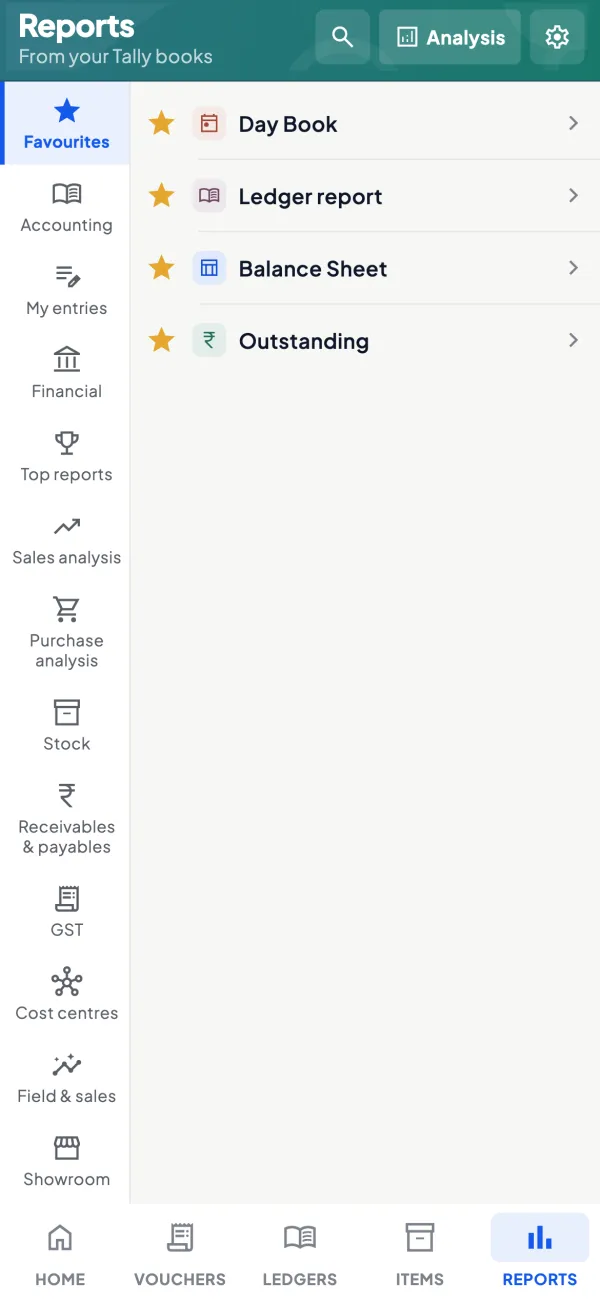
Ask what comes in and goes out next week
The AI assistant answers from the synced books, for example which receipts are expected next week or which supplier bills are due.
See AI assistant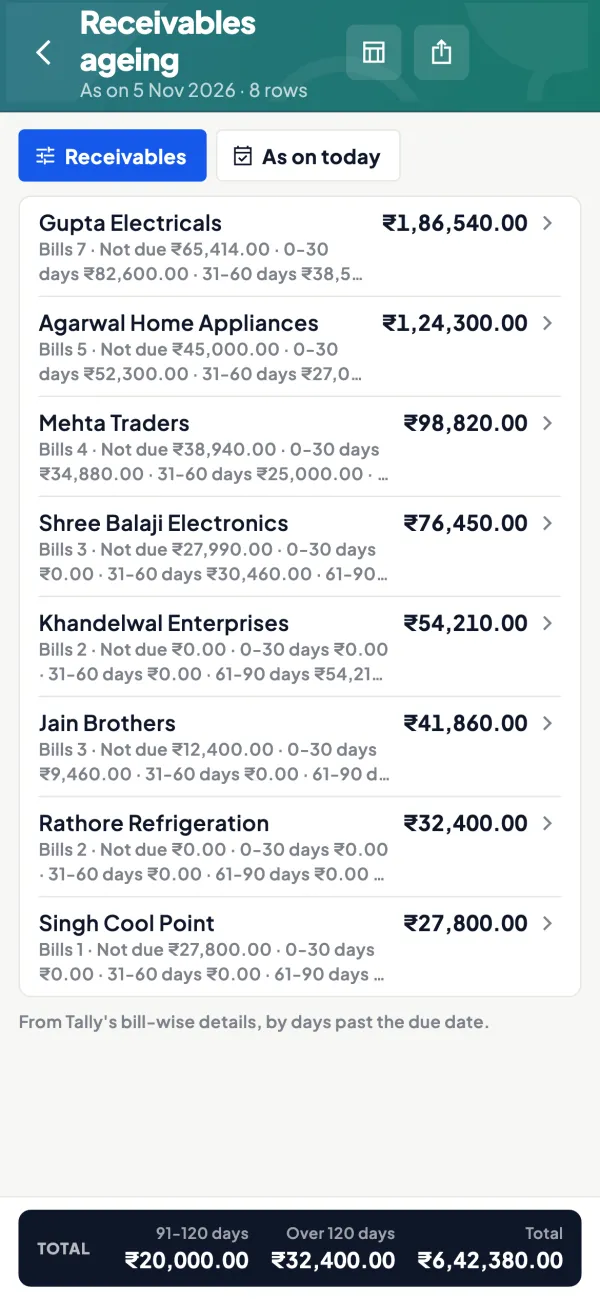
Questions people ask
How far ahead should a small business forecast cash?
Is an AI forecast more accurate than a spreadsheet?
What should I do when the forecast shows a shortfall?
What is the difference between a cash flow forecast and a profit forecast?
What inputs does an AI cash flow forecast need?
Can I show an AI forecast to my bank for a loan?
Why did my forecast miss so badly last month?
How much cash buffer should I keep?
This page is general information for Indian businesses, not tax, legal or financial advice. Rules and rates change — check the official portals or your CA before acting.